Home > Press > New advance could help soldiers, athletes, others rebound from traumatic brain injuries
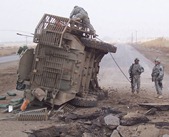 |
| Advance could help victims of traumatic brain injuries such as soldiers injured in explosions, as well as athletes and accident victims.
Credit: U.S. Army |
Abstract:
A potential new treatment for traumatic brain injury (TBI), which affects thousands of soldiers, auto accident victims, athletes and others each year, has shown promise in laboratory research, scientists are reporting. TBI can occur in individuals who experience a violent blow to the head that makes the brain collide with the inside of the skull, a gunshot injury or exposure to a nearby explosion. The report on TBI, which currently cannot be treated and may result in permanent brain damage or death, appears in the journal ACS Nano.
New advance could help soldiers, athletes, others rebound from traumatic brain injuries
Washington, DC | Posted on October 17th, 2012Thomas Kent, James Tour and colleagues explain that TBI disrupts the supply of oxygen-rich blood to the brain. With the brain so oxygen-needy — accounting for only 2 percent of a person's weight, but claiming 20 percent of the body's oxygen supply — even a mild injury, such as a concussion, can have serious consequences. Reduced blood flow and resuscitation result in a build-up of free-radicals, which can kill brain cells. Despite years of far-ranging efforts, no effective treatment has emerged for TBI. That's why the scientists tried a new approach, based on nanoparticles so small that 1000 would fit across the width of a human hair.
They describe development and successful laboratory tests of nanoparticles, called PEG-HCCs. In laboratory rats, the nanoparticles acted like antioxidants, rapidly restoring blood flow to the brain following resuscitation after TBI. "This finding is of major importance for improving patient health under clinically relevant conditions during resuscitative care, and it has direct implications for the current [TBI] war-fighter victims in the Afghanistan and Middle East theaters," they say.
The authors acknowledge funding from the Department of Defense, the National Science Foundation and the National Institutes of Health.
####
About American Chemical Society
The American Chemical Society is a nonprofit organization chartered by the U.S. Congress. With more than 164,000 members, ACS is the world's largest scientific society and a global leader in providing access to chemistry-related research through its multiple databases, peer-reviewed journals and scientific conferences. Its main offices are in Washington, D.C., and Columbus, Ohio.
To automatically receive news releases from the American Chemical Society, contact .
For more information, please click here
Contacts:
Michael Bernstein
202-872-6042
Thomas A. Kent, M.D.
Baylor College of Medicine
Michael E. DeBakey VA Medical Center
Houston, Texas 77030
or
James M. Tour, Ph.D.
Rice University
Houston, Texas 77005
Copyright © American Chemical Society
If you have a comment, please Contact us.Issuers of news releases, not 7th Wave, Inc. or Nanotechnology Now, are solely responsible for the accuracy of the content.
Bookmark:


| Related News Press |
News and information
 Simulating magnetization in a Heisenberg quantum spin chain April 5th, 2024
NRL charters Navy’s quantum inertial navigation path to reduce drift April 5th, 2024
Discovery points path to flash-like memory for storing qubits: Rice find could hasten development of nonvolatile quantum memory April 5th, 2024
Govt.-Legislation/Regulation/Funding/Policy
NRL charters Navy’s quantum inertial navigation path to reduce drift April 5th, 2024
Discovery points path to flash-like memory for storing qubits: Rice find could hasten development of nonvolatile quantum memory April 5th, 2024
Chemical reactions can scramble quantum information as well as black holes April 5th, 2024
Nanomedicine
New micromaterial releases nanoparticles that selectively destroy cancer cells April 5th, 2024
Good as gold - improving infectious disease testing with gold nanoparticles April 5th, 2024
Researchers develop artificial building blocks of life March 8th, 2024
Discoveries
Chemical reactions can scramble quantum information as well as black holes April 5th, 2024
New micromaterial releases nanoparticles that selectively destroy cancer cells April 5th, 2024
Utilizing palladium for addressing contact issues of buried oxide thin film transistors April 5th, 2024
Announcements
NRL charters Navy’s quantum inertial navigation path to reduce drift April 5th, 2024
Discovery points path to flash-like memory for storing qubits: Rice find could hasten development of nonvolatile quantum memory April 5th, 2024
Military
NRL charters Navy’s quantum inertial navigation path to reduce drift April 5th, 2024
What heat can tell us about battery chemistry: using the Peltier effect to study lithium-ion cells March 8th, 2024
New chip opens door to AI computing at light speed February 16th, 2024
Alliances/Trade associations/Partnerships/Distributorships
Chicago Quantum Exchange welcomes six new partners highlighting quantum technology solutions, from Chicago and beyond September 23rd, 2022
University of Illinois Chicago joins Brookhaven Lab's Quantum Center June 10th, 2022
 |
||
 |
||
| The latest news from around the world, FREE | ||
 |
||
|
|
||
| Premium Products | ||
 |
||
|
Only the news you want to read!
Learn More |
||
 |
||
|
Full-service, expert consulting
Learn More |
||
|
|
||