Home > Press > Electrochromic Bragg mirror
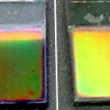 |
Abstract:
Researchers report the first example of an electrochromic Bragg mirror based on nanoporous multilayers of nickel oxide and tungsten trioxide nanoparticles.
Electrochromic Bragg mirror
Germany | Posted on September 13th, 2012Electrochromic materials change their color by electrically induced storage of ions and electrons in the material. This storage can be reversed by applying an opposing electrical bias.
Two prototypical electrochromic materials are tungsten trioxide, W(VI)O3, and nickel oxide, Ni(II)O.
Now, for the first time, both materials have been combined in a single photonic crystal architecture, where tungsten trioxide is the high refractive index component and nickel oxide the low refractive index component.
In contrast to electrochromic photonic crystals based on a single material, an applied potential does not lead to a strong spectral shift of the photonic stop band. Instead, the device behaves as an electrochromic Bragg mirror, where the reflectance can be modulated by the applied potential.
This reflectance modulation may be useful for tunable mirror devices and for grayscale control in reflective displays, such as ebooks.
The research was reported in Advanced Optical Materials, a new section in Advanced Materials dedicated to breakthrough discoveries and fundamental research in photonics, plasmonics, metamaterials, and more, covering all aspects of light-matter interactions.
####
For more information, please click here
Copyright © Wiley-VCH Materials Science Journals
If you have a comment, please Contact us.Issuers of news releases, not 7th Wave, Inc. or Nanotechnology Now, are solely responsible for the accuracy of the content.
Bookmark:


| Related Links |
 To get Advanced Optical Materials email alerts: click here:
The paper, “Electrochromic Bragg Mirror: ECBM”, is free to download for a limited time:
| Related News Press |
News and information
Simulating magnetization in a Heisenberg quantum spin chain April 5th, 2024
NRL charters Navy’s quantum inertial navigation path to reduce drift April 5th, 2024
Discovery points path to flash-like memory for storing qubits: Rice find could hasten development of nonvolatile quantum memory April 5th, 2024
Discoveries
Chemical reactions can scramble quantum information as well as black holes April 5th, 2024
New micromaterial releases nanoparticles that selectively destroy cancer cells April 5th, 2024
Utilizing palladium for addressing contact issues of buried oxide thin film transistors April 5th, 2024
Announcements
NRL charters Navy’s quantum inertial navigation path to reduce drift April 5th, 2024
Discovery points path to flash-like memory for storing qubits: Rice find could hasten development of nonvolatile quantum memory April 5th, 2024
Photonics/Optics/Lasers
With VECSELs towards the quantum internet Fraunhofer: IAF achieves record output power with VECSEL for quantum frequency converters April 5th, 2024
Nanoscale CL thermometry with lanthanide-doped heavy-metal oxide in TEM March 8th, 2024
Optically trapped quantum droplets of light can bind together to form macroscopic complexes March 8th, 2024
HKUST researchers develop new integration technique for efficient coupling of III-V and silicon February 16th, 2024
 |
||
 |
||
| The latest news from around the world, FREE | ||
 |
||
|
|
||
| Premium Products | ||
 |
||
|
Only the news you want to read!
Learn More |
||
 |
||
|
Full-service, expert consulting
Learn More |
||
|
|
||