Home > Press > A breakthrough in Nylon characterization from Malvern Instruments
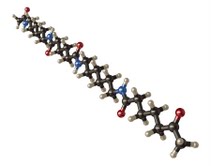 |
| Nylon molecular model |
Abstract:
A novel gel permeation chromatography (GPC) method for characterizing Nylon, developed by researchers at Malvern Instruments, significantly reduces the cost of analysis while simultaneously improving safety, when compared with conventional techniques. The new method uses formic acid as a solvent for Nylon, in place of the traditional choice of hexafluoroisopropanol (HFIPA), a relatively expensive, aggressively corrosive solvent with poor health and safety characteristics. First presented at a recent webinar by Dr Wei Sen Wong, his breakthrough is expected to generate significant industrial interest. Revisit it at www.malvern.com/nylon_characterization
A breakthrough in Nylon characterization from Malvern Instruments
Malvern, UK | Posted on August 31st, 2012 GPC is routinely used to determine the molecular weight and molecular weight distribution of Nylon, and indeed many other polymers. It relies on complete dissolution of the polymer in a suitable solvent and this can be a challenge with sparingly soluble polymers. For Nylon, HFIPA is conventionally chosen as a solvent because of its effectiveness, despite the deterrents of toxicity, cost and corrosivity.
The new method, developed by Drs Wei Sen Wong and Kyle Williams at Malvern's research facility in Houston, Texas, achieves complete dissolution using formic acid, a solvent that is typically around 1% of the cost of HFIPA. In addition, formic acid has a more favourable health and safety profile. The new technique can also handle residual water from the polymerization process and does not require the addition of corrosive salts (such as potassium trifluoroacetate KTFA), reducing wear and tear on the chromatography system. These benefits add up to a considerable advance for Nylon characterization, an improvement in health and safety coupled with significant potential for cost reduction.
To find out more about this exciting advance download the webinar or visit the separations section of the www.malvern.com/viscotek-range
www.malvern.com
Malvern, Malvern Instruments and Viscotek are registered trademarks of Malvern Instruments Ltd
####
About Malvern Instruments
Malvern Instruments is a market leader in measuring performance controlling material properties. These include particle size, particle shape, zeta potential, molecular weight, size and conformation, rheological properties and chemical identification. Malvern delivers the systems, support and expertise that ensure the analytical integrity and productivity needed to drive research, development and manufacturing.
Malvern’s measurement solutions for scientists, technologists and engineers advance continually through customer collaboration. Complementary materials characterization systems deliver inter-related measurements that reflect the complexities of particulates and disperse systems, nanomaterials and macromolecules. Combining intelligently implemented technologies with in-depth industry applications knowledge and support, Malvern provides customers with the competitive advantage they demand.
Headquartered in Malvern, UK, Malvern Instruments has subsidiary organizations in all major European markets, North America, China, Japan and Korea, a joint venture in India, a global distributor network and applications laboratories around the world.
Facebook: MalvernInstruments
Blog: www.materials-talks.com
Youtube: malverninstruments
Linked-In: malvern-instruments
Twitter: malvern_news
For more information, please click here
Contacts:
For press information, please contact:
Trish Appleton
Kapler Communications
Phoenix House, Phoenix Park
Eaton Socon, Cambridgeshire, PE19 8EP, UK
Tel: +44 (0)1480 471059
Fax: +44 (0)1480 471069
USA contact:
Marisa Fraser
Malvern Instruments Inc.
117 Flanders Road
Westborough, MA 01581-1042 USA
Tel: +1 508 768 6400
Fax: +1 508 768 6403
Please send sales enquiries to:
Alison Vines
Malvern Instruments Ltd
Enigma Business Park, Grovewood Road
Malvern, Worcestershire WR14 1XZ UK
Tel: +44 (0) 1684 892456
Fax: +44 (0) 1684 892789
Copyright © Malvern Instruments
If you have a comment, please Contact us.Issuers of news releases, not 7th Wave, Inc. or Nanotechnology Now, are solely responsible for the accuracy of the content.
Bookmark:


| Related News Press |
News and information
 Simulating magnetization in a Heisenberg quantum spin chain April 5th, 2024
NRL charters Navy’s quantum inertial navigation path to reduce drift April 5th, 2024
Discovery points path to flash-like memory for storing qubits: Rice find could hasten development of nonvolatile quantum memory April 5th, 2024
Chemistry
What heat can tell us about battery chemistry: using the Peltier effect to study lithium-ion cells March 8th, 2024
Nanoscale CL thermometry with lanthanide-doped heavy-metal oxide in TEM March 8th, 2024
Discoveries
Chemical reactions can scramble quantum information as well as black holes April 5th, 2024
New micromaterial releases nanoparticles that selectively destroy cancer cells April 5th, 2024
Utilizing palladium for addressing contact issues of buried oxide thin film transistors April 5th, 2024
Announcements
NRL charters Navy’s quantum inertial navigation path to reduce drift April 5th, 2024
Discovery points path to flash-like memory for storing qubits: Rice find could hasten development of nonvolatile quantum memory April 5th, 2024
Tools
Ferroelectrically modulate the Fermi level of graphene oxide to enhance SERS response November 3rd, 2023
The USTC realizes In situ electron paramagnetic resonance spectroscopy using single nanodiamond sensors November 3rd, 2023
 |
||
 |
||
| The latest news from around the world, FREE | ||
 |
||
|
|
||
| Premium Products | ||
 |
||
|
Only the news you want to read!
Learn More |
||
 |
||
|
Full-service, expert consulting
Learn More |
||
|
|
||