Home > Press > Breakthrough in nanotechnology: A new use for atomically engineered gold
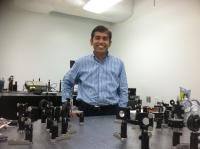 |
| Jayan Thomas works on in his lab at the University of Central Florida in Orlando.
Credit: UCF |
Abstract:
A University of Central Florida assistant professor has developed a new material using nanotechnology, which could help keep pilots and sensitive equipment safe from destructive lasers.
Breakthrough in nanotechnology: A new use for atomically engineered gold
Orlando, FL | Posted on August 29th, 2012UCF Assistant Professor Jayan Thomas, in collaboration with Carnegie Mellon University Associate Professor Rongchao Jin chronicle their work in the July issue of the journal Nano Letters. (dx.doi.org/10.1021/nl301988v)
Thomas is working with gold nanoparticles and studying their properties when they are shrunk into a small size regime called nanoclusters. Nanoparticles are already microscopic in size, and a nanometer is about 1/80000 of the thickness of a single strand of human hair. Nanoclusters are on the small end and nanocrystals are on the larger end of the nanoregime. Nano clusters are so small that the laws of physics that govern the world people touch and smell aren't often observed.
"Nanoclusters occupy the intriguing quantum size regime between atoms and nanocrystals, and the synthesis of ultra-small, atomically precise metal nanoclusters is a challenging task," Thomas said.
Thomas and his team found that nanoclusters developed by adding atoms in a sequential manner could provide interesting optical properties. It turns out that the gold nanoclusters exhibit qualities that may make them suitable for creating surfaces that would diffuse laser beams of high energy. They appear to be much more effective than its big sister, gold nanocrystal which is the (nano) material used by artists to make medieval church window paintings.
So why does it matter?
Think of commercial pilots or fighter pilots. They use sunglasses or helmet shields to protect their eyes from the sun's light. If the glasses or helmet shield could be coated with nanoclusters tested in Thomas' lab at UCF, the shield could potentially diffuse high-energy beams of light, such as laser. Highly sensitive instruments needed for navigation and other applications could also be protected in case of an enemy attack using high energy laser beams.
"These results give me great pleasure since the technique we used to study the optical properties of these atomically precise particle is one invented by UCF Professors Eric VanStryland and David Hagan many years ago," Thomas said. "But the progression we've made is very exciting."
Because nanoclusters appear to have a better ability to diffuse high beams of energy, they are a promising area for future development. There is still plenty of applications to be explored using these very interesting atomically engineered materials. Until now, much research has been focused on the larger nanocrystal.
Thomas is also exploring the use of these particles in the polymer material used for 3D telepresence to make it more sensitive to light. If successful, it can take the current polymers a step closer to developing real time 3D telepresence.
3D-Telepresence provides a holographic illusion to a viewer who is present in another location by giving that person a 360-degree view (in 3D) of everything that's going on. It's a step beyond 3-D and is expected to revolutionize the way people see television and in how they participate in activities around the world. For example, by allowing a viewer to "walk around" a remote location as if in a virtual game, a surgeon could help execute a complicated medical procedure from thousands of miles away.
Others who contributed to the new material include: Reji Philip from the UCF's NanoScience Technology Center, Panit Chantharasupawong from UCF's College of Optics and Photonics, and Huifeng Qian from Department of Chemistry at the Carnegie Mellon University.
Thomas joined UCF in 2011 and is a part of the NanoScience Technology Center with a joint appointment in The College of Optics and Photonics and the Department of Material Science and Engineering in the College of Engineering. Previously he was at the University of Arizona in its College of Optical Sciences. He has several degrees including a Ph. D. in Chemistry/Material Science from Cochin University of Science and Technology in India. He's earned several awards and grants.
####
About University of Central Florida
UCF Stands For Opportunity -- The University of Central Florida is a metropolitan research university that ranks as the second largest in the nation with more than 59,000 students. UCF's first classes were offered in 1968. The university offers impressive academic and research environments that power the region's economic development. UCF's culture of opportunity is driven by our diversity, Orlando environment, history of entrepreneurship and our youth, relevance and energy.
For more information, please click here
Contacts:
Zenaida Kotala
407-823-6120
Copyright © University of Central Florida
If you have a comment, please Contact us.Issuers of news releases, not 7th Wave, Inc. or Nanotechnology Now, are solely responsible for the accuracy of the content.
Bookmark:


| Related News Press |
News and information
 Simulating magnetization in a Heisenberg quantum spin chain April 5th, 2024
NRL charters Navy’s quantum inertial navigation path to reduce drift April 5th, 2024
Discovery points path to flash-like memory for storing qubits: Rice find could hasten development of nonvolatile quantum memory April 5th, 2024
Govt.-Legislation/Regulation/Funding/Policy
NRL charters Navy’s quantum inertial navigation path to reduce drift April 5th, 2024
Discovery points path to flash-like memory for storing qubits: Rice find could hasten development of nonvolatile quantum memory April 5th, 2024
Chemical reactions can scramble quantum information as well as black holes April 5th, 2024
Discoveries
Chemical reactions can scramble quantum information as well as black holes April 5th, 2024
New micromaterial releases nanoparticles that selectively destroy cancer cells April 5th, 2024
Utilizing palladium for addressing contact issues of buried oxide thin film transistors April 5th, 2024
Materials/Metamaterials/Magnetoresistance
Nanoscale CL thermometry with lanthanide-doped heavy-metal oxide in TEM March 8th, 2024
Focused ion beam technology: A single tool for a wide range of applications January 12th, 2024
Announcements
NRL charters Navy’s quantum inertial navigation path to reduce drift April 5th, 2024
Discovery points path to flash-like memory for storing qubits: Rice find could hasten development of nonvolatile quantum memory April 5th, 2024
Military
NRL charters Navy’s quantum inertial navigation path to reduce drift April 5th, 2024
What heat can tell us about battery chemistry: using the Peltier effect to study lithium-ion cells March 8th, 2024
New chip opens door to AI computing at light speed February 16th, 2024
Aerospace/Space
Under pressure - space exploration in our time: Advancing space exploration through diverse collaborations and ethical policies February 16th, 2024
Bridging light and electrons January 12th, 2024
Manufacturing advances bring material back in vogue January 20th, 2023
Photonics/Optics/Lasers
With VECSELs towards the quantum internet Fraunhofer: IAF achieves record output power with VECSEL for quantum frequency converters April 5th, 2024
Nanoscale CL thermometry with lanthanide-doped heavy-metal oxide in TEM March 8th, 2024
Optically trapped quantum droplets of light can bind together to form macroscopic complexes March 8th, 2024
HKUST researchers develop new integration technique for efficient coupling of III-V and silicon February 16th, 2024
 |
||
 |
||
| The latest news from around the world, FREE | ||
 |
||
|
|
||
| Premium Products | ||
 |
||
|
Only the news you want to read!
Learn More |
||
 |
||
|
Full-service, expert consulting
Learn More |
||
|
|
||