Home > Press > Molecular capsules: Glowing with promise
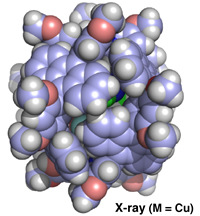 |
| Crystal structure of the copper capsule |
Abstract:
Fluorescence has widespread applications, helping researchers to understand issues in the fundamental sciences and develop practical materials and devices. Among the useful fluorescent compounds in development, capsule-shaped molecular architectures, which possess both strong fluorescent properties and a nanometer-sized cavity, are particularly promising.
Molecular capsules: Glowing with promise
Tokyo, Japan | Posted on August 27th, 2012Molecular cages and capsules can be prepared through a simple synthetic process called coordinative self-assembly. However, most of them are composed of precious metal ions such as palladium and platinum, and are non-emissive due to quenching by the heavy metals.
Now, Michito Yoshizawa, Zhiou Li, and co-workers from the Chemical Resources Laboratory at Tokyo Institute of Technology report novel molecular nanocapsules with the M2L4 composition (where M represents zinc, copper, platinum, palladium, nickel, cobalt, and manganese). Their zinc and copper capsules, in particular, display unique fluorescent properties.
The M2L4 capsules self-assemble from two metal ions and four bent ligands that include anthracene fluorophores (fluorescent parts). X-ray crystallographic analysis verified the closed shell structures where the large interior cavities of the capsules, around one nanometer in diameter, are shielded by eight anthracene panels.
The zinc capsule emitted strong blue fluorescence with a high quantum yield (80%), in sharp contrast to the weakly emissive nickel and manganese capsules and the non-emissive palladium, platinum, and cobalt capsules. The fluorescence of the copper capsule, on the other hand, depends on the solvent; for example, it shows blue emission in dimethyl sulfoxide but no emission in acetonitrile.
This study is the first to show such emissive properties of molecular capsules bearing an isolated large cavity. The researchers believe their nanocapsules could have novel applications in devices such as chemosensors, biological probes, and light-emitting diodes.
Reference:
・ Authors: Zhiou Li, Norifumi Kishi, Kenji Yoza, Munetaka Akita, Michito Yoshizawa*
・ Title of original paper: Isostructural M2L4 Molecular Capsules with Anthracene Shells: Synthesis, Crystal Structures, and Fluorescent Properties.
・ Journal, volume, pages and year: Chemistry - A European Journal, 18, 8358 (2012).
・ Digital Object Identifier (DOI): 10.1002/chem.201200155.
・ Affiliations: Chemical Resources Laboratory, Tokyo Institute of Technology.
・ Department website: www.res.titech.ac.jp/~smart/smart_e.html
####
About Tokyo Institute of Technology
As one of Japan’s top universities, Tokyo Institute of Technology seeks to contribute to civilization, peace and prosperity in the world, and aims at developing global human capabilities par excellence through pioneering research and education in science and technology, including industrial and social management. To achieve this mission, we have an eye on educating highly moral students to acquire not only scientific expertise but also expertise in the liberal arts, and a balanced knowledge of the social sciences and humanities, all while researching deeply from basics to practice with academic mastery. Through these activities, we wish to contribute to global sustainability of the natural world and the support of human life.
For more information, please click here
Contacts:
Miwako Kato and Yukiko Tokida
Center for Public Information
Tokyo Institute of Technology
2-12-1, Ookayama, Meguro-ku, Tokyo 152-8550, Japan
http://www.titech.ac.jp/english/
Tel: +81-3-5734-2975
Fax: +81-3-5734-3661
Copyright © Tokyo Institute of Technology
If you have a comment, please Contact us.Issuers of news releases, not 7th Wave, Inc. or Nanotechnology Now, are solely responsible for the accuracy of the content.
Bookmark:


| Related News Press |
News and information
 Simulating magnetization in a Heisenberg quantum spin chain April 5th, 2024
NRL charters Navy’s quantum inertial navigation path to reduce drift April 5th, 2024
Discovery points path to flash-like memory for storing qubits: Rice find could hasten development of nonvolatile quantum memory April 5th, 2024
Imaging
Nanoscale CL thermometry with lanthanide-doped heavy-metal oxide in TEM March 8th, 2024
The USTC realizes In situ electron paramagnetic resonance spectroscopy using single nanodiamond sensors November 3rd, 2023
Observation of left and right at nanoscale with optical force October 6th, 2023
Self Assembly
Liquid crystal templated chiral nanomaterials October 14th, 2022
Nanoclusters self-organize into centimeter-scale hierarchical assemblies April 22nd, 2022
Atom by atom: building precise smaller nanoparticles with templates March 4th, 2022
Nanostructures get complex with electron equivalents: Nanoparticles of two different sizes break away from symmetrical designs January 14th, 2022
Discoveries
Chemical reactions can scramble quantum information as well as black holes April 5th, 2024
New micromaterial releases nanoparticles that selectively destroy cancer cells April 5th, 2024
Utilizing palladium for addressing contact issues of buried oxide thin film transistors April 5th, 2024
Announcements
NRL charters Navy’s quantum inertial navigation path to reduce drift April 5th, 2024
Discovery points path to flash-like memory for storing qubits: Rice find could hasten development of nonvolatile quantum memory April 5th, 2024
 |
||
 |
||
| The latest news from around the world, FREE | ||
 |
||
|
|
||
| Premium Products | ||
 |
||
|
Only the news you want to read!
Learn More |
||
 |
||
|
Full-service, expert consulting
Learn More |
||
|
|
||