Home > Press > New Piezo Bimorph Actuators are Smaller, Require Lower Voltage, by PI Ceramic
 |
Abstract:
Piezo ceramics specialist PI ceramic offers a new line of co-fired multilayer piezo bimorph actuators.
New Piezo Bimorph Actuators are Smaller, Require Lower Voltage, by PI Ceramic
Auburn, MA | Posted on August 5th, 2012 Bimorph piezo actuators achieve a mechanical amplification effect by different layers expanding at different rates. The new actuators are co-fired, i.e. they are monolithic and all layers are produced in one step.
They achieve long travel ranges with motion to 2 mm and nanometer resolution. Response times are in the millisecond range, important for fast switching or scanning applications. Due to the monolithic design they provide excellent mechanical stability, low operating voltage and can be operated at temperatures to 150°C.
Typical applications of bimorph piezos
Pneumatic valves, fast optical switches, beam deflection, micropositioning acceleration sensors, medical device engineering, semiconductor manufacturing, aerospace, bio-nanotechnology and automotive.
More information can be downloaded at: http://www.piceramic.com/datasheet/PL112_Datasheet.pdf
Closed Loop Option
The piezo bimorph actuators can be factory equipped with position feedback sensors for closed-loop operation. Controllers, OEM driver electronics / piezo power supplies are also available.
Variety of Different Shapes, Even with Central Aperture
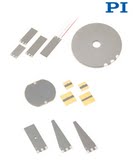
The new bimorph actuators come in a variety of standard and custom shapes, from rectangular stripes to triangles, circular disks with optional aperture etc.
Compact versions with only a few millimeters in size can be produced.
Piezoceramic Actuator Basics:
A piezo actuator is a ceramic device that converts electrical energy into mechanical energy or motion with high precision, speed and force. There is no friction and wear involved resulting in a device with very high motion resolution and virtually unlimited lifetime.
Two basic types of piezo actuators are common: bulk / stacked / glued discrete actuators and cofired (multilayer, monolithic) actuators
Ceramic, Physik Instrumente's electroceramics division manufactures both types and is set up for custom designs even in smaller production runs at a competitive price.
Specifications of standard bimorph benders are available here: http://www.piceramic.com/prspecs.php?sortnr=103000&onl_prw
####
For more information, please click here
Contacts:
PI (Physik Instrumente) LP
16 Albert St.
Auburn, MA 01501
USA / Canada/Mexico: http://www.pi-usa.us, Email: info(at)pi-usa(dot)us
Phone: East / Midwest: (508) 832-3456, West: (949) 679-9191
Follow PI on Twitter: @PI_Physik_Inst, http://twitter.com/PI_Physik_Inst/
PI Blog: http://physik-instrumente.blogspot.com
Copyright © PI (Physik Instrumente)
If you have a comment, please Contact us.Issuers of news releases, not 7th Wave, Inc. or Nanotechnology Now, are solely responsible for the accuracy of the content.
Bookmark:


| Related News Press |
News and information
 Simulating magnetization in a Heisenberg quantum spin chain April 5th, 2024
NRL charters Navy’s quantum inertial navigation path to reduce drift April 5th, 2024
Discovery points path to flash-like memory for storing qubits: Rice find could hasten development of nonvolatile quantum memory April 5th, 2024
Announcements
NRL charters Navy’s quantum inertial navigation path to reduce drift April 5th, 2024
Discovery points path to flash-like memory for storing qubits: Rice find could hasten development of nonvolatile quantum memory April 5th, 2024
Tools
Ferroelectrically modulate the Fermi level of graphene oxide to enhance SERS response November 3rd, 2023
The USTC realizes In situ electron paramagnetic resonance spectroscopy using single nanodiamond sensors November 3rd, 2023
 |
||
 |
||
| The latest news from around the world, FREE | ||
 |
||
|
|
||
| Premium Products | ||
 |
||
|
Only the news you want to read!
Learn More |
||
 |
||
|
Full-service, expert consulting
Learn More |
||
|
|
||