Home > Press > Researchers Create Highly Conductive and Elastic Conductors Using Silver Nanowires
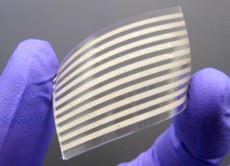 |
| The silver nanowires can be printed to fabricate patterned stretchable conductors. |
Abstract:
Researchers from North Carolina State University have developed highly conductive and elastic conductors made from silver nanoscale wires (nanowires). These elastic conductors could be used to develop stretchable electronic devices.
Researchers Create Highly Conductive and Elastic Conductors Using Silver Nanowires
Raleigh, NC | Posted on July 12th, 2012Stretchable circuitry would be able to do many things that its rigid counterpart cannot. For example, an electronic "skin" could help robots pick up delicate objects without breaking them, and stretchable displays and antennas could make cell phones and other electronic devices stretch and compress without affecting their performance. However, the first step toward making such applications possible is to produce conductors that are elastic and able to effectively and reliably transmit electric signals regardless of whether they are deformed.
Dr. Yong Zhu, an assistant professor of mechanical and aerospace engineering at NC State, and Feng Xu, a Ph.D. student in Zhu's lab have developed such elastic conductors using silver nanowires.
Silver has very high electric conductivity, meaning that it can transfer electricity efficiently. And the new technique developed at NC State embeds highly conductive silver nanowires in a polymer that can withstand significant stretching without adversely affecting the material's conductivity. This makes it attractive as a component for use in stretchable electronic devices.
"This development is very exciting because it could be immediately applied to a broad range of applications," Zhu said. "In addition, our work focuses on high and stable conductivity under a large degree of deformation, complementary to most other work using silver nanowires that are more concerned with flexibility and transparency."
"The fabrication approach is very simple," says Xu. Silver nanowires are placed on a silicon plate. A liquid polymer is poured over the silicon substrate. The polymer is then exposed to high heat, which turns the polymer from a liquid into an elastic solid. Because the polymer flows around the silver nanowires when it is in liquid form, the nanowires are trapped in the polymer when it becomes solid. The polymer can then be peeled off the silicon plate.
"Also silver nanowires can be printed to fabricate patterned stretchable conductors," Xu says. The fact that it is easy to make patterns using the silver nanowire conductors should facilitate the technique's use in electronics manufacturing.
When the nanowire-embedded polymer is stretched and relaxed, the surface of the polymer containing nanowires buckles. The end result is that the composite is flat on the side that contains no nanowires, but wavy on the side that contains silver nanowires.
After the nanowire-embedded surface has buckled, the material can be stretched up to 50 percent of its elongation, or tensile strain, without affecting the conductivity of the silver nanowires. This is because the buckled shape of the material allows the nanowires to stay in a fixed position relative to each other, even as the polymer is being stretched.
"In addition to having high conductivity and a large stable strain range, the new stretchable conductors show excellent robustness under repeated mechanical loading," Zhu says. Other reported stretchable conductive materials are typically deposited on top of substrates and could delaminate under repeated mechanical stretching or surface rubbing.
The paper, "Highly Conductive and Stretchable Silver Nanowire Conductors," was published online July 12 in Advanced Materials. The research was supported by the National Science Foundation.
####
For more information, please click here
Contacts:
Matt Shipman
News Services
919.515.6386
Dr. Yong Zhu
919.513.7735
Copyright © North Carolina State University
If you have a comment, please Contact us.Issuers of news releases, not 7th Wave, Inc. or Nanotechnology Now, are solely responsible for the accuracy of the content.
Bookmark:


| Related Links |
 Download paper - “Highly Conductive and Stretchable Silver Nanowire Conductors”:
| Related News Press |
News and information
Simulating magnetization in a Heisenberg quantum spin chain April 5th, 2024
NRL charters Navy’s quantum inertial navigation path to reduce drift April 5th, 2024
Discovery points path to flash-like memory for storing qubits: Rice find could hasten development of nonvolatile quantum memory April 5th, 2024
Flexible Electronics
CityU awarded invention: Soft, ultrathin photonic material cools down wearable electronic devices June 30th, 2023
Liquid metal sticks to surfaces without a binding agent June 9th, 2023
Breaking through the limits of stretchable semiconductors with molecular brakes that harness light June 9th, 2023
Govt.-Legislation/Regulation/Funding/Policy
NRL charters Navy’s quantum inertial navigation path to reduce drift April 5th, 2024
Discovery points path to flash-like memory for storing qubits: Rice find could hasten development of nonvolatile quantum memory April 5th, 2024
Chemical reactions can scramble quantum information as well as black holes April 5th, 2024
Chip Technology
Discovery points path to flash-like memory for storing qubits: Rice find could hasten development of nonvolatile quantum memory April 5th, 2024
Utilizing palladium for addressing contact issues of buried oxide thin film transistors April 5th, 2024
HKUST researchers develop new integration technique for efficient coupling of III-V and silicon February 16th, 2024
Discoveries
Chemical reactions can scramble quantum information as well as black holes April 5th, 2024
New micromaterial releases nanoparticles that selectively destroy cancer cells April 5th, 2024
Utilizing palladium for addressing contact issues of buried oxide thin film transistors April 5th, 2024
Announcements
NRL charters Navy’s quantum inertial navigation path to reduce drift April 5th, 2024
Discovery points path to flash-like memory for storing qubits: Rice find could hasten development of nonvolatile quantum memory April 5th, 2024
 |
||
 |
||
| The latest news from around the world, FREE | ||
 |
||
|
|
||
| Premium Products | ||
 |
||
|
Only the news you want to read!
Learn More |
||
 |
||
|
Full-service, expert consulting
Learn More |
||
|
|
||