Home > Press > UCLA researchers devise scalable method for fabricating high-quality graphene transistors
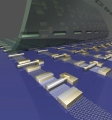 |
| Self-aligned graphene transistor |
Abstract:
Graphene, a one-atom-thick layer of graphitic carbon, has attracted a great deal of attention for its potential use as a transistor that could make consumer electronic devices faster and smaller.
But the material's unique properties, and the shrinking scale of electronics, also make graphene difficult to fabricate on a large scale. The production of high-performance graphene using conventional fabrication techniques often leads to damage to the graphene lattice's shape and performance, resulting in problems that include parasitic capacitance and serial resistance.
Now, researchers from the California NanoSystems Institute at UCLA, the UCLA Department of Chemistry and Biochemistry, and the department of materials science and engineering at the UCLA Henry Samueli School of Engineering and Applied Science have developed a successful, scalable method for fabricating self-aligned graphene transistors with transferred gate stacks.
UCLA researchers devise scalable method for fabricating high-quality graphene transistors
Los Angeles, CA | Posted on July 6th, 2012By performing the conventional lithography, deposition and etching steps on a sacrificial substrate before integrating with large-area graphene through a physical transferring process, the new approach addresses and overcomes the challenges of conventional fabrication. With a damage-free transfer process and a self-aligned device structure, this method has enabled self-aligned graphene transistors with the highest cutoff frequency to date — greater than 400 GHz.
IMPACT:
The research demonstrates a unique, scalable pathway to high-speed, self-aligned graphene transistors and holds significant promise for the future application of graphene-based devices in ultra-high-frequency circuits.
AUTHORS:
Authors of the research include UCLA chemistry postdoctoral scholars Lei Liao and Hailong Zhou; UCLA chemistry graduate students Lixin Liu and Shan Jiang; UCLA materials science and engineering graduate students Rui Cheng, Yu Chen, YungChen Lin and Jinwei Bai (now a research scientist at IBM); UCLA associate professor of materials science and engineering Yu Huang; and UCLA associate professor of chemistry and biochemistry Xiangfeng Duan.
Professors Huang and Duan are also members of the California NanoSystems Institute at UCLA.
FUNDING:
The research was supported by the National Science Foundation, the National Institutes of Health and the U.S. Office of Naval Research.
####
For more information, please click here
Contacts:
Jennifer Marcus,
310-267-4839
Copyright © University of California - Los Angeles
If you have a comment, please Contact us.Issuers of news releases, not 7th Wave, Inc. or Nanotechnology Now, are solely responsible for the accuracy of the content.
Bookmark:


| Related Links |
| Related News Press |
News and information
 Simulating magnetization in a Heisenberg quantum spin chain April 5th, 2024
NRL charters Navy’s quantum inertial navigation path to reduce drift April 5th, 2024
Discovery points path to flash-like memory for storing qubits: Rice find could hasten development of nonvolatile quantum memory April 5th, 2024
Graphene/ Graphite
NRL discovers two-dimensional waveguides February 16th, 2024
Govt.-Legislation/Regulation/Funding/Policy
NRL charters Navy’s quantum inertial navigation path to reduce drift April 5th, 2024
Discovery points path to flash-like memory for storing qubits: Rice find could hasten development of nonvolatile quantum memory April 5th, 2024
Chemical reactions can scramble quantum information as well as black holes April 5th, 2024
Announcements
NRL charters Navy’s quantum inertial navigation path to reduce drift April 5th, 2024
Discovery points path to flash-like memory for storing qubits: Rice find could hasten development of nonvolatile quantum memory April 5th, 2024
Military
NRL charters Navy’s quantum inertial navigation path to reduce drift April 5th, 2024
What heat can tell us about battery chemistry: using the Peltier effect to study lithium-ion cells March 8th, 2024
New chip opens door to AI computing at light speed February 16th, 2024
 |
||
 |
||
| The latest news from around the world, FREE | ||
 |
||
|
|
||
| Premium Products | ||
 |
||
|
Only the news you want to read!
Learn More |
||
 |
||
|
Full-service, expert consulting
Learn More |
||
|
|
||