Home > Press > The Science and Engineering Institutes, Singapore, are using Nanoparticle Tracking Analysis to characterize exosomes
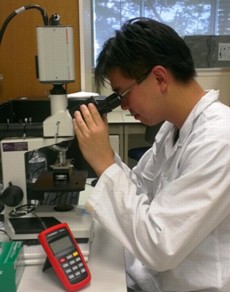 |
| Dr Seow Yiqi using his NanoSight LM10 system at the MEL in Singapore |
Abstract:
NanoSight, leading manufacturers of unique nanoparticle characterization technology, reports on the work of Dr Seow Yiqi at SCEI, Singapore where they apply Nanoparticle Tracking Analysis (NTA) to characterize exosomes for use in delivering therapeutic moieties to specific tissues in vivo.
The Science and Engineering Institutes, Singapore, are using Nanoparticle Tracking Analysis to characterize exosomes
Salisbury, UK | Posted on July 4th, 2012The Molecular Engineering Laboratory was established in 2009 by Nobel Laureate Dr Sydney Brenner as a multi-disciplinary laboratory where diverse expertise from different realms of science could come together to develop novel technologies. Post-doctoral fellows in the laboratory undertake a wide variety of research ranging from organic fluorophore development to characterization of marine biomaterials with unique physical properties to genetic therapies.
Dr Seow Yiqi is working to use exosomes (nanoparticles secreted by cells of ~100nm in size) to deliver therapeutic moieties to specific tissues in vivo. This is work that follows on from his DPhil studies at the University of Oxford in Professor Matthew Wood's group. Describing his work, he said "I used targeted exosomes loaded with siRNA to effect knockdown in the brain after intravenous injection of these exosomes. The development of 'self' delivery vehicles, such as patient-derived exosomes, may be a good first step towards gene/drug therapy that requires repeated delivery over a period of years or decades. Towards this aim, using the NanoSight system has proved to be invaluable in providing size and concentration measurement for each exosome purification. This data allows me to check the quality and purity of the preparation as well as to look at the physical effects of my surface modifications and loading protocols on the physical characteristics of exosomes."
Other than NTA, he had used dynamic light scattering (DLS) for bulk measurement, and transmission electron microscopy using negative staining with phosphotungstanic acid for sizing. DLS was useful if the purification was pure and the sample being measured was relatively homogenous, but more often than not, the population purified tended to be polydisperse with nanoparticles of varying sizes in the same preparation. That biased the DLS measurements and it was difficult to get reproducible results with the system. In contrast, the TEM was accurate and precise, but the preparation was arduous and time-consuming and the results are a very small representation of the bulk, so it was not useful in working out concentration or size distribution. Concluding, he says, "Using Nanoparticle Tracking Analysis overcame these issues perfectly for my work. Measurements were rapid and by counting particle by particle, the true polydisperse nature of the samples was reported."
To find out about the company and to learn more about particle characterization using NanoSight's unique nanoparticle tracking analysis solutions, visit www.nanosight.com and register to receive the next issue of NanoTrail, the company's electronic newsletter.
####
About NanoSight
NanoSight delivers the world's most versatile and proven multi-parameter nanoparticle analysis in a single instrument.
NanoSight's "Nanoparticle Tracking Analysis" (NTA) detects and visualizes populations of nanoparticles in liquids down to 10 nm, dependent on material, and measures the size of each particle from direct observations of diffusion. Additionally, NanoSight measures concentration and a fluorescence mode differentiates suitably-labelled particles within complex background suspensions. Zeta potential measurements are similarly particle-specific. It is this particle-by-particle methodology that takes NTA beyond traditional light scattering and other ensemble techniques in providing high-resolution particle size distributions and validates data with information-rich video files of the particles moving under Brownian motion.
This simultaneous multiparameter characterization matches the demands of complex biological systems, hence its wide application in development of drug delivery systems, of viral vaccines, and in nanotoxicology. This real-time data gives insight into the kinetics of protein aggregation and other time-dependent phenomena in a qualitative and quantitative manner. NanoSight has a growing role in biodiagnostics, being proven in detection and speciation of nanovesicles (exosomes) and microvesicles.
NanoSight has installed approaching 500 systems worldwide with users including BASF, GlaxoSmithKline, Merck, Novartis, Pfizer, Proctor and Gamble, Roche and Unilever together with the most eminent universities and research institutes. NanoSight's technology is validated by 450+ third party papers citing NanoSight results and by the ASTM Standard E2834, consolidating NanoSight's leadership position in nanoparticle characterization.
For more information, please click here
Contacts:
NanoSight Limited
Minton Park
London Road
Amesbury SP4 7RT UK
T +44(0)1980 676060
F +44(0)1980 624703
www.nanosight.com
Talking Science Limited
39 de Bohun Court
Saffron Walden
Essex CB10 2BA UK
T +44(0)1799 521881
M +44(0)7843 012997
www.talking-science.com
Copyright © NanoSight
If you have a comment, please Contact us.Issuers of news releases, not 7th Wave, Inc. or Nanotechnology Now, are solely responsible for the accuracy of the content.
Bookmark:


| Related News Press |
News and information
 Simulating magnetization in a Heisenberg quantum spin chain April 5th, 2024
NRL charters Navy’s quantum inertial navigation path to reduce drift April 5th, 2024
Discovery points path to flash-like memory for storing qubits: Rice find could hasten development of nonvolatile quantum memory April 5th, 2024
Imaging
Nanoscale CL thermometry with lanthanide-doped heavy-metal oxide in TEM March 8th, 2024
The USTC realizes In situ electron paramagnetic resonance spectroscopy using single nanodiamond sensors November 3rd, 2023
Observation of left and right at nanoscale with optical force October 6th, 2023
Announcements
NRL charters Navy’s quantum inertial navigation path to reduce drift April 5th, 2024
Discovery points path to flash-like memory for storing qubits: Rice find could hasten development of nonvolatile quantum memory April 5th, 2024
Tools
Ferroelectrically modulate the Fermi level of graphene oxide to enhance SERS response November 3rd, 2023
The USTC realizes In situ electron paramagnetic resonance spectroscopy using single nanodiamond sensors November 3rd, 2023
New-Contracts/Sales/Customers
Bruker Light-Sheet Microscopes at Major Comprehensive Cancer Center: New Advanced Imaging Center Powered by Two MuVi and LCS SPIM Microscopes March 25th, 2021
Arrowhead Pharmaceuticals Announces Closing of Agreement with Takeda November 27th, 2020
Veeco Announces Aledia Order of 300mm MOCVD Equipment for microLED Displays: Propel™ Platform First 300mm System with EFEM Designed for Advanced Display Applications October 20th, 2020
GREENWAVES TECHNOLOGIES Announces Next Generation GAP9 Hearables Platform Using GLOBALFOUNDRIES 22FDX Solution October 16th, 2020
 |
||
 |
||
| The latest news from around the world, FREE | ||
 |
||
|
|
||
| Premium Products | ||
 |
||
|
Only the news you want to read!
Learn More |
||
 |
||
|
Full-service, expert consulting
Learn More |
||
|
|
||