Home > Press > Hark! Group Demonstrates First Heralded Single Photon Source Made from Silicon
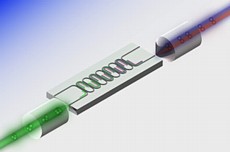 |
| Illustration of the process of photon pair generation, in which input pump photons spontaneously generate special pairs of new photons that emerge at precisely the same time, with one at a slightly lower frequency and the other a slightly higher frequency, after which heralding occurs. Credit: Srinivasan, Davanco/NIST |
Abstract:
In an important step towards more practical quantum information processing, researchers from the National Institute of Standards and Technology (NIST), the University of California, San Diego; and the Politecnico di Milano in Milan, Italy, have demonstrated the first heralded single photon source made from silicon. This source complements two other recently developed silicon-based technologies—interferometers for manipulating the entanglement of photons and single photon detectors—needed to build a quantum optical circuit or a secure quantum communication system.
heralded photons
Hark! Group Demonstrates First Heralded Single Photon Source Made from Silicon
Gaithersburg, MD | Posted on June 28th, 2012The line between "interesting" and practical in advanced electronics and optics often comes down to making the new device compatible with existing technology. According to NIST scientist Kartik Srinivasan, the new 0.5 mm x 0.05 mm-sized heralded photon generator meshes with existing technology in three important ways: it operates at room temperature; it produces photons compatible with existing telecommunications systems (wavelengths of about 1550 nanometers); and it's in silicon, and so can be built using standard, scalable fabrication techniques.
A "heralded" photon is one of a pair whose existence is announced by the detection of its partner—the "herald" photon. To get heralded single photons, the group built upon a technique previously demonstrated in silicon called photon pair generation.
In photon pair generation, a laser pumps photons into a material whose properties cause two incoming pump photons to spontaneously generate a new pair of frequency-shifted photons. However, while these new photons emerge at precisely the same time, it is impossible to know when that will occur.
"Detecting one of these photons, therefore, lets us know to look for its partner," says Srinivasan. "While there are a number of applications for photon pairs, heralded pairs will sometimes be needed, for example, to trigger the storage of information in future quantum-based computer memories."
According to Srinivasan, the group's silicon-based device efficiently produced pairs of single photons, and their experiment clearly demonstrated they could herald the presence of one photon by the detection of the other.
While the new device is a step forward, it is not yet practical, according to co-author Professor Shayan Mookherjea at UC San Diego, because a single source is not bright enough and a number of other required functions need to be integrated onto the chip. However, putting multiple sources along with their complementary components onto a single chip—something made possible by using silicon-based technology—could supply the performance needed for practical applications.
The work was among the three finalists and received an honorable mention in the Maiman Student Paper Competition.
####
About National Institute of Standards and Technology (NIST)
The National Institute of Standards and Technology (NIST) is an agency of the U.S. Department of Commerce.
For more information, please click here
Contacts:
Mark Esser
301-975-8735
Copyright © National Institute of Standards and Technology (NIST)
If you have a comment, please Contact us.Issuers of news releases, not 7th Wave, Inc. or Nanotechnology Now, are solely responsible for the accuracy of the content.
Bookmark:


| Related News Press |
News and information
 Simulating magnetization in a Heisenberg quantum spin chain April 5th, 2024
NRL charters Navy’s quantum inertial navigation path to reduce drift April 5th, 2024
Discovery points path to flash-like memory for storing qubits: Rice find could hasten development of nonvolatile quantum memory April 5th, 2024
Laboratories
A battery’s hopping ions remember where they’ve been: Seen in atomic detail, the seemingly smooth flow of ions through a battery’s electrolyte is surprisingly complicated February 16th, 2024
NRL discovers two-dimensional waveguides February 16th, 2024
Three-pronged approach discerns qualities of quantum spin liquids November 17th, 2023
Govt.-Legislation/Regulation/Funding/Policy
NRL charters Navy’s quantum inertial navigation path to reduce drift April 5th, 2024
Discovery points path to flash-like memory for storing qubits: Rice find could hasten development of nonvolatile quantum memory April 5th, 2024
Chemical reactions can scramble quantum information as well as black holes April 5th, 2024
Quantum Computing
Simulating magnetization in a Heisenberg quantum spin chain April 5th, 2024
Discovery points path to flash-like memory for storing qubits: Rice find could hasten development of nonvolatile quantum memory April 5th, 2024
With VECSELs towards the quantum internet Fraunhofer: IAF achieves record output power with VECSEL for quantum frequency converters April 5th, 2024
Chemical reactions can scramble quantum information as well as black holes April 5th, 2024
Optical computing/Photonic computing
With VECSELs towards the quantum internet Fraunhofer: IAF achieves record output power with VECSEL for quantum frequency converters April 5th, 2024
Chemical reactions can scramble quantum information as well as black holes April 5th, 2024
Optically trapped quantum droplets of light can bind together to form macroscopic complexes March 8th, 2024
HKUST researchers develop new integration technique for efficient coupling of III-V and silicon February 16th, 2024
Announcements
NRL charters Navy’s quantum inertial navigation path to reduce drift April 5th, 2024
Discovery points path to flash-like memory for storing qubits: Rice find could hasten development of nonvolatile quantum memory April 5th, 2024
Tools
Ferroelectrically modulate the Fermi level of graphene oxide to enhance SERS response November 3rd, 2023
The USTC realizes In situ electron paramagnetic resonance spectroscopy using single nanodiamond sensors November 3rd, 2023
Photonics/Optics/Lasers
With VECSELs towards the quantum internet Fraunhofer: IAF achieves record output power with VECSEL for quantum frequency converters April 5th, 2024
Nanoscale CL thermometry with lanthanide-doped heavy-metal oxide in TEM March 8th, 2024
Optically trapped quantum droplets of light can bind together to form macroscopic complexes March 8th, 2024
HKUST researchers develop new integration technique for efficient coupling of III-V and silicon February 16th, 2024
Research partnerships
Discovery points path to flash-like memory for storing qubits: Rice find could hasten development of nonvolatile quantum memory April 5th, 2024
Researchers’ approach may protect quantum computers from attacks March 8th, 2024
'Sudden death' of quantum fluctuations defies current theories of superconductivity: Study challenges the conventional wisdom of superconducting quantum transitions January 12th, 2024
 |
||
 |
||
| The latest news from around the world, FREE | ||
 |
||
|
|
||
| Premium Products | ||
 |
||
|
Only the news you want to read!
Learn More |
||
 |
||
|
Full-service, expert consulting
Learn More |
||
|
|
||