Home > Press > SU researchers use nanotechnology to harness power of fireflies
 |
Abstract:
What do fireflies, nanorods and Christmas lights have in common? Someday, consumers may be able to purchase multicolor strings of light that don't need electricity or batteries to glow. Scientists in Syracuse University's College of Arts and Sciences found a new way to harness the natural light produced by fireflies (called bioluminescence) using nanoscience. Their breakthrough produces a system that is 20 to 30 times more efficient than those produced during previous experiments.
SU researchers use nanotechnology to harness power of fireflies
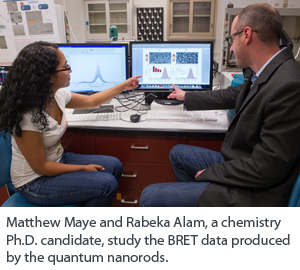
Syracuse, NY | Posted on June 16th, 2012It's all about the size and structure of the custom, quantum nanorods, which are produced in the laboratory by Mathew Maye, assistant professor of chemistry in SU's College of Arts and Sciences; and Rabeka Alam, a chemistry Ph.D. candidate. Maye is also a member of the Syracuse Biomaterials Institute.
"Firefly light is one of nature's best examples of bioluminescence," Maye says. "The light is extremely bright and efficient. We've found a new way to harness biology for nonbiological applications by manipulating the interface between the biological and nonbiological components."
Their work, "Designing Quantum Rods for Optimized Energy Transfer with Firefly Luciferase Enzymes," was published online May 23 in Nano Letters and is forthcoming in print. Nano Letters is a premier journal of the American Chemical Society and one of the highest-rated journals in the nanoscience field. Collaborating on the research were Professor Bruce Branchini and Danielle Fontaine, both from Connecticut College.
Fireflies produce light through a chemical reaction between luciferin and its counterpart, the enzyme luciferase. In Maye's laboratory, the enzyme is attached to the nanorod's surface; luciferin, which is added later, serves as the fuel. The energy that is released when the fuel and the enzyme interact is transferred to the nanorods, causing them to glow. The process is called Bioluminescence Resonance Energy Transfer (BRET).
"The trick to increasing the efficiency of the system is to decrease the distance between the enzyme and the surface of the rod and to optimize the rod's architecture," Maye says. "We designed a way to chemically attach genetically manipulated luciferase enzymes directly to the surface of the nanorod." Maye's collaborators at Connecticut College provided the genetically manipulated luciferase enzyme.
The nanorods are composed of an outer shell of cadmium sulfide and an inner core of cadmium seleneide. Both are semiconductor metals. Manipulating the size of the core, and the length of the rod, alters the color of the light that is produced. The colors produced in the laboratory are not possible for fireflies. Maye's nanorods glow green, orange and red. Fireflies naturally emit a yellowish glow. The efficiency of the system is measured on a BRET scale. The researchers found their most efficient rods (BRET scale of 44) occurred for a special rod architecture (called rod-in-rod) that emitted light in the near-infrared light range. Infrared light has longer wavelengths than visible light and is invisible to the eye. Infrared illumination is important for such things as night vision goggles, telescopes, cameras and medical imaging.
Maye's and Alam's firefly-conjugated nanorods currently exist only in their chemistry laboratory. Additional research is ongoing to develop methods of sustaining the chemical reaction—and energy transfer—for longer periods of time and to "scale up" the system. Maye believes the system holds the most promise for future technologies that that will convert chemical energy directly to light; however, the idea of glowing nanorods substituting for LED lights is not the stuff of science fiction.
"The nanorods are made of the same materials used in computer chips, solar panels and LED lights," Maye says. "It's conceivable that someday firefly-coated nanorods could be inserted into LED-type lights that you don't have to plug in."
Maye's research was funded by a Department of Defense PECASE award sponsored by the Air Force Office of Scientific Research (AFOSR). The AFOSR and the National Science Foundation supported the work performed by Maye's collaborators at Connecticut College.
####
For more information, please click here
Contacts:
Judy Holmes
(315) 443-8085
Copyright © Syracuse University
If you have a comment, please Contact us.Issuers of news releases, not 7th Wave, Inc. or Nanotechnology Now, are solely responsible for the accuracy of the content.
Bookmark:


| Related News Press |
News and information
 Simulating magnetization in a Heisenberg quantum spin chain April 5th, 2024
NRL charters Navy’s quantum inertial navigation path to reduce drift April 5th, 2024
Discovery points path to flash-like memory for storing qubits: Rice find could hasten development of nonvolatile quantum memory April 5th, 2024
Good as gold - improving infectious disease testing with gold nanoparticles April 5th, 2024
Display technology/LEDs/SS Lighting/OLEDs
Utilizing palladium for addressing contact issues of buried oxide thin film transistors April 5th, 2024
Light guide plate based on perovskite nanocomposites November 3rd, 2023
Simple ballpoint pen can write custom LEDs August 11th, 2023
Govt.-Legislation/Regulation/Funding/Policy
NRL charters Navy’s quantum inertial navigation path to reduce drift April 5th, 2024
Discovery points path to flash-like memory for storing qubits: Rice find could hasten development of nonvolatile quantum memory April 5th, 2024
Chemical reactions can scramble quantum information as well as black holes April 5th, 2024
Discoveries
Chemical reactions can scramble quantum information as well as black holes April 5th, 2024
New micromaterial releases nanoparticles that selectively destroy cancer cells April 5th, 2024
Utilizing palladium for addressing contact issues of buried oxide thin film transistors April 5th, 2024
Announcements
NRL charters Navy’s quantum inertial navigation path to reduce drift April 5th, 2024
Discovery points path to flash-like memory for storing qubits: Rice find could hasten development of nonvolatile quantum memory April 5th, 2024
Military
NRL charters Navy’s quantum inertial navigation path to reduce drift April 5th, 2024
What heat can tell us about battery chemistry: using the Peltier effect to study lithium-ion cells March 8th, 2024
New chip opens door to AI computing at light speed February 16th, 2024
Quantum Dots/Rods
A new kind of magnetism November 17th, 2023
IOP Publishing celebrates World Quantum Day with the announcement of a special quantum collection and the winners of two prestigious quantum awards April 14th, 2023
Qubits on strong stimulants: Researchers find ways to improve the storage time of quantum information in a spin rich material January 27th, 2023
NIST’s grid of quantum islands could reveal secrets for powerful technologies November 18th, 2022
 |
||
 |
||
| The latest news from around the world, FREE | ||
 |
||
|
|
||
| Premium Products | ||
 |
||
|
Only the news you want to read!
Learn More |
||
 |
||
|
Full-service, expert consulting
Learn More |
||
|
|
||