Home > Press > Thermal noise molecular ratchet mechanism found by researchers in the Chinese Academy of Sciences
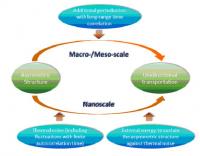 |
| At macro-/meso-scale, an additional perturbation with long-range time correlation is required for unidirectional transport in asymmetric systems. However, at nanoscale, because thermal noise has a significantly long autocorrelation time, unidirectional transport is feasible in asymmetric systems, even in the situation that thermal noise is the only perturbation. In such a situation, extra energy is required to sustain the asymmetry of the system against thermal noise.
Credit: © Science China Press |
Abstract:
Designing machines that can be driven by thermal noise is a dream for scientists. In 1912, Smoluchowski presented a gedankenexperiment consisting of an asymmetric ratchet with a pawl that could harness work from thermal noise but the concept was disproved. In 1997, Kelly et al. experimentally designed a molecule and observed spontaneous unidirectional rotations of the molecule (Angew. Chem. Int. Ed. Engl. 36, 1866 (1997)). Later, in a paper entitled "Tilting at Windmills? The Second Law Survives" Davies argued that this observation did not challenge the second law of thermodynamics because the spontaneous unidirectional rotations happened only within a limited angle (Angew. Chem. Int. Ed. 37, 909 (1998)). In 2007, Fang et al. theoretically proposed a charge-driven molecular water pump, in which water spontaneously flows from one side to the other through a nanochannel with asymmetrically distributed charges that are adjacent to the nanochannel (Nat Nanotechnol. 2, 709 (2007)). This pump has been empirically queried, from the viewpoint of whether the second law of thermodynamics holds. Recently, Professor Fang Haiping and his group from the Shanghai Institute of Applied Physics, Chinese Academy of Sciences theoretically showed that asymmetric transport is feasible in nanoscale systems experiencing thermal noise, without the presence of external fluctuations. The key to this theoretical advance is the recognition that thermal noise, previously considered to be white noise, is not white at the nanoscale, i.e., the autocorrelation time of thermal noise becomes significantly long in nanoscale systems. Their work, entitled "Asymmetric transportation induced by thermal noise at the nanoscale", was published in SCIENCE CHINA Physics, Mechanics & Astronomy.2012, doi: 10.1007/s11433-012-4695-8.
Thermal noise molecular ratchet mechanism found by researchers in the Chinese Academy of Sciences
PR China | Posted on June 15th, 2012Smoluchowski's gedankenexperiment in 1912 is widely considered as the first identifiable contribution to ratchet theory. Later, Feynman recapitulated and extended this device in his lectures (The Feynman Lectures on Physics Vol. 1, Chapter 46). Ratchet theory for meso- and macroscopic systems was established based on this idea, in which long-range time correlation of the perturbation and broken spatial inversion symmetry in the systems are two necessary conditions for biased motion (Europhys. Lett. 28 459 (1994)). In this theory, thermal noise is regarded as white noise, and white noise alone cannot result in biased motion in an asymmetric meso-/macroscopic system.
However, down at the nanoscale, is thermal noise still unable to induce biased motion in asymmetric nanoscale systems, as is the case in meso- or macroscopic systems? If we stick to the traditional ratchet theory, thermal noise alone cannot induce biased motion in asymmetric systems because thermal noise is treated as white noise (zero autocorrelation time). Actually, thermal noise cannot be regarded as white noise for nanoscale systems, because at room temperature, the time duration between two collisions of molecules is on the order of 10 to 100 picoseconds, which, although negligibly small at a meso- or macroscopic view, is significantly large at the nanoscale. Based on a very simple model at nanoscale, Prof. Fang and his group show the feasibility of unidirectional transport in nanoscale systems with thermal noise by considering the finite autocorrelation time of the thermal noise. Although the autocorrelation time of thermal noise has not been measured directly by experiment, they find that the thermal noise in bulk water at room temperature has an autocorrelation time of the order of 10 ps from molecular dynamics (MD) simulations.
Now, one may argue that such a nanoscale system with an asymmetric structure comprises a perpetual motion machine of the second kind, because the biased motion is induced from a single heat bath. Prof. Fang said: "At nanoscale, we cannot keep the asymmetry of the systems against thermal motion without any input of extra energy. This is different from the situation of meso- and macroscopic systems, in which the length scale of the asymmetry is large enough to ignore the thermal motion. Thus, the biased motion driven by the thermal noise in the asymmetric nanoscale systems accompany with the extra energy-input to maintain the asymmetry does not violate the second law of thermodynamics."
This work provides a seminal contribution to the study of the unique behavior of nanoscale systems, which usually have spatial inversion asymmetry. It is expected to be of fundamental importance in the understanding and prediction of the behaviors of nanoscale systems, including molecular motors. The results should be of interest to a wide-ranging community of scientists in the fields of physics, chemistry, biology, and nanotechnologies. However, experiments are called for to determine the distribution of the autocorrelation time of thermal noise and more studies are required on energy transformations in such nanoscale processes.
This research project was partially supported by a grant from the National Natural Science Foundation of China, the Knowledge Innovation Program of the Chinese Academy of Sciences, and the Shanghai Supercomputer Center of China.
See: Wan R Z, Hu J and Fang H P, Asymmetric transportation induced by thermal noise at the nanoscale. SCI CHINA-Phys Mech Astron, 2012, doi: 10.1007/s11433-012-4695-8.
####
For more information, please click here
Contacts:
FANG HaiPing
Copyright © Science in China Press
If you have a comment, please Contact us.Issuers of news releases, not 7th Wave, Inc. or Nanotechnology Now, are solely responsible for the accuracy of the content.
Bookmark:


| Related News Press |
News and information
 Simulating magnetization in a Heisenberg quantum spin chain April 5th, 2024
NRL charters Navy’s quantum inertial navigation path to reduce drift April 5th, 2024
Discovery points path to flash-like memory for storing qubits: Rice find could hasten development of nonvolatile quantum memory April 5th, 2024
Physics
Simulating magnetization in a Heisenberg quantum spin chain April 5th, 2024
Govt.-Legislation/Regulation/Funding/Policy
NRL charters Navy’s quantum inertial navigation path to reduce drift April 5th, 2024
Discovery points path to flash-like memory for storing qubits: Rice find could hasten development of nonvolatile quantum memory April 5th, 2024
Chemical reactions can scramble quantum information as well as black holes April 5th, 2024
Discoveries
Chemical reactions can scramble quantum information as well as black holes April 5th, 2024
New micromaterial releases nanoparticles that selectively destroy cancer cells April 5th, 2024
Utilizing palladium for addressing contact issues of buried oxide thin film transistors April 5th, 2024
Announcements
NRL charters Navy’s quantum inertial navigation path to reduce drift April 5th, 2024
Discovery points path to flash-like memory for storing qubits: Rice find could hasten development of nonvolatile quantum memory April 5th, 2024
 |
||
 |
||
| The latest news from around the world, FREE | ||
 |
||
|
|
||
| Premium Products | ||
 |
||
|
Only the news you want to read!
Learn More |
||
 |
||
|
Full-service, expert consulting
Learn More |
||
|
|
||