Home > Press > Raman Microspectroscopy Now Offered On Many Optical Microscopes by CRAIC Technologies
 |
Abstract:
he CRAIC Apollo™ is designed to add Raman spectroscopy to modern optical microscopes. With the ability to measure Raman spectra of micron-scale samples, the CRAIC Apollo™ is a powerful tool to identify and characterize materials, pharmaceuticals, semiconductors and biological samples.
Raman Microspectroscopy Now Offered On Many Optical Microscopes by CRAIC Technologies
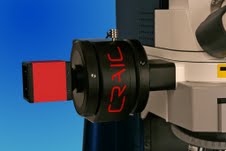
San Dimas, CA | Posted on June 7th, 2012Raman microspectroscopy is a non-destructive technique that allows you to identify and study materials, pharmaceuticals, semiconductors, biological samples and more. CRAIC Technologies has developed the CRAIC Apollo™ Raman microspectrometer to fit to most of the major brands of optical microscopes. The Apollo™ is a powerful solution, allowing you to collect Raman spectra from microscopic samples or microscopic sampling areas of larger samples. Now, with a single microscope you can image your samples and then measure the vibrational spectra of microscopic sample areas without further sample preparation or moving to another instrument. With the introduction of the CRAIC Apollo™ Raman spectrometer, CRAIC Technologies is proud to offer you another powerful tool for sample micro-analysis.
"CRAIC Technologies has been an innovator in the field of UV-visible-NIR microanalysis since its founding. We have helped to advance the field of microscale analysis with innovative instrumentation, software, research and teaching. We have seen the need for Raman microspectroscopy in addition to our current capabilities of UV-visible-NIR and luminescence microspectroscopy. Therefore, we created the CRAIC Apollo™ Raman microspectrometer with the power and flexibility to add to most of the major brands of optical microscopes" states Dr. Paul Martin, President of CRAIC Technologies. "By incorporating Raman spectroscopy with optical microscopes, our customers have a very powerful tool at their disposal. It is also quite easy to use: you can simply analyze the same microscopic area of the sample under the same conditions without additional sample preparation or instrument alignment. Laboratory efficiency, accuracy and sample analysis throughput can therefore be dramatically increased."
The CRAIC Apollo™ Raman spectrometer is a self contained unit that features a cutting edge stabilized laser as an excitation source, a sophisticated optical interface to the microscope, a Raman spectrometer and advanced software for instrument control and data analysis. Different units are designed for use with different wavelength lasers and can be used in conjunction with one another. The idea is to give you a highly flexible Raman microspectrometer using the laser wavelengths you require to enhance your spectroscopic results. These rugged, self-contained units can also be used with a CRAIC Technologies microspectrophotometer. With high sensitivity, durable design, ease-of-use, multiple imaging and spectroscopic techniques and the support of CRAIC Technologies, the CRAIC Apollo™ is more than just a Raman microspectrometer...it is a key component to your analytical solution.
####
About CRAIC Technologies, Inc.
CRAIC Technologies, Inc. is a global technology leader focused on innovations for microscopy and microspectroscopy in the ultraviolet, visible and near-infrared regions. CRAIC Technologies creates cutting-edge solutions, with the very best in customer support, by listening to our customers and implementing solutions that integrate operational excellence and technology expertise. CRAIC Technologies provides answers for customers in forensic sciences, biotechnology, semiconductor, geology, nanotechnology and materials science markets who demand quality, accuracy, precision, speed and the best in customer support.
For more information, please click here
Contacts:
CRAIC Technologies, Inc.
http://www.microspectra.com/
+1-310-573-8180
Copyright © CRAIC Technologies, Inc.
If you have a comment, please Contact us.Issuers of news releases, not 7th Wave, Inc. or Nanotechnology Now, are solely responsible for the accuracy of the content.
Bookmark:


| Related News Press |
News and information
 Simulating magnetization in a Heisenberg quantum spin chain April 5th, 2024
NRL charters Navy’s quantum inertial navigation path to reduce drift April 5th, 2024
Discovery points path to flash-like memory for storing qubits: Rice find could hasten development of nonvolatile quantum memory April 5th, 2024
Imaging
Nanoscale CL thermometry with lanthanide-doped heavy-metal oxide in TEM March 8th, 2024
The USTC realizes In situ electron paramagnetic resonance spectroscopy using single nanodiamond sensors November 3rd, 2023
Observation of left and right at nanoscale with optical force October 6th, 2023
Chip Technology
Discovery points path to flash-like memory for storing qubits: Rice find could hasten development of nonvolatile quantum memory April 5th, 2024
Utilizing palladium for addressing contact issues of buried oxide thin film transistors April 5th, 2024
HKUST researchers develop new integration technique for efficient coupling of III-V and silicon February 16th, 2024
Announcements
NRL charters Navy’s quantum inertial navigation path to reduce drift April 5th, 2024
Discovery points path to flash-like memory for storing qubits: Rice find could hasten development of nonvolatile quantum memory April 5th, 2024
Tools
Ferroelectrically modulate the Fermi level of graphene oxide to enhance SERS response November 3rd, 2023
The USTC realizes In situ electron paramagnetic resonance spectroscopy using single nanodiamond sensors November 3rd, 2023
 |
||
 |
||
| The latest news from around the world, FREE | ||
 |
||
|
|
||
| Premium Products | ||
 |
||
|
Only the news you want to read!
Learn More |
||
 |
||
|
Full-service, expert consulting
Learn More |
||
|
|
||