Home > Press > Chiral asymmetry can emerge from maximal symmetry
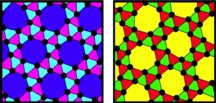 |
| These two patterns are mirror images of each other. To see the difference between them, compare how a row with six triangles connects to one of the hexagonal shapes. A chiral pattern of this kind can occur despite the fact that all particles (dots) are the same type and acting with equal force in all directions. Picture credit: Physical Review Letters: “Chiral Surfaces Self-Assembling in One-Component Systems with Isotropic Interactions”. |
Abstract:
Researchers at Chalmers have shown that maximally symmetric systems of particles can spontaneously produce two different patterns, which are mirror images of each other. The results have been published in the prestigious journal Physical Review Letters - one of four articles from the research group in the same journal within a short period of time. The research group is working towards a mathematical design of self-assembling nanomaterials.
Chiral asymmetry can emerge from maximal symmetry
Gothenburg, Sweden | Posted on June 6th, 2012The Chalmers researchers are working on so-called self-assembling systems. The aim is to calculate how to construct molecular building blocks which, when mixed together, self-assemble into advanced nanomaterials - like pieces of a puzzle that completes itself.
An important property in many chemical and physical systems is something called chirality. Most larger molecules are chiral, which means they exist in two different versions that are mirror images of each other, like our left and right hands. The two versions often produce a completely different effect in, for example, the human body. One well known example of this is the drug thalidomide, where one chiral variation of the active molecule can cause birth defects.
Chirality normally occurs when different types of particle or atoms combine into complex molecules. Researchers at Chalmers have now, however, demonstrated something completely new in the field of physics: chirality can occur spontaneously, even in systems that comprise only a single type of basic, spherically symmetric particle. This means that it doesn't matter how the particles are rotated in relation to one another. The forces acting between the particles depend only on the distance between them.
"Chiral asymmetry can therefore occur spontaneously in a system where the basic condition is maximal symmetry", says Martin Nilsson Jacobi, head of the research group. "This is an important breakthrough in our attempt to develop self-assembling materials. It may also shed new light on the issue of why chirality is so prevalent in nature."
The basis for the discovery is a mathematical method developed by the research group. This method enables them to take any crystal and calculate exactly which forces are required between the particles to form this exact crystal. This is a new technique for designing self-assembling systems, and has also been published in Physical Review Letters.
The majority of researchers in the field use experiments and data simulations to cope with the enormous complexity represented by self-assembling systems. To design the building blocks that lead to a desired structure, the components are gradually altered to try and achieve the correct final result. Chalmers researchers, however, calculate the solution to the design problem in advance.
"We design the building blocks mathematically", says Martin Nilsson Jacobi. "So far, the forces between the particles produced using our methods are too complicated to be implemented in the lab, but we are working to simplify them in various ways."
The group is currently developing analytical methods to construct nanoparticles whose surfaces are covered by molecules in a set pattern. The molecules will enable the particles to combine in exactly the right way to form desired structures.
"Research into material manufacturing is currently focusing increasingly on self-assembling materials", says Martin Nilsson Jacobi. "One source of inspiration is living cells, where self-assembly and self-reparation take place all the time. Incredibly complex molecular machineries are assembled spontaneously, when atoms and molecules attach themselves to one another with different types of bindings."
Researchers across the world are now attempting to emulate these systems, which evolution has created and fine-tuned over millions of years. They can also create wholly new materials with exotic properties which do not occur in nature, so-called metamaterials. Examples are materials that do not propagate sound in certain frequency bands, or materials that do not expand when heated.
####
About Chalmers University of Technology
Chalmers University of Technology performs research and education in technology, science and architecture, with a sustainable future as overall vision. Chalmers is well-known for providing an effective environment for innovation and has eight Areas of Advance – Built Environment, Energy, Information and Communication Technology, Life Science, Materials Science, Nanoscience and Nanotechnology, Production, and Transportation. Situated in Gothenburg, Sweden, Chalmers has 13,000 students and 2,500 employees.
For more information, please click here
Contacts:
Martin Nilsson Jacobi
Professor in Complex systems
Chalmers University of Technology
+46 31-772 31 66
or +46 730-79 58 22
Christian Borg
+46 - (0)31 772 3395
Copyright © AlphaGalileo
If you have a comment, please Contact us.Issuers of news releases, not 7th Wave, Inc. or Nanotechnology Now, are solely responsible for the accuracy of the content.
Bookmark:


| Related Links |
 "Asymmetric Patterns from Symmetric Forces":
"Designer lattices" (joint comments on two articles published in the same journal edition):
| Related News Press |
Physics
Simulating magnetization in a Heisenberg quantum spin chain April 5th, 2024
News and information
Simulating magnetization in a Heisenberg quantum spin chain April 5th, 2024
NRL charters Navy’s quantum inertial navigation path to reduce drift April 5th, 2024
Discovery points path to flash-like memory for storing qubits: Rice find could hasten development of nonvolatile quantum memory April 5th, 2024
Molecular Nanotechnology
Scientists push the boundaries of manipulating light at the submicroscopic level March 3rd, 2023
First electric nanomotor made from DNA material: Synthetic rotary motors at the nanoscale perform mechanical work July 22nd, 2022
Nanotech scientists create world's smallest origami bird March 17th, 2021
Self Assembly
Liquid crystal templated chiral nanomaterials October 14th, 2022
Nanoclusters self-organize into centimeter-scale hierarchical assemblies April 22nd, 2022
Atom by atom: building precise smaller nanoparticles with templates March 4th, 2022
Nanostructures get complex with electron equivalents: Nanoparticles of two different sizes break away from symmetrical designs January 14th, 2022
Discoveries
Chemical reactions can scramble quantum information as well as black holes April 5th, 2024
New micromaterial releases nanoparticles that selectively destroy cancer cells April 5th, 2024
Utilizing palladium for addressing contact issues of buried oxide thin film transistors April 5th, 2024
Materials/Metamaterials/Magnetoresistance
Nanoscale CL thermometry with lanthanide-doped heavy-metal oxide in TEM March 8th, 2024
Focused ion beam technology: A single tool for a wide range of applications January 12th, 2024
Announcements
NRL charters Navy’s quantum inertial navigation path to reduce drift April 5th, 2024
Discovery points path to flash-like memory for storing qubits: Rice find could hasten development of nonvolatile quantum memory April 5th, 2024
 |
||
 |
||
| The latest news from around the world, FREE | ||
 |
||
|
|
||
| Premium Products | ||
 |
||
|
Only the news you want to read!
Learn More |
||
 |
||
|
Full-service, expert consulting
Learn More |
||
|
|
||