Home > Press > BGU Researchers Successfully Test Solar Desalination System for Arid Land Agriculture
 |
Abstract:
Ben-Gurion University of the Negev (BGU) researchers have created a man-made oasis in the desert with the successful application of a solar-powered desalination system that provides water for irrigation in arid regions. The project was made possible with support from American Associates, Ben-Gurion University of the Negev (AABGU).
BGU Researchers Successfully Test Solar Desalination System for Arid Land Agriculture
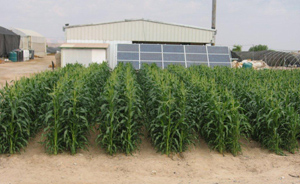
New York, NY | Posted on May 25th, 2012The solar-powered system uses nanofiltration membranes to treat the local brackish (saline) water, resulting in high-quality desalinated irrigation water. The results of the Josefowitz Oasis Project indicate that irrigation with desalinated water yields higher productivity from water and inorganic fertilizers compared with current practices. Crops grown with desalinated water required 25 percent less irrigation and fertilizer than brackish water irrigation. In some cases, the yield of crops increased.
The findings were presented in a paper at the Conference on Desalination for the Environment in Barcelona late last month by Dr. Andrea Ghermandi of BGU's Zuckerberg Institute for Water Research (ZIWR) on behalf of his colleagues Drs. Rami Messalem (ZIWR), Rivka Offenbach, and Shabtai Cohen of the Central Arava Research and Development Station. The Josefowitz Oasis Project was funded by Samuel Josefowitz, of Lausanne, Switzerland with additional support from The Alliance for Global Good, Greensboro, North Carolina through AABGU.
"The growing global demand for food and competition for resources between economic sectors compel future agricultural systems to be more efficient in the use of natural resources, such as land and water," says Dr. Ghermandi. "In the Middle East, the lack of fresh water promotes the exploitation of marginal quality sources such as brackish aquifers, but the sustainability of the current management practices is questionable."
The research was conducted in the Arava Valley of Israel, south of the Dead Sea at a facility that produces environmentally sustainable crops in arid environments. The Arava basin is extremely dry and its agricultural activities rely extensively on brackish groundwater from local aquifers.
Agricultural experiments with variable irrigation water quality, application rate and four different staple crops were conducted over two growing seasons between September 2010 and June 2011. Nanofiltration membranes allowed for less pumping of energy. The desalination plant operated at low pressure, low energy consumption and with little maintenance required during the period.
The researchers also used red beet, a salt-tolerant crop, to successfully consume the liquid wastes of the pilot facility over two growing seasons. This demonstrates that the moderately saline concentrate waste from brackish water desalination can be a useable byproduct.
"The Alliance for Global Good, generously supported by Leonard Kaplan, has been a partner of ours for a year now and is focused on innovation and research to solve global problems," explains AABGU Executive Vice President Doron Krakow. "The Josefowitz Oasis Project has the potential to help quench the thirst of a very parched world."
####
About American Associates, Ben-Gurion University of the Negev
American Associates, Ben-Gurion University of the Negev plays a vital role in sustaining David Ben-Gurion's vision, creating a world-class institution of education and research in the Israeli desert, nurturing the Negev community and sharing the University's expertise locally and around the globe. With some 20,000 students on campuses in Beer-Sheva, Sede Boqer and Eilat in Israel’s southern desert, BGU is a university with a conscience, where the highest academic standards are integrated with community involvement, committed to sustainable development of the Negev.
For more information, please click here
Contacts:
Andrew Lavin
516-944-4486
Copyright © American Associates, Ben-Gurion University of the Negev
If you have a comment, please Contact us.Issuers of news releases, not 7th Wave, Inc. or Nanotechnology Now, are solely responsible for the accuracy of the content.
Bookmark:


| Related News Press |
News and information
 Simulating magnetization in a Heisenberg quantum spin chain April 5th, 2024
NRL charters Navy’s quantum inertial navigation path to reduce drift April 5th, 2024
Discovery points path to flash-like memory for storing qubits: Rice find could hasten development of nonvolatile quantum memory April 5th, 2024
Discoveries
Chemical reactions can scramble quantum information as well as black holes April 5th, 2024
New micromaterial releases nanoparticles that selectively destroy cancer cells April 5th, 2024
Utilizing palladium for addressing contact issues of buried oxide thin film transistors April 5th, 2024
Announcements
NRL charters Navy’s quantum inertial navigation path to reduce drift April 5th, 2024
Discovery points path to flash-like memory for storing qubits: Rice find could hasten development of nonvolatile quantum memory April 5th, 2024
Food/Agriculture/Supplements
Silver nanoparticles: guaranteeing antimicrobial safe-tea November 17th, 2023
Night-time radiative warming using the atmosphere November 17th, 2023
DGIST and New Life Group launched a research project on "Functional beauty and health products using the latest nanotechnology" May 12th, 2023
Water
Taking salt out of the water equation October 7th, 2022
 |
||
 |
||
| The latest news from around the world, FREE | ||
 |
||
|
|
||
| Premium Products | ||
 |
||
|
Only the news you want to read!
Learn More |
||
 |
||
|
Full-service, expert consulting
Learn More |
||
|
|
||