Home > Press > Exotic particles, chilled and trapped, form giant matter wave: Excitons form Bose-Einstein condensate
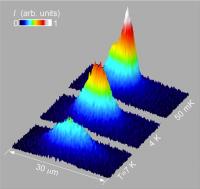 |
| As excitons cool to a fraction of a degree above absolute zero, they condense at the bottom of an electrostatic trap and spontaneously form coherent matter waves. Creating indirect excitons, with electrons and holes in separate layers of a semiconductor, allowed them to persist long enough to cool into this state.
Credit: Butov group/UCSD |
Abstract:
Physicists have trapped and cooled exotic particles called excitons so effectively that they condensed and cohered to form a giant matter wave.
Exotic particles, chilled and trapped, form giant matter wave: Excitons form Bose-Einstein condensate
San Diego, CA | Posted on May 24th, 2012This feat will allow scientists to better study the physical properties of excitons, which exist only fleetingly yet offer promising applications as diverse as efficient harvesting of solar energy and ultrafast computing.
"The realization of the exciton condensate in a trap opens the opportunity to study this interesting state. Traps allow control of the condensate, providing a new way to study fundamental properties of light and matter," said Leonid Butov, professor of physics at the University of California, San Diego. A paper reporting his team's success was recently published in the scientific journal Nano Letters.
Excitons are composite particles made up of an electron and a "hole" left by a missing electron in a semiconductor. Created by light, these coupled pairs exist in nature. The formation and dynamics of excitons play a critical role in photosynthesis, for example.
Like other matter, excitons have a dual nature of both particle and wave, in a quantum mechanical view. The waves are usually unsynchronized, but when particles are cooled enough to condense, their waves synchronize and combine to form a giant matter wave, a state that others have observed for atoms.
Scientists can easily create excitons by shining light on a semiconductor, but in order for the excitons to condense they must be chilled before they recombine.
The key to the team's success was to separate the electrons far enough from their holes so that excitons could last long enough for the scientists to cool them into a condensate. They accomplished this by creating structures called "coupled quantum wells" that separate electrons from holes in different layers of alloys made of gallium, arsenic and aluminum.
Then they set an electrostatic trap made by a diamond-shaped electrode and chilled their special semiconducting material in an optical dilution refrigerator to as cold as 50 milli-Kelvin, just a fraction of a degree above absolute zero.
A laser focused on the surface of the material created excitons, which began to accumulate at the bottom of the trap as they cooled. Below 1 Kelvin, the entire cloud of excitons cohered to form a single matter wave, a signature of a state called a Bose-Einstein condensate.
Other scientists have seen whole atoms do this when confined in a trap and cooled, but this is the first time that scientists have seen subatomic particles form coherent matter waves in a trap.
Varying the size and depth of the trap will alter the coherent exciton state, providing this team, and others, the opportunity to study the properties of light and mater in a new way.
This most recent discovery stems from an ongoing collaboration between Leonid Butov's research group in UC San Diego's Division of Physical Sciences, including Alexander High, Jason Leonard and Mikas Remeika, and Micah Hanson and Arthur Gossard in UC Santa Barbara's Materials Department. The Army Research Office and the National Science Foundation funded the experiments, and the Department of Energy supported the development of spectroscopy in the optical dilution refrigerator, the technique used to observe the exciton condensate in a trap.
####
For more information, please click here
Contacts:
Susan Brown
858-246-0161
Copyright © University of California - San Diego
If you have a comment, please Contact us.Issuers of news releases, not 7th Wave, Inc. or Nanotechnology Now, are solely responsible for the accuracy of the content.
Bookmark:


| Related News Press |
News and information
 Simulating magnetization in a Heisenberg quantum spin chain April 5th, 2024
NRL charters Navy’s quantum inertial navigation path to reduce drift April 5th, 2024
Discovery points path to flash-like memory for storing qubits: Rice find could hasten development of nonvolatile quantum memory April 5th, 2024
Physics
Simulating magnetization in a Heisenberg quantum spin chain April 5th, 2024
Nanoscale CL thermometry with lanthanide-doped heavy-metal oxide in TEM March 8th, 2024
Optically trapped quantum droplets of light can bind together to form macroscopic complexes March 8th, 2024
'Sudden death' of quantum fluctuations defies current theories of superconductivity: Study challenges the conventional wisdom of superconducting quantum transitions January 12th, 2024
Imaging
Nanoscale CL thermometry with lanthanide-doped heavy-metal oxide in TEM March 8th, 2024
Govt.-Legislation/Regulation/Funding/Policy
NRL charters Navy’s quantum inertial navigation path to reduce drift April 5th, 2024
Discovery points path to flash-like memory for storing qubits: Rice find could hasten development of nonvolatile quantum memory April 5th, 2024
Chemical reactions can scramble quantum information as well as black holes April 5th, 2024
Chip Technology
Discovery points path to flash-like memory for storing qubits: Rice find could hasten development of nonvolatile quantum memory April 5th, 2024
Utilizing palladium for addressing contact issues of buried oxide thin film transistors April 5th, 2024
HKUST researchers develop new integration technique for efficient coupling of III-V and silicon February 16th, 2024
Quantum Computing
Simulating magnetization in a Heisenberg quantum spin chain April 5th, 2024
Discovery points path to flash-like memory for storing qubits: Rice find could hasten development of nonvolatile quantum memory April 5th, 2024
With VECSELs towards the quantum internet Fraunhofer: IAF achieves record output power with VECSEL for quantum frequency converters April 5th, 2024
Chemical reactions can scramble quantum information as well as black holes April 5th, 2024
Discoveries
Chemical reactions can scramble quantum information as well as black holes April 5th, 2024
New micromaterial releases nanoparticles that selectively destroy cancer cells April 5th, 2024
Utilizing palladium for addressing contact issues of buried oxide thin film transistors April 5th, 2024
Announcements
NRL charters Navy’s quantum inertial navigation path to reduce drift April 5th, 2024
Discovery points path to flash-like memory for storing qubits: Rice find could hasten development of nonvolatile quantum memory April 5th, 2024
Tools
Ferroelectrically modulate the Fermi level of graphene oxide to enhance SERS response November 3rd, 2023
The USTC realizes In situ electron paramagnetic resonance spectroscopy using single nanodiamond sensors November 3rd, 2023
Military
NRL charters Navy’s quantum inertial navigation path to reduce drift April 5th, 2024
What heat can tell us about battery chemistry: using the Peltier effect to study lithium-ion cells March 8th, 2024
New chip opens door to AI computing at light speed February 16th, 2024
Energy
Development of zinc oxide nanopagoda array photoelectrode: photoelectrochemical water-splitting hydrogen production January 12th, 2024
Shedding light on unique conduction mechanisms in a new type of perovskite oxide November 17th, 2023
Inverted perovskite solar cell breaks 25% efficiency record: Researchers improve cell efficiency using a combination of molecules to address different November 17th, 2023
The efficient perovskite cells with a structured anti-reflective layer – another step towards commercialization on a wider scale October 6th, 2023
Research partnerships
Discovery points path to flash-like memory for storing qubits: Rice find could hasten development of nonvolatile quantum memory April 5th, 2024
Researchers’ approach may protect quantum computers from attacks March 8th, 2024
'Sudden death' of quantum fluctuations defies current theories of superconductivity: Study challenges the conventional wisdom of superconducting quantum transitions January 12th, 2024
Solar/Photovoltaic
Development of zinc oxide nanopagoda array photoelectrode: photoelectrochemical water-splitting hydrogen production January 12th, 2024
Shedding light on unique conduction mechanisms in a new type of perovskite oxide November 17th, 2023
Inverted perovskite solar cell breaks 25% efficiency record: Researchers improve cell efficiency using a combination of molecules to address different November 17th, 2023
Charged “molecular beasts” the basis for new compounds: Researchers at Leipzig University use “aggressive” fragments of molecular ions for chemical synthesis November 3rd, 2023
 |
||
 |
||
| The latest news from around the world, FREE | ||
 |
||
|
|
||
| Premium Products | ||
 |
||
|
Only the news you want to read!
Learn More |
||
 |
||
|
Full-service, expert consulting
Learn More |
||
|
|
||