Home > Press > XEI Scientific reports on how Nanolab uses Evactron® SoftClean™ Chamber for specimen cleaning
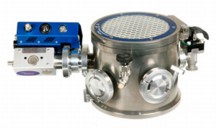 |
| XEI Scientific's new Evactron ® SoftClean™ specimen cleaner for use with the Evactron ® decontamination system. |
Abstract:
XEI Scientific Inc, maker of the popular EVACTRON® De-Contaminator™ Plasma Cleaning System for electron microscopes and other vacuum chambers, announces their new Evactron® SoftClean™ specimen cleaning chamber is being used at Nanolab Technologies.
XEI Scientific reports on how Nanolab uses Evactron® SoftClean™ Chamber for specimen cleaning
Redwood City, CA | Posted on May 23rd, 2012Nanolab Technologies are based in California offering cutting edge technology and expertise for Failure Analysis, Advanced Microscopy and FIB circuit edit services. Comprised of an experienced team of analysts using state of the art equipment, Nanolab delivers guaranteed accuracy and results. They offer both the expertise and technology that is necessary to provide the solutions to the ever-increasing challenges that their clients experience with today's shrinking geometries.
The microscopy group under Vincent Hou provides TEM/STEM imaging and EDS/EELS services. They are continually looking at new ways of improving the quality of services provided to their clients. Nanolab has recently added Evactron® technology from XEI Scientific through the Evactron SoftClean specimen cleaning chamber. This downstream chemical etching system provides a very "gentle" cleaning process.
As noted by Jein Shyue, VP of Technology Development, "we are now able to control contamination without either etching/damaging our samples, in particular, those with polymer fillers."
The Evactron SoftClean System combination is not a "plasma cleaner" in the usual sense. Samples are cleaned by a downstream RF plasma process that breaks down hydrocarbons into CO2, CO & H2O. This gentle process can prevent specimen damage that is typically caused by heat and ion bombardment associated with sputtering of energetic ion species. The delicate downstream process chemically ashes hydrocarbons and pumps them free of the chamber.
XEI has now sold more than 1,300 Evactron systems worldwide solving contamination problems in many different environments using instrumentation such as electron microscopes, FIBs and other vacuum sample chamber set-ups.
####
About XEI Scientific Inc.
XEI Scientific Inc. invented the Evactron De-Contaminator in 1999 as the first plasma cleaner to use a downstream cleaning process to remove carbon from electron microscopes. A proprietary plasma source uses air to produce oxygen radicals for oxidation of carbon compounds for removal by the pumps. Carbon-free-vacuum produces the highest quality images and analytical results from SEMs and other vacuum analytical instruments. XEI innovations include a unique RF plasma generator, a patented RF electrode, and easy start programmed plasma cleaning. All XEI products come with a 5 year warranty and are compliant with CE, NRTL, and Semi-S2 safety standards. XEI offers a variety of Evactron® decontamination systems to meet user needs and has over 1300 installations around the world.
For more information, please click here
Contacts:
XEI Scientific, Inc
1755 E Bayshore Road
Redwood City
CA 94063, USA
T +1 (972) 318-0196
F +1 (650) 363-1659
http://www.evactron.com/
Talking Science Limited
39 de Bohun Court
Saffron Walden
Essex CB10 2BA UK
T +44 (0)1799 521881
M +44 (0)7843 012997
http://www.talking-science.com/
Copyright © XEI Scientific Inc
If you have a comment, please Contact us.Issuers of news releases, not 7th Wave, Inc. or Nanotechnology Now, are solely responsible for the accuracy of the content.
Bookmark:


| Related News Press |
News and information
 Simulating magnetization in a Heisenberg quantum spin chain April 5th, 2024
NRL charters Navy’s quantum inertial navigation path to reduce drift April 5th, 2024
Discovery points path to flash-like memory for storing qubits: Rice find could hasten development of nonvolatile quantum memory April 5th, 2024
Imaging
Nanoscale CL thermometry with lanthanide-doped heavy-metal oxide in TEM March 8th, 2024
The USTC realizes In situ electron paramagnetic resonance spectroscopy using single nanodiamond sensors November 3rd, 2023
Observation of left and right at nanoscale with optical force October 6th, 2023
Tools
Ferroelectrically modulate the Fermi level of graphene oxide to enhance SERS response November 3rd, 2023
The USTC realizes In situ electron paramagnetic resonance spectroscopy using single nanodiamond sensors November 3rd, 2023
Alliances/Trade associations/Partnerships/Distributorships
Chicago Quantum Exchange welcomes six new partners highlighting quantum technology solutions, from Chicago and beyond September 23rd, 2022
University of Illinois Chicago joins Brookhaven Lab's Quantum Center June 10th, 2022
New-Contracts/Sales/Customers
Bruker Light-Sheet Microscopes at Major Comprehensive Cancer Center: New Advanced Imaging Center Powered by Two MuVi and LCS SPIM Microscopes March 25th, 2021
Arrowhead Pharmaceuticals Announces Closing of Agreement with Takeda November 27th, 2020
Veeco Announces Aledia Order of 300mm MOCVD Equipment for microLED Displays: Propel™ Platform First 300mm System with EFEM Designed for Advanced Display Applications October 20th, 2020
GREENWAVES TECHNOLOGIES Announces Next Generation GAP9 Hearables Platform Using GLOBALFOUNDRIES 22FDX Solution October 16th, 2020
 |
||
 |
||
| The latest news from around the world, FREE | ||
 |
||
|
|
||
| Premium Products | ||
 |
||
|
Only the news you want to read!
Learn More |
||
 |
||
|
Full-service, expert consulting
Learn More |
||
|
|
||