Home > Press > Purdue professor to speak before Congress about nanotechnology in brain treatment research
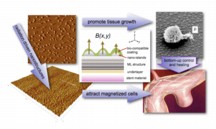 |
| This diagram illustrates the concept behind a new type of "bioactive" coating for stents used to treat brain aneurisms, including those suffered by military personnel from head trauma due to bomb blasts. Portions of the stents - tubular structures made of a metallic mesh - will be designed using coatings to attract magnetized cells to repair blood vessels damaged in trauma. (Purdue University image/Jean Paul Allain) |
Abstract:
Researchers at Purdue University are working with the U.S. Army and neurosurgeons at the Walter Reed National Military Medical Center to create a new type of "bioactive" coating for stents used to treat brain aneurisms including those caused by head trauma from bomb blasts.
Purdue professor to speak before Congress about nanotechnology in brain treatment research
West Lafayette, IN | Posted on May 21st, 2012"Stents coated with a bioactive coating might be inserted at the site of an aneurism to help heal the inside lining of the blood vessel," said Jean Paul Allain, an associate professor of nuclear engineering. "Aneurisms are saclike bulges in blood vessels caused by weakening of artery walls. We're talking about using a regenerative approach, attracting cells to reconstruct the arterial wall."
He will speak before Congress on Thursday (May 24) during the first Brain Mapping Day to discuss the promise of nanotechnology in treating brain injury and disease.
Purdue researchers are working with Col. Rocco Armonda, Dr. Teodoro Tigno and other neurosurgeons at Walter Reed National Military Medical Center in Bethesda, Md. Collaborations also are planned with research scientists from the University of Queensland in Australia, Universidad de Antioquía and Universidad de Los Andes, both in Colombia.
Portions of the stents - tubular structures made of a metallic mesh - will be designed using bioactive coatings to attract magnetized cells to repair blood vessels damaged in trauma.
The stent coatings are modified in a Purdue facility that uses beams of charged particles called ions to modify the stent coatings with a magnetic material. The ion beams also are used to create lifelike or "biomimetic" surface textures designed to promote cellular proliferation and repair damaged vessels, Allain said.
Findings will be detailed in an invited talk to be delivered by Allain during the Ninth Annual World Congress of SBMT on Brain, Spinal Cord Mapping and Image Guide Therapy on June 2-4 in Toronto.
Currently, aneurisms are treated either by performing brain surgery, opening the skull and clipping the sac, or by inserting a catheter through an artery into the brain and implanting a metallic coil into the balloon-like sac.
Both procedures risk major complications, including massive bleeding or the formation of potentially fatal blood clots.
"The survival rate is about 50/50 or worse, and those who do survive could be impaired," said Allain, who holds a courtesy appointment with materials engineering and is affiliated with the Birck Nanotechnology Center in Purdue's Discovery Park.
Cells needed to repair blood vessels are influenced by both the surface texture - features such as bumps and irregular shapes as tiny as 10 nanometers wide - as well as the surface chemistry of the stent materials.
"We are learning how to regulate cell proliferation and growth by tailoring both the function of surface chemistry and topology," Allain said. "There is correlation between surface chemistry and how cells send signals back and forth for proliferation. So the surface needs to be tailored to promote regenerative healing."
The facility being used to irradiate the stents - the Radiation Surface Science and Engineering Laboratory in Purdue's School of Nuclear Engineering - also is used for work aimed at developing linings for experimental nuclear fusion reactors for power generation.
Irradiating materials with the ion beams causes surface features to "self-organize" and also influences the surface chemistry, Allain said.
The stents are made of nonmagnetic materials, such as stainless steel and an alloy of nickel and titanium. Only a certain part of the stents is rendered magnetic to precisely direct the proliferation of cells to repair a blood vessel where it begins bulging to form the aneurism.
Researchers will study the stents using blood from pigs during the first phase in collaboration with the Walter Reed National Military Medical Center.
The stent coating's surface is "functionalized" so that it interacts properly with the blood-vessel tissue. Some of the cells are magnetic naturally, and "magnetic nanoparticles" would be injected into the bloodstream to speed tissue regeneration. Researchers also are aiming to engineer the stents so that they show up in medical imaging to reveal how the coatings hold up in the bloodstream.
The research is led by Allain and co-principal investigator Lisa Reece of the Birck Nanotechnology Center. This effort has spawned new collaborations with researchers around the world including those at Universidad de Antioquía, University of Queensland. The research also involves doctoral students Ravi Kempaiah and Emily Walker.
The work is funded with a three-year, $1.5 million grant from the U.S. Army.
####
For more information, please click here
Contacts:
Writer: Emil Venere
765-494-4709
Source:
Jean Paul Allain
765 496-9718
Copyright © Purdue University
If you have a comment, please Contact us.Issuers of news releases, not 7th Wave, Inc. or Nanotechnology Now, are solely responsible for the accuracy of the content.
Bookmark:


| Related News Press |
News and information
 Simulating magnetization in a Heisenberg quantum spin chain April 5th, 2024
NRL charters Navy’s quantum inertial navigation path to reduce drift April 5th, 2024
Discovery points path to flash-like memory for storing qubits: Rice find could hasten development of nonvolatile quantum memory April 5th, 2024
Govt.-Legislation/Regulation/Funding/Policy
NRL charters Navy’s quantum inertial navigation path to reduce drift April 5th, 2024
Discovery points path to flash-like memory for storing qubits: Rice find could hasten development of nonvolatile quantum memory April 5th, 2024
Chemical reactions can scramble quantum information as well as black holes April 5th, 2024
Nanomedicine
New micromaterial releases nanoparticles that selectively destroy cancer cells April 5th, 2024
Good as gold - improving infectious disease testing with gold nanoparticles April 5th, 2024
Researchers develop artificial building blocks of life March 8th, 2024
Discoveries
Chemical reactions can scramble quantum information as well as black holes April 5th, 2024
New micromaterial releases nanoparticles that selectively destroy cancer cells April 5th, 2024
Utilizing palladium for addressing contact issues of buried oxide thin film transistors April 5th, 2024
Announcements
NRL charters Navy’s quantum inertial navigation path to reduce drift April 5th, 2024
Discovery points path to flash-like memory for storing qubits: Rice find could hasten development of nonvolatile quantum memory April 5th, 2024
Military
NRL charters Navy’s quantum inertial navigation path to reduce drift April 5th, 2024
What heat can tell us about battery chemistry: using the Peltier effect to study lithium-ion cells March 8th, 2024
New chip opens door to AI computing at light speed February 16th, 2024
Events/Classes
Researchers demonstrate co-propagation of quantum and classical signals: Study shows that quantum encryption can be implemented in existing fiber networks January 20th, 2023
 |
||
 |
||
| The latest news from around the world, FREE | ||
 |
||
|
|
||
| Premium Products | ||
 |
||
|
Only the news you want to read!
Learn More |
||
 |
||
|
Full-service, expert consulting
Learn More |
||
|
|
||