Home > Press > New Catalyst for Safe, Reversible Hydrogen Storage: Room-temperature reaction takes place in water; can switch from hydrogen storage to release by changing pH
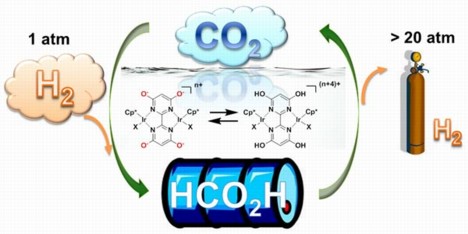 |
| This diagram shows the new catalyst in its protonated and deprotonated states as it reversibly converts hydrogen and CO2 gas to and from liquid formate or formic acid at ambient temperature and pressure. The gases can thereby be stored and transported as a liquid, and used later in carbon-neutral energy applications, simply by adjusting the pH. |
Abstract:
Scientists at the U.S. Department of Energy's (DOE) Brookhaven National Laboratory and collaborators have developed a new catalyst that reversibly converts hydrogen gas and carbon dioxide to a liquid under very mild conditions. The work - described in a paper published online March 18, 2012, in Nature Chemistry - could lead to efficient ways to safely store and transport hydrogen for use as an alternative fuel.
New Catalyst for Safe, Reversible Hydrogen Storage: Room-temperature reaction takes place in water; can switch from hydrogen storage to release by changing pH
Upton, NY | Posted on March 19th, 2012Hydrogen is seen as an attractive fuel because it can efficiently be converted to energy without producing toxic products or greenhouse gases. However, the storage and transportation of hydrogen remain more problematic than for liquid hydrocarbon fuels. The new work builds on earlier efforts to combine hydrogen with carbon dioxide to produce a liquid formic acid solution that can be transported using the same kind of infrastructure used to transport gasoline and oil.
"This is not the first catalyst capable of carrying out this reaction, but it is the first to work at room temperature, in an aqueous (water) solution, under atmospheric pressure - and that is capable of running the reaction in forward or reverse directions depending on the acidity of the solution," said Brookhaven chemist Etsuko Fujita, who oversaw Brookhaven's contributions to this research.
"When the release of hydrogen is desired for use in fuel cells or other applications, one can simply flip the 'pH switch' on the catalyst to run the reaction in reverse," said Brookhaven chemist James Muckerman, a co-author on the study. He noted that the liquid formic acid might also be used directly in a formic-acid fuel cell.
Collaborator Yuichiro Himeda of the National Institute of Advanced Industrial Science and Technology (AIST) of Japan had been making substantial progress toward the goal of developing this type of catalyst for a number of years. He used iridium metal complexes containing aromatic diimine ligands (groups of atoms bound to the metal) with pendent, peripheral hydroxyl (OH) groups that can serve as acidic sites that release protons to become pendent bases.
Himeda recently entered into collaboration - via the U.S.-Japan Collaboration on Clean Energy Technology program - with Fujita, Muckerman, and Jonathan Hull (a Goldhaber Fellow working on Fujita's team). The Brookhaven group carried out coordinated experimental and theoretical studies to understand the sequence of chemical steps by which these catalysts converted H2 and CO2 into formic acid. Their goal was to design new catalysts with improved performance.
The Brookhaven team's key idea came from Nature: "We were inspired by the way hydrogen bonds and bases relay protons in the active sites of some enzymes," Hull said.
"Good catalysts efficiently move protons and electrons around, taking them from some molecules and placing them onto others to produce the desired product," he explained. "Nature has many ways of doing this. Under the right conditions, the hydroxyl groups on the diimine ligand of the catalyst help hydrogen react with carbon dioxide, which is difficult to do. We thought we could improve the reactivity by placing the pendent bases near the metal centers, rather than in peripheral positions."
Once the Brookhaven team understood how Himeda's catalysts worked, Hull realized that a novel ligand that had been synthesized by collaborators Brian Hashiguchi and Roy Periana of The Scripps Research Institute for an entirely different purpose would possibly be ideal for accomplishing this goal. The Brookhaven group designed a new iridium metal catalyst incorporating this new ligand.
Collaborator David Szalda of Baruch College (City University of New York) determined the atomic level crystal structure of the new catalyst to "see" how the arrangement of its atoms might explain its function.
Tests of the new catalyst revealed superior catalytic performance for storing and releasing H2 under very mild reaction conditions. For the reaction combining CO2 with H2, the scientists observed high turnovers at room temperature and ambient pressure; for the catalytic decomposition of formic acid to release hydrogen, the catalytic rate was faster than any previous report.
"We were able to convert a 1:1 mixture of H2 and CO2 to formate (the deprotonated form of formic acid) at room temperature, successfully regenerate H2, and then repeat the cycle. It's a design principle we are very fortunate to have found," said Hull.
The regenerated high-pressure gas mixture (hydrogen and carbon dioxide) is quite pure; importantly, no carbon monoxide (CO) - an impurity that can 'poison' fuel cells and thus reduce their lifetime - was detected. Therefore, this method of storing and regenerating hydrogen might have a use in hydrogen fuel cells.
Further efforts to optimize the hydrogen storage process are ongoing using several catalysts with the same design principle.
"This is a wonderful example of how fundamental research can lead to the understanding and control of factors that contribute to the solution of technologically important problems," Muckerman concluded.
This research was funded by the DOE Office of Science, a Goldhaber Distinguished Fellowship, and by the Japanese Ministry of Economy, Trade, and Industry.
DOE's Office of Science is the single largest supporter of basic research in the physical sciences in the United States, and is working to address some of the most pressing challenges of our time. For more information, please visit science.energy.gov.
####
About Brookhaven National Laboratory
One of ten national laboratories overseen and primarily funded by the Office of Science of the U.S. Department of Energy (DOE), Brookhaven National Laboratory conducts research in the physical, biomedical, and environmental sciences, as well as in energy technologies and national security. Brookhaven Lab also builds and operates major scientific facilities available to university, industry and government researchers. Brookhaven is operated and managed for DOE's Office of Science by Brookhaven Science Associates, a limited-liability company founded by the Research Foundation of State University of New York on behalf of Stony Brook University, the largest academic user of Laboratory facilities, and Battelle, a nonprofit, applied science and technology organization.
For more information, please click here
Contacts:
Karen McNulty Walsh
(631) 344-8350
or
Peter Genzer
(631) 344-3174
Copyright © Brookhaven National Laboratory
If you have a comment, please Contact us.Issuers of news releases, not 7th Wave, Inc. or Nanotechnology Now, are solely responsible for the accuracy of the content.
Bookmark:


| Related Links |
| Related News Press |
News and information
 Simulating magnetization in a Heisenberg quantum spin chain April 5th, 2024
NRL charters Navy’s quantum inertial navigation path to reduce drift April 5th, 2024
Discovery points path to flash-like memory for storing qubits: Rice find could hasten development of nonvolatile quantum memory April 5th, 2024
Chemistry
What heat can tell us about battery chemistry: using the Peltier effect to study lithium-ion cells March 8th, 2024
Nanoscale CL thermometry with lanthanide-doped heavy-metal oxide in TEM March 8th, 2024
Focused ion beam technology: A single tool for a wide range of applications January 12th, 2024
Laboratories
A battery’s hopping ions remember where they’ve been: Seen in atomic detail, the seemingly smooth flow of ions through a battery’s electrolyte is surprisingly complicated February 16th, 2024
NRL discovers two-dimensional waveguides February 16th, 2024
Govt.-Legislation/Regulation/Funding/Policy
NRL charters Navy’s quantum inertial navigation path to reduce drift April 5th, 2024
Discovery points path to flash-like memory for storing qubits: Rice find could hasten development of nonvolatile quantum memory April 5th, 2024
Chemical reactions can scramble quantum information as well as black holes April 5th, 2024
Discoveries
Chemical reactions can scramble quantum information as well as black holes April 5th, 2024
New micromaterial releases nanoparticles that selectively destroy cancer cells April 5th, 2024
Utilizing palladium for addressing contact issues of buried oxide thin film transistors April 5th, 2024
Announcements
NRL charters Navy’s quantum inertial navigation path to reduce drift April 5th, 2024
Discovery points path to flash-like memory for storing qubits: Rice find could hasten development of nonvolatile quantum memory April 5th, 2024
Energy
Development of zinc oxide nanopagoda array photoelectrode: photoelectrochemical water-splitting hydrogen production January 12th, 2024
Shedding light on unique conduction mechanisms in a new type of perovskite oxide November 17th, 2023
Inverted perovskite solar cell breaks 25% efficiency record: Researchers improve cell efficiency using a combination of molecules to address different November 17th, 2023
The efficient perovskite cells with a structured anti-reflective layer – another step towards commercialization on a wider scale October 6th, 2023
 |
||
 |
||
| The latest news from around the world, FREE | ||
 |
||
|
|
||
| Premium Products | ||
 |
||
|
Only the news you want to read!
Learn More |
||
 |
||
|
Full-service, expert consulting
Learn More |
||
|
|
||