Home > Press > Thinking Big about Small-Scale Research: Advanced Materials Special Issue featuring the International Center for Materials Nanoarchitectonics
 |
Abstract:
"Nano-" has been a buzzword, or rather "buzz-prefix", in materials science for almost 20 years now. Indeed, it is rare to find a chemistry/physics/engineering research unit without some members dedicated to the study of making and manipulating objects on an atomic or molecular scale. But sometimes the investigation of things so small is best carried out using a large-scale approach. The Japanese Government certainly thought so, and when it formed the International Center for Materials Nanoarchitectonics (WPI-MANA, www.nims.go.jp/mana/) in 2007 it created "one of the most successful research ventures ever initiated", according to Harry Kroto, Nobel Laureate and Advisor to MANA.
Thinking Big about Small-Scale Research: Advanced Materials Special Issue featuring the International Center for Materials Nanoarchitectonics
Weinheim, Germany | Posted on January 4th, 2012According to Director General Masakazu Aono, MANA's aim is to combine nanotechnology and materials science to "produce cutting-edge research by promoting the participation of leading scientists from around the world and by providing an attractive research environment." The extremely high quality of the research and the global nature of the scientists involved are both evident in recent results from MANA which have now been published together in a special issue of Advanced Materials.
MANA hosts over 200 research scientists, with almost half coming from outside Japan.
According to Aono, in order to fully develop the potential of the science called nanotechnology, the end results must be greater than the sum of the constituent parts - the tiny objects must interact in such a way as to create entirely new properties or functionalities. "We coined the term nanoarchitectonics to express this innovation of nanotechnology: it is a technology system aimed at arranging nanoscale structural units - a group of atoms, molecules, or nanoscale functional components - into a configuration that creates a novel functionality through mutual interactions among those units."
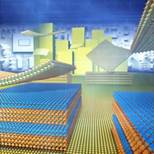
Various techniques are used to arrange the objects, including self-organization and the use of external fields, such as electric or magnetic. The approach can be likened to constructing a house, different materials are designed and arranged carefully to create a complex and useful object. The cover picture above illustrates this comparison, with the new building that is being constructed to house MANA shown with a molecular assembly; both macroscopic architecture and nano-architecture are shown.
MANA scientists do not make houses, but design and construct a broad range of other useful systems. From sensors to catalysts to brain-like electronic circuits, MANA scientists see the tremendous potential for using nanotechnology.
In addition to the research papers listed below, the issue includes as a bonus Nobel Laureate and MANA Advisor Heinrich Rohrer offering his insights on the relationship between society and science and some advice for researchers in an editorial. You can also discover why Kroto thinks so highly of MANA.
The breadth of research is illustrated in the papers presented. Some titles are abbreviated and the "Nano-Fields" are those used in MANA:
Nano-Materials papers:2D Dielectric nanosheets: novel nanoelectronics from nanocrystal building blocks (M.Osada and T. Sasaki), Mechanical control of nanomaterials and nanosystems (K. Ariga et al.), Nanoengineering and property studies in a transmission electron microscope (D .Goldberg et al.), Self-powered nanosensors and nanosystems (Z. L. Wang).
Nano-Systems papers: Atomic switches - atom/ion movement controlled devices for beyond-von Neumann computers (T. Hasegawa et al.), Emergent criticality in Turing B-type atomic switch networks (A.Z. Steig, et al.) Half-metallic antiferromagnets as a prospective materials for spintronics (X. Hu et al.), Composite particles: superconductor/semiconductor/superconductor junctions (R. Inoue and H. Takayanagi), Self-assembly of semiconductors for solution-based organic field-effect transistor fabrication (T. Minariet al.), Designs of molecular logic gates (C. Joachim et al.).
Nano-Green papers: Nanophotocatalytic materials (H. Tong et al.), Solid-oxide fuel cells (E. Fabbri et al.), Molecular catalysts (T. Masuda et al.).
Nano-Bio papers: Shape-Memory Surface with Dynamically Tuneable Nano-Geometry Activated by Body Heat (M. Ebara et al.).
Advanced Materials, Volume 24, Issue 2. The special issue is available at doi.wiley.com/10.1002/adma.v24.2 or on MaterialsViews.com.
Guest Editors:
Masakazu Aono (Director General):
Yoshio Bando (Chief Operating Officer):
Katsuhiko Ariga (Principal Investigator):
International Center for Materials Nanoarchitectonics (WPI-MANA)
National Institute of Materials Science (NIMS)
1-1 Namiki, Tsukuba, Ibaraki 305-0044 Japan
####
For more information, please click here
Contacts:
Carmen Teutsch
Editor & Press coordinator
Materials Science and Physics Journals
Wiley-VCH
Boschstrasse 12
69469 Weinheim, Germany
Email:
Phone: +49 6201-606-238
Fax: +49 6201-606-510
Full text: onlinelibrary.wiley.com
Copyright © Wiley-VCH Materials Science Journals
If you have a comment, please Contact us.Issuers of news releases, not 7th Wave, Inc. or Nanotechnology Now, are solely responsible for the accuracy of the content.
Bookmark:


| Related News Press |
News and information
 Simulating magnetization in a Heisenberg quantum spin chain April 5th, 2024
NRL charters Navy’s quantum inertial navigation path to reduce drift April 5th, 2024
Discovery points path to flash-like memory for storing qubits: Rice find could hasten development of nonvolatile quantum memory April 5th, 2024
Chemistry
What heat can tell us about battery chemistry: using the Peltier effect to study lithium-ion cells March 8th, 2024
Nanoscale CL thermometry with lanthanide-doped heavy-metal oxide in TEM March 8th, 2024
Spintronics
Quantum materials: Electron spin measured for the first time June 9th, 2023
Linearly assembled Ag-Cu nanoclusters: Spin transfer and distance-dependent spin coupling November 4th, 2022
Chip Technology
Discovery points path to flash-like memory for storing qubits: Rice find could hasten development of nonvolatile quantum memory April 5th, 2024
Utilizing palladium for addressing contact issues of buried oxide thin film transistors April 5th, 2024
HKUST researchers develop new integration technique for efficient coupling of III-V and silicon February 16th, 2024
Self Assembly
Liquid crystal templated chiral nanomaterials October 14th, 2022
Nanoclusters self-organize into centimeter-scale hierarchical assemblies April 22nd, 2022
Atom by atom: building precise smaller nanoparticles with templates March 4th, 2022
Nanostructures get complex with electron equivalents: Nanoparticles of two different sizes break away from symmetrical designs January 14th, 2022
Sensors
Materials/Metamaterials/Magnetoresistance
Nanoscale CL thermometry with lanthanide-doped heavy-metal oxide in TEM March 8th, 2024
Focused ion beam technology: A single tool for a wide range of applications January 12th, 2024
Announcements
NRL charters Navy’s quantum inertial navigation path to reduce drift April 5th, 2024
Discovery points path to flash-like memory for storing qubits: Rice find could hasten development of nonvolatile quantum memory April 5th, 2024
Energy
Development of zinc oxide nanopagoda array photoelectrode: photoelectrochemical water-splitting hydrogen production January 12th, 2024
Shedding light on unique conduction mechanisms in a new type of perovskite oxide November 17th, 2023
Inverted perovskite solar cell breaks 25% efficiency record: Researchers improve cell efficiency using a combination of molecules to address different November 17th, 2023
The efficient perovskite cells with a structured anti-reflective layer – another step towards commercialization on a wider scale October 6th, 2023
Fuel Cells
Current and Future Developments in Nanomaterials and Carbon Nanotubes: Applications of Nanomaterials in Energy Storage and Electronics October 28th, 2022
 |
||
 |
||
| The latest news from around the world, FREE | ||
 |
||
|
|
||
| Premium Products | ||
 |
||
|
Only the news you want to read!
Learn More |
||
 |
||
|
Full-service, expert consulting
Learn More |
||
|
|
||