Home > Press > Prototype NIST Device Measures Absolute Optical Power in Fiber at Nanowatt Levels
 |
Abstract:
Researchers at the National Institute of Standards and Technology (NIST) have demonstrated a prototype device capable of absolute measurements of optical power delivered through an optical fiber.
Prototype NIST Device Measures Absolute Optical Power in Fiber at Nanowatt Levels
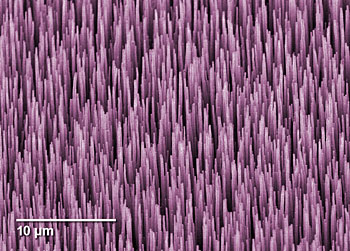
Boulder, CO | Posted on December 21st, 2011The device is the world's first fiber-coupled cryogenic radiometer that links optical fiber power measurements directly to fundamental electrical units and national standards. It uses a microscopic forest of carbon nanotubes—the world's darkest material—to measure values that are about one-thousandth of the levels typically attained with a cryogenic radiometer lacking direct fiber input capability.* With improvements in temperature control and speed, the device could meet the needs for ultraprecise calibrations at ultralow power in telecommunications, medical devices and other industries.
Optical power and energy are traceable to fundamental electrical units. Radiometers absorb optical energy and convert it to heat. Then the electrical power needed to induce the same temperature increase is measured. Because optical and electrical heating are not exactly equivalent, measurement uncertainties can be relatively large from a metrology point of view.
The demonstration is also a step toward converting radiometry from a classical practice based on electrical units to a quantum practice based on single particles of light (photons).
"We have many customers who request optical power measurements in fiber, mainly for optical communications," project leader John Lehman says. "Also, our single-photon measurements are done in fiber."
The new radiometer is about 70 millimeters (mm) long and incorporates a 1.45-mm-thick optical fiber capped by a light-trapping cavity at one end with the nanotube absorber and a heater. The ultra-dark nanotubes** are grown on a tiny X-shaped piece of micromachined silicon. Light absorption was so high it was difficult to determine measurement uncertainties; Lehman travelled to a special facility at the National Physical Laboratory (the British equivalent of NIST) to make some measurements.
Experiments and calculations indicate the new radiometer can measure a power level of 10 nanowatts with an uncertainty of 0.1 percent. By comparison, typical measurements of optical power delivered through fiber have an uncertainty of 3 percent or more at similar power levels. More importantly, these commercial devices rely on a series of calibrations to establish traceability to national standards.
NIST aims to develop an absolute quantum standard for optical power and energy based on single photons. The effort includes development of sources and detectors spanning a wide range of optical power measurements, from single photon counts to trillions of photons. Single photons are already used in quantum communications systems, which offer novel capabilities such as detecting extremely weak optical signals and providing quantum guarantees on security.
* D. Livigni, N. Tomlin, C.L. Cromer and J.H. Lehman. Fiber-coupled cryogenic radiometer with carbon nanotube absorber. Paper presented at 11th International Conference on New Developments and Applications in Optical Radiometry (NEWRAD 2011), Maui, Hawaii, Sept. 19-23, 2011.
D.J. Livigni, N.A. Tomlin, C.L. Cromer and J.H. Lehman. Optical fiber-coupled cryogenic radiometer with carbon nanotube absorber. Metrologia. Forthcoming.
####
About NIST
The National Institute of Standards and Technology (NIST) is an agency of the U.S. Department of Commerce.
For more information, please click here
Contacts:
Laura Ost
303-497-4880
Copyright © NIST
If you have a comment, please Contact us.Issuers of news releases, not 7th Wave, Inc. or Nanotechnology Now, are solely responsible for the accuracy of the content.
Bookmark:


| Related News Press |
News and information
 Simulating magnetization in a Heisenberg quantum spin chain April 5th, 2024
NRL charters Navy’s quantum inertial navigation path to reduce drift April 5th, 2024
Discovery points path to flash-like memory for storing qubits: Rice find could hasten development of nonvolatile quantum memory April 5th, 2024
Laboratories
A battery’s hopping ions remember where they’ve been: Seen in atomic detail, the seemingly smooth flow of ions through a battery’s electrolyte is surprisingly complicated February 16th, 2024
NRL discovers two-dimensional waveguides February 16th, 2024
Three-pronged approach discerns qualities of quantum spin liquids November 17th, 2023
Govt.-Legislation/Regulation/Funding/Policy
NRL charters Navy’s quantum inertial navigation path to reduce drift April 5th, 2024
Discovery points path to flash-like memory for storing qubits: Rice find could hasten development of nonvolatile quantum memory April 5th, 2024
Chemical reactions can scramble quantum information as well as black holes April 5th, 2024
Nanotubes/Buckyballs/Fullerenes/Nanorods/Nanostrings
Tests find no free-standing nanotubes released from tire tread wear September 8th, 2023
Detection of bacteria and viruses with fluorescent nanotubes July 21st, 2023
Discoveries
Chemical reactions can scramble quantum information as well as black holes April 5th, 2024
New micromaterial releases nanoparticles that selectively destroy cancer cells April 5th, 2024
Utilizing palladium for addressing contact issues of buried oxide thin film transistors April 5th, 2024
Announcements
NRL charters Navy’s quantum inertial navigation path to reduce drift April 5th, 2024
Discovery points path to flash-like memory for storing qubits: Rice find could hasten development of nonvolatile quantum memory April 5th, 2024
Tools
Ferroelectrically modulate the Fermi level of graphene oxide to enhance SERS response November 3rd, 2023
The USTC realizes In situ electron paramagnetic resonance spectroscopy using single nanodiamond sensors November 3rd, 2023
Photonics/Optics/Lasers
With VECSELs towards the quantum internet Fraunhofer: IAF achieves record output power with VECSEL for quantum frequency converters April 5th, 2024
Nanoscale CL thermometry with lanthanide-doped heavy-metal oxide in TEM March 8th, 2024
Optically trapped quantum droplets of light can bind together to form macroscopic complexes March 8th, 2024
HKUST researchers develop new integration technique for efficient coupling of III-V and silicon February 16th, 2024
 |
||
 |
||
| The latest news from around the world, FREE | ||
 |
||
|
|
||
| Premium Products | ||
 |
||
|
Only the news you want to read!
Learn More |
||
 |
||
|
Full-service, expert consulting
Learn More |
||
|
|
||