Home > Press > New material can enhance energy, computer, lighting technologies: Crystal erbium compound offers superior optical properties
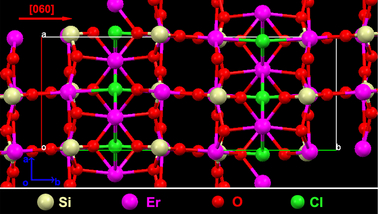 |
| The image, called a “ball-and-stick modal,” illustrates the crystal structure of the new erbium crystal compound developed at ASU’s Nanophotonics Lab. The four different colors represent the four elements that were combined to produce the new material. |
Abstract:
Arizona State University researchers have created a new compound crystal material that promises to help produce advances in a range of scientific and technological pursuits.
New material can enhance energy, computer, lighting technologies: Crystal erbium compound offers superior optical properties
Tempe, AZ | Posted on November 25th, 2011Cun-Zheng Ning, an electrical engineering professor at ASU, says the material, called erbium chloride silicate, can be used to develop the next generations of computers, improve the capabilities of the Internet, increase the efficiency of silicon-based photovoltaic cells to convert sunlight into electrical energy, and enhance the quality of solid-state lighting and sensor technology.
Ning's research team of team of students and post-doctoral degree assistants help synthesize the new compound in ASU's Nanophotonics Lab in the School of Electrical, Computer and Energy Engineering, one of the university's Ira A. Fulton Schools of Engineering.
The lab's erbium research is supported by the U.S. Army Research Office and U.S. Air Force Office of Scientific Research. Details about the new compound are reported in the Optical Materials Express on the website of the Optical Society of America.
The breakthrough involves the first-ever synthesis of a new erbium compound in the form of a single-crystal nanowire, which has superior properties compared to erbium compounds in other forms.
Erbium is one of the most important members of the rare earth family in the periodic table of chemical elements. It emits photons in the wavelength range of 1.5 micrometers, which are used in the optical fibers essential to high-quality performance of the Internet and telephones.
Erbium is used in doping optical fibers to amplify the signal of the Internet and telephones in telecommunications systems. Doping is the term used to describe the process of inserting low concentrations of various elements into other substances as a way to alter the electrical or optical properties of the substances to produce desired results. The elements used in such processes are referred to as dopants.
"Since we could not dope as many erbium atoms in a fiber as we wish, fibers had to be very long to be useful for amplifying an Internet signal. This makes integrating Internet communications and computing on a chip very difficult," Ning explains.
"With the new erbium compound, 1,000 times more erbium atoms are contained in the compound. This means many devices can be integrated into a chip-scale system," he says. "Thus the new compound materials containing erbium can be integrated with silicon to combine computing and communication functionalities on the same inexpensive silicon platform to increase the speed of computing and Internet operation at the same time."
Erbium materials can also be used to increase the energy-conversion efficiency of silicon solar cells.
Silicon does not absorb solar radiation with wavelengths longer than 1.1 microns, which results in waste of energy - making solar cells less efficient.
Erbium materials can remedy the situation by converting two or more photons carrying small amounts of energy into one photon that is carrying a larger amount of energy. The single, more powerful photon can then be absorbed by silicon, thus increasing the efficiency of solar cells.
Erbium materials also help absorb ultraviolet light from the sun and convert it into photons carrying small amounts of energy, which can then be more efficiently converted into electricity by silicon cells. This color-conversion function of turning ultraviolet light into other visible colors of light is also important in generating white light for solid-state lighting devices.
While erbium's importance is well-recognized, producing erbium materials of high quality has been challenging, Ning says.
The standard approach is to introduce erbium as a dopant into various host materials, such as silicon oxide, silicon, and many other crystals and glasses.
"One big problem has been that we have not been able to introduce enough erbium atoms into crystals and glasses without degrading optical quality, because too many of these kinds of dopants would cluster, which lowers the optical quality," he says.
What is unique about the new erbium material synthesized by Ning's group is that erbium is no longer randomly introduced as a dopant. Instead, erbium is part of a uniform compound and the number of erbium atoms is a factor of 1,000 more than the maximum amount that can be introduced in other erbium-doped materials.
Increasing the number of erbium atoms provides more optical activity to produce stronger lighting. It also enhances the conversion of different colors of light into white light to produce higher-quality solid-state lighting and enables solar cells to more efficiently convert sunlight in electrical energy.
In addition, since erbium atoms are organized in a periodic array, they do not cluster in this new compound. The fact that the material has been produced in a high-quality single-crystal form makes the optical quality superior to the other doped materials, Ning says.
Like many scientific discoveries, the synthesis of this new erbium material was made somewhat by accident.
"Similar to what other researchers are doing, we were originally trying to dope erbium into silicon nanowires. But the characteristics demonstrated by the material surprised us," he says. "We got a new material. We did not know what it was, and there was no published document that described it. It took us more than a year to finally realize we got a new single-crystal material no one else had produced."
Ning and his team are now trying to use the new erbium compound for various applications, such as increasing silicon solar cell efficiency and making miniaturized optical amplifiers for chip-scale photonic systems for computers and high-speed Internet.
"Most importantly," he says, "there are many things we have yet to learn about what can be achieved with use of the material. Our preliminary studies of its characteristics show it has many amazing properties and superior optical quality. More exciting discoveries are waiting to be made."
####
For more information, please click here
Contacts:
Joe Kullman
(480) 965-8122
Ira A. Fulton Schools of Engineering
Copyright © Arizona State University
If you have a comment, please Contact us.Issuers of news releases, not 7th Wave, Inc. or Nanotechnology Now, are solely responsible for the accuracy of the content.
Bookmark:


| Related Links |
 Learn more about Ning's nanophotonics group:
| Related News Press |
News and information
Simulating magnetization in a Heisenberg quantum spin chain April 5th, 2024
NRL charters Navy’s quantum inertial navigation path to reduce drift April 5th, 2024
Discovery points path to flash-like memory for storing qubits: Rice find could hasten development of nonvolatile quantum memory April 5th, 2024
Chip Technology
Discovery points path to flash-like memory for storing qubits: Rice find could hasten development of nonvolatile quantum memory April 5th, 2024
Utilizing palladium for addressing contact issues of buried oxide thin film transistors April 5th, 2024
HKUST researchers develop new integration technique for efficient coupling of III-V and silicon February 16th, 2024
Discoveries
Chemical reactions can scramble quantum information as well as black holes April 5th, 2024
New micromaterial releases nanoparticles that selectively destroy cancer cells April 5th, 2024
Utilizing palladium for addressing contact issues of buried oxide thin film transistors April 5th, 2024
Materials/Metamaterials/Magnetoresistance
Nanoscale CL thermometry with lanthanide-doped heavy-metal oxide in TEM March 8th, 2024
Focused ion beam technology: A single tool for a wide range of applications January 12th, 2024
Announcements
NRL charters Navy’s quantum inertial navigation path to reduce drift April 5th, 2024
Discovery points path to flash-like memory for storing qubits: Rice find could hasten development of nonvolatile quantum memory April 5th, 2024
Photonics/Optics/Lasers
With VECSELs towards the quantum internet Fraunhofer: IAF achieves record output power with VECSEL for quantum frequency converters April 5th, 2024
Nanoscale CL thermometry with lanthanide-doped heavy-metal oxide in TEM March 8th, 2024
Optically trapped quantum droplets of light can bind together to form macroscopic complexes March 8th, 2024
HKUST researchers develop new integration technique for efficient coupling of III-V and silicon February 16th, 2024
 |
||
 |
||
| The latest news from around the world, FREE | ||
 |
||
|
|
||
| Premium Products | ||
 |
||
|
Only the news you want to read!
Learn More |
||
 |
||
|
Full-service, expert consulting
Learn More |
||
|
|
||