Home > Press > Nanotech key to sustainability for UQ Scopus award winner
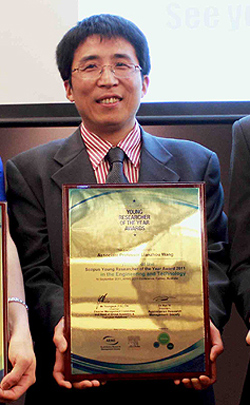 |
| Scopus Young Researcher of the Year Award recipient Associate Professor Wang |
Abstract:
The University of Queensland's Associate Professor Lianzhou Wang has won a Scopus Young Researcher of the Year Award for his work on new nanomaterials for efficient solar energy conversion technology.
Nanotech key to sustainability for UQ Scopus award winner
Brisbane, Australia | Posted on September 22nd, 2011Associate Professor Wang joined finalists in Sydney this week for the award announcements and took out the category for Engineering and Technology.
His research is expected to have a profound impact on the use of nanomaterials in improving sustainability in applications such as water and air purification, solar cells, self-cleaning coatings and hydrogen production from solar energy.
Associate Professor Wang, from UQ's School of Chemical Engineering and the ARC Centre of Excellence for Functional Nanomaterials, is the first academic from UQ to receive an award of this kind.
"It is extremely humbling to receive this award in recognition of the research I have undertaken," Associate Professor Wang said.
"I hope to further my research within the sustainable energy industry."
The Scopus Young Researcher Awards recognise researchers under the age of 40 who have undertaken an outstanding research project at an Australian university.
Associate Professor Wang received the award for developing a new strategy to design highly visible-light active nanomaterials, which underpin many important applications such as water and air purification, new generation solar cells, self-cleaning coatings and hydrogen production from water splitting through use of abundant solar energy.
The research conducted by Associate Professor Wang and his team focuses on synthesis, characterisation and applications of functional nanomaterials - through which a number of significant contributions to clean and renewable energy conversion systems have been made.
Executive Dean of the Faculty of Engineering, Architecture and Information Technology (EAIT), Professor Graham Schaffer, congratulated Associate Professor Wang on his achievement.
"It is very exciting to see Associate Professor Wang be rewarded for his high-quality research," he said.
"The award is a true reflection of his work's significance in the sustainable energy sector."
####
For more information, please click here
Contacts:
Media:
Associate Professor
Lianzhou Wang
+61 7 33654218
or
Madelene Flanagan
+61 7 3365 8525
Copyright © University of Queensland
If you have a comment, please Contact us.Issuers of news releases, not 7th Wave, Inc. or Nanotechnology Now, are solely responsible for the accuracy of the content.
Bookmark:


| Related News Press |
News and information
 Simulating magnetization in a Heisenberg quantum spin chain April 5th, 2024
NRL charters Navy’s quantum inertial navigation path to reduce drift April 5th, 2024
Discovery points path to flash-like memory for storing qubits: Rice find could hasten development of nonvolatile quantum memory April 5th, 2024
Academic/Education
Rice University launches Rice Synthetic Biology Institute to improve lives January 12th, 2024
Multi-institution, $4.6 million NSF grant to fund nanotechnology training September 9th, 2022
Announcements
NRL charters Navy’s quantum inertial navigation path to reduce drift April 5th, 2024
Discovery points path to flash-like memory for storing qubits: Rice find could hasten development of nonvolatile quantum memory April 5th, 2024
Energy
Development of zinc oxide nanopagoda array photoelectrode: photoelectrochemical water-splitting hydrogen production January 12th, 2024
Shedding light on unique conduction mechanisms in a new type of perovskite oxide November 17th, 2023
Inverted perovskite solar cell breaks 25% efficiency record: Researchers improve cell efficiency using a combination of molecules to address different November 17th, 2023
The efficient perovskite cells with a structured anti-reflective layer – another step towards commercialization on a wider scale October 6th, 2023
Grants/Sponsored Research/Awards/Scholarships/Gifts/Contests/Honors/Records
Discovery points path to flash-like memory for storing qubits: Rice find could hasten development of nonvolatile quantum memory April 5th, 2024
Chemical reactions can scramble quantum information as well as black holes April 5th, 2024
Solar/Photovoltaic
Development of zinc oxide nanopagoda array photoelectrode: photoelectrochemical water-splitting hydrogen production January 12th, 2024
Shedding light on unique conduction mechanisms in a new type of perovskite oxide November 17th, 2023
Inverted perovskite solar cell breaks 25% efficiency record: Researchers improve cell efficiency using a combination of molecules to address different November 17th, 2023
Charged “molecular beasts” the basis for new compounds: Researchers at Leipzig University use “aggressive” fragments of molecular ions for chemical synthesis November 3rd, 2023
 |
||
 |
||
| The latest news from around the world, FREE | ||
 |
||
|
|
||
| Premium Products | ||
 |
||
|
Only the news you want to read!
Learn More |
||
 |
||
|
Full-service, expert consulting
Learn More |
||
|
|
||