Home > Press > First to use microfluidization for cassava starch modification
 |
Abstract:
Researchers at National Nanotechnology Center (NANOTEC) have discovered that using microfluidization has an effect on the structure and thermal properties of cassava starch-water suspension (20% w/w).
First to use microfluidization for cassava starch modification
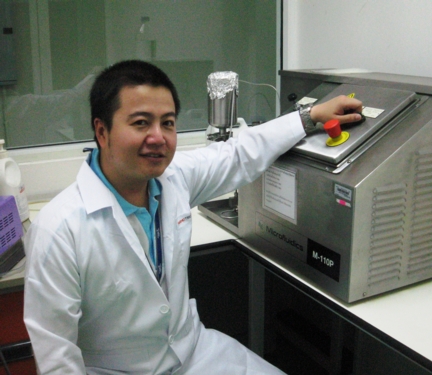
Pathumthani, Thailand | Posted on July 8th, 2011"This is the first time that anyone has ever used microfluidization for cassava starch modification" said Dr. Kittiwut Kasemwong, researcher at NANOTEC Nano-Delivery Lab. "After using the microfluidization treatment, we noticed bigger starch granule was partially gelatinized, and a gel-like structure was formed on a granular surface. Our investigation indicates that high- pressure microfluidization process induce the gelatinization process which is crucial for granule swelling and water access".
This discovery has many application potentials in the food and drug industry. According to the Thai Board of Investment (BOI), the Thai food industry generates about $15 billion dollars annually and comprises about 30% of GDP. As for the drug industry, it is estimated that by 2016 Thailand will have the seventh largest pharmaceutical market in the Asia Pacific region.
Collaborators on this investigation included researchers from Srinakharinwirot University and Kasetsart University. The researchers reported their investigation in a paper published by Starch - Starke.
####
For more information, please click here
Contacts:
Ramjitti Indaraprasirt
Manager
International Relations Section
NANOTEC
02-564-7100 ext: 6617
Copyright © NANOTEC
If you have a comment, please Contact us.Issuers of news releases, not 7th Wave, Inc. or Nanotechnology Now, are solely responsible for the accuracy of the content.
Bookmark:


| Related News Press |
News and information
 Simulating magnetization in a Heisenberg quantum spin chain April 5th, 2024
NRL charters Navy’s quantum inertial navigation path to reduce drift April 5th, 2024
Discovery points path to flash-like memory for storing qubits: Rice find could hasten development of nonvolatile quantum memory April 5th, 2024
Discoveries
Chemical reactions can scramble quantum information as well as black holes April 5th, 2024
New micromaterial releases nanoparticles that selectively destroy cancer cells April 5th, 2024
Utilizing palladium for addressing contact issues of buried oxide thin film transistors April 5th, 2024
Announcements
NRL charters Navy’s quantum inertial navigation path to reduce drift April 5th, 2024
Discovery points path to flash-like memory for storing qubits: Rice find could hasten development of nonvolatile quantum memory April 5th, 2024
Food/Agriculture/Supplements
Silver nanoparticles: guaranteeing antimicrobial safe-tea November 17th, 2023
Night-time radiative warming using the atmosphere November 17th, 2023
DGIST and New Life Group launched a research project on "Functional beauty and health products using the latest nanotechnology" May 12th, 2023
 |
||
 |
||
| The latest news from around the world, FREE | ||
 |
||
|
|
||
| Premium Products | ||
 |
||
|
Only the news you want to read!
Learn More |
||
 |
||
|
Full-service, expert consulting
Learn More |
||
|
|
||