Home > Press > Penn Researchers Break Light-Matter Coupling Strength Limit in Nanoscale Semiconductors
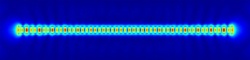 |
| A computer simulation of a one-dimensional cavity wave in a 200nm nanowire |
Abstract:
New engineering research at the University of Pennsylvania demonstrates that polaritons have increased coupling strength when confined to nanoscale semiconductors. This represents a promising advance in the field of photonics: smaller and faster circuits that use light rather than electricity.
Penn Researchers Break Light-Matter Coupling Strength Limit in Nanoscale Semiconductors
Philadelphia, PA | Posted on June 16th, 2011The research was conducted by assistant professor Ritesh Agarwal, postdoctoral fellow Lambert van Vugt and graduate student Brian Piccione of the Department of Materials Science and Engineering in Penn's School of Engineering and Applied Science. Chang-Hee Cho and Pavan Nukala, also of the Materials Science department, contributed to the study.
Their work was published in the journal Proceedings of the National Academy of Sciences.
Polaritons are quasiparticles, combinations of physical particles and the energy they contribute to a system that can be measured and tracked as a single unit. Polaritons are combinations of photons and another quasiparticle, excitons. Together, they have qualities of both light and electric charge, without being fully either.
"An exciton is a combination of a an electron, which has negative charge and an electron hole, which has a positive charge. Light is an oscillating electro-magnetic field, so it can couple with the excitons," Agarwal said. "When their frequencies match, they can talk to one another; both of their oscillations become more pronounced."
High light-matter coupling strength is a key factor in designing photonic devices, which would use light instead of electricity and thus be faster and use less power than comparable electronic devices. However, the coupling strength exhibited within bulk semiconductors had always been thought of as a fixed property of the material they were made of.
Agarwal's team proved that, with the proper fabrication and finishing techniques, this limit can be broken.
"When you go from bulk sizes to one micron, the light-matter coupling strength is pretty constant," Agarwal said. "But, if you try to go below 500 nanometers or so, what we have shown is that this coupling strength increases dramatically."
The difference is a function of one of nanotechnology's principle phenomena: the traits of a bulk material are different than structures of the same material on the nanoscale.
"When you're working at bigger sizes, the surface is not as important. The surface to volume ratio — the number of atoms on the surface divided by the number of atoms in the whole material — is a very small number," Agarwal said. "But when you make a very small structure, say 100 nanometers, this number is dramatically increased. Then what is happening on the surface critically determines the device's properties."
Other researchers have tried to make polariton cavities on this small a scale, but the chemical etching method used to fabricate the devices damages the semiconductor surface. The defects on the surface trap the excitons and render them useless.
"Our cadmium sulfide nanowires are self-assembled; we don't etch them. But the surface quality was still a limiting factor, so we developed techniques of surface passivation. We grew a silicon oxide shell on the surface of the wires and greatly improved their optical properties," Agarwal said.
The oxide shell fills the electrical gaps in the nanowire surface, preventing the excitons from getting trapped.
"We also developed tools and techniques for measuring this light-matter coupling strength," Piccione said. "We've quantified the light-matter coupling strength, so we can show that it's enhanced in the smaller structures,"
Being able to quantify this increased coupling strength opens the door for designing nanophotonic circuit elements and devices.
"The stronger you can make light-matter coupling, the better you can make photonic switches," Agarwal said. "Electrical transistors work because electrons care what other electrons are doing, but, on their own, photons do not interact with each other. You need to combine optical properties with material properties to make it work"
This research was supported by the Netherlands Organization for Scientific Research Rubicon Programme, the U.S. Army Research Office, the National Science Foundation, Penn's Nano/Bio Interface Center and the National Institutes of Health.
####
For more information, please click here
Contacts:
Media Contact:
Evan Lerner
215-573-6604
Copyright © University of Pennsylvania
If you have a comment, please Contact us.Issuers of news releases, not 7th Wave, Inc. or Nanotechnology Now, are solely responsible for the accuracy of the content.
Bookmark:


| Related News Press |
News and information
 Simulating magnetization in a Heisenberg quantum spin chain April 5th, 2024
NRL charters Navy’s quantum inertial navigation path to reduce drift April 5th, 2024
Discovery points path to flash-like memory for storing qubits: Rice find could hasten development of nonvolatile quantum memory April 5th, 2024
Govt.-Legislation/Regulation/Funding/Policy
NRL charters Navy’s quantum inertial navigation path to reduce drift April 5th, 2024
Discovery points path to flash-like memory for storing qubits: Rice find could hasten development of nonvolatile quantum memory April 5th, 2024
Chemical reactions can scramble quantum information as well as black holes April 5th, 2024
Possible Futures
Discovery points path to flash-like memory for storing qubits: Rice find could hasten development of nonvolatile quantum memory April 5th, 2024
With VECSELs towards the quantum internet Fraunhofer: IAF achieves record output power with VECSEL for quantum frequency converters April 5th, 2024
Academic/Education
Rice University launches Rice Synthetic Biology Institute to improve lives January 12th, 2024
Multi-institution, $4.6 million NSF grant to fund nanotechnology training September 9th, 2022
Self Assembly
Liquid crystal templated chiral nanomaterials October 14th, 2022
Nanoclusters self-organize into centimeter-scale hierarchical assemblies April 22nd, 2022
Atom by atom: building precise smaller nanoparticles with templates March 4th, 2022
Nanostructures get complex with electron equivalents: Nanoparticles of two different sizes break away from symmetrical designs January 14th, 2022
Nanoelectronics
Interdisciplinary: Rice team tackles the future of semiconductors Multiferroics could be the key to ultralow-energy computing October 6th, 2023
Key element for a scalable quantum computer: Physicists from Forschungszentrum Jülich and RWTH Aachen University demonstrate electron transport on a quantum chip September 23rd, 2022
Reduced power consumption in semiconductor devices September 23rd, 2022
Atomic level deposition to extend Moore’s law and beyond July 15th, 2022
Discoveries
Chemical reactions can scramble quantum information as well as black holes April 5th, 2024
New micromaterial releases nanoparticles that selectively destroy cancer cells April 5th, 2024
Utilizing palladium for addressing contact issues of buried oxide thin film transistors April 5th, 2024
Photonics/Optics/Lasers
With VECSELs towards the quantum internet Fraunhofer: IAF achieves record output power with VECSEL for quantum frequency converters April 5th, 2024
Nanoscale CL thermometry with lanthanide-doped heavy-metal oxide in TEM March 8th, 2024
Optically trapped quantum droplets of light can bind together to form macroscopic complexes March 8th, 2024
HKUST researchers develop new integration technique for efficient coupling of III-V and silicon February 16th, 2024
 |
||
 |
||
| The latest news from around the world, FREE | ||
 |
||
|
|
||
| Premium Products | ||
 |
||
|
Only the news you want to read!
Learn More |
||
 |
||
|
Full-service, expert consulting
Learn More |
||
|
|
||