Home > Press > Top journal announces highlighted “hot paper” on AFM-IR research by Anasys scientific advisor, Alexandre Dazzi, and co-workers from the Université de Paris-Sud
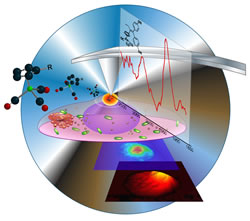 |
| Schematic representation of AFM-IR as described by Dazzi and his colleagues in Angew. Chemie. |
Abstract:
Anasys Instruments is pleased to report the publication and highlighting of a "hot paper" from a group of leading French scientists in the leading scientific journal, Angewandte Chemie. The paper address a molecular mapping challenge using the exciting technique of AFM-IR, the combination of an atomic force microscope (AFM) and IR spectroscopy.
Top journal announces highlighted “hot paper” on AFM-IR research by Anasys scientific advisor, Alexandre Dazzi, and co-workers from the Université de Paris-Sud
Santa Barbara, CA | Posted on May 17th, 2011The mapping of molecules inside cells is a contemporary challenge that requires both high sensitivity and sub-micron resolution. IR-spectroscopy is valuable for chemical imaging. In the case of vibrational excitation in the IR, no photobleaching is induced in contrast to what is observed with organic fluorophores in the visible or UV range. The diffraction limit restricts optical resolution in the IR to over 5 μm. The paper describes how this challenge was overcome using thermal rather than optical detection.
The AFM-IR technique was developed by Dr. Alexandre Dazzi at the University of Paris-Sud. It uses an AFM-tip in contact mode with an object as the IR absorbance detector. This breakthrough technique made it possible for this consortium of chemists, physicists and cell biologists to localize a rhenium-carbonyl complex inside cells after a 1h-incubation at 10 μL. They have also localized the nucleus using its own IR-signature without any trackers and shown that the molecule is localized inside the nucleus.
Dr. Dazzi's research has been at the core of the Anasys nanoIR system. Potential nanoIR application areas include polymer blends, multilayer films and laminates, organic defect analysis, tissue morphology and histology, subcellular spectroscopy, and organic photovoltaics. For further details, please see the application notes at the Anasys website (www.anasysinstruments.com/nano_IR_spectroscopy.php?fi=applications#apn).
Reference: Subcellular Imaging in the mid-IR of a Metal-Carbonyl Moiety using Photothermal Induced Resonance, Clotilde Policar, Jenny-Birgitta Waern, Marie-Aude Plamont, Sylvain Clède, Céline Mayet, Rui Prazeres, Jaan-Michel Ortega, Anne Vessières, Alexandre Dazzi, Angew. Chemie, Int. Ed., 2011, 860.
####
About Anasys Instruments Corporation
Anasys Instruments is dedicated to delivering innovative products and solutions that measure material properties for samples with spatially varying physical and chemical properties at the micro and nanoscale. The Santa Barbara, California-based company has already pioneered two major material property measurement breakthroughs: nanoscale IR Spectroscopy and nanoscale thermal analysis.
For more information, please click here
Contacts:
Anasys Instruments Corporation
121 Gray Avenue, Suite 100
Santa Barbara, CA 93101
USA
T +1 (805) 730 3310
F +1 (805) 730 3300
www.anasysinstruments.com
NetDyaLog Limited
39 de Bohun Court
Saffron Walden
Essex CB10 2BA
T +44 (0) 1799 521881
www.netdyalog.com
Copyright © Anasys Instruments Corporation
If you have a comment, please Contact us.Issuers of news releases, not 7th Wave, Inc. or Nanotechnology Now, are solely responsible for the accuracy of the content.
Bookmark:


| Related News Press |
News and information
 Simulating magnetization in a Heisenberg quantum spin chain April 5th, 2024
NRL charters Navy’s quantum inertial navigation path to reduce drift April 5th, 2024
Discovery points path to flash-like memory for storing qubits: Rice find could hasten development of nonvolatile quantum memory April 5th, 2024
Imaging
Nanoscale CL thermometry with lanthanide-doped heavy-metal oxide in TEM March 8th, 2024
The USTC realizes In situ electron paramagnetic resonance spectroscopy using single nanodiamond sensors November 3rd, 2023
Observation of left and right at nanoscale with optical force October 6th, 2023
Announcements
NRL charters Navy’s quantum inertial navigation path to reduce drift April 5th, 2024
Discovery points path to flash-like memory for storing qubits: Rice find could hasten development of nonvolatile quantum memory April 5th, 2024
Interviews/Book Reviews/Essays/Reports/Podcasts/Journals/White papers/Posters
Simulating magnetization in a Heisenberg quantum spin chain April 5th, 2024
Discovery points path to flash-like memory for storing qubits: Rice find could hasten development of nonvolatile quantum memory April 5th, 2024
Tools
Ferroelectrically modulate the Fermi level of graphene oxide to enhance SERS response November 3rd, 2023
The USTC realizes In situ electron paramagnetic resonance spectroscopy using single nanodiamond sensors November 3rd, 2023
Grants/Sponsored Research/Awards/Scholarships/Gifts/Contests/Honors/Records
Discovery points path to flash-like memory for storing qubits: Rice find could hasten development of nonvolatile quantum memory April 5th, 2024
Chemical reactions can scramble quantum information as well as black holes April 5th, 2024
 |
||
 |
||
| The latest news from around the world, FREE | ||
 |
||
|
|
||
| Premium Products | ||
 |
||
|
Only the news you want to read!
Learn More |
||
 |
||
|
Full-service, expert consulting
Learn More |
||
|
|
||