Home > Press > Bill & Melinda Gates Foundation funds Portuguese researcher to develop an innovative therapy against HIV/AIDS
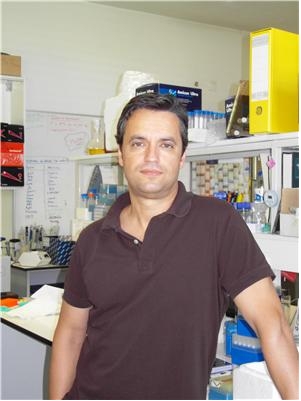 |
| João Gonçalves, Lisbon, Portugal |
Abstract:
João Gonçalves, from Faculdade de Farmácia e Instituto de Medicina Molecular, Lisbon, Portugal, to win a Grand Challenges Exploration Award.
Bill & Melinda Gates Foundation funds Portuguese researcher to develop an innovative therapy against HIV/AIDS
Lisbon, Portugal | Posted on April 30th, 2011Portuguese researcher João Gonçalves is to receive a Grand Challenges Exploration Grants from the Bill & Melinda Gates Foundation. João Gonçalves is Professor at Faculdade de Farmácia de Lisboa and researcher at Instituto de Medicina Molecular in Lisbon, Portugal, and will develop therapeutic nanoparticles to eliminate HIV-1 viruses from infected organisms.
Gonçalves' project Nanotechnology against viral latency: Sensor strategies to eliminate HIV-1 infected cells is one of the 88 grants announced by the Gates Foundation in the sixth funding round of Grand Challenges Explorations, an initiative to help scientists around the world explore bold and largely unproven ways to improve health in developing countries. The initiative is highly competitive, receiving more than 2500 proposals in this round.
HIV-1 virus can remain latent inside infected organisms for several years, integrated in the genome of certain cell types of the immune system, such as T lymphocytes. Presently, it is not know any form to eradicate HIV-1 viruses from infected individuals. The Portuguese researcher and his team at Faculdade de Farmácia / Instituto de Medicina Molecular in Lisbon, Portugal, will now design and develop therapeutic nanoparticles aimed at specifically recognizing - and destroying - HIV-1 infected cells (where the virus has integrated the cells' genome).
These nanoparticles will have two essential molecules: antibodies to specifically recognize the cell types where latent HIV-1 viruses integrate the genome; and a DNA portion encoding information for the production of a toxin which will destroy cells containing HIV-1 viruses. The nanoparticles will be designed in such a way that the toxin production will only be triggered inside cells that actually contain HIV-1 viruses integrated in the genome.
Thus, the therapeutic nanoparticles will target specifically the cell types that HVI-1 viruses infect (due to the action of the specific antibody); and trigger solely the destruction of those cells that actually host HVI-1 viruses (through activation of the toxin production).
Says João Gonçalves, "We are very proud to receive this award. It will allow us to pursue an out-of-the-box, bold approach to fight HIV/AIDS infection, something that is seldom funded by traditional funding schemes. This award also shows that science in Portugal is recognized internationally and that it can be a trigger for the country's development."
"GCE winners are expanding the pipeline of ideas for serious global health and development challenges where creative thinking is most urgently needed. These grants are meant to spur on new discoveries that could ultimately save millions of lives," said Chris Wilson, director of Global Health Discovery at the Bill & Melinda Gates Foundation.
The project will develop two parallel strategies to construct the therapeutic nanoparticles and will have funding of USD 100,000 during 12 months. This is a basic research project, developed in the laboratory, with the possibility of further funding of up to USD 1million, if the research project demonstrates initial success. In this eventual second phase, the nanoparticles will be produced in large scale and efficacy and security tests will be developed.
João Gonçalves is the second resercher from Instituto de Medicina Molecular to be funded by Bill & Melinda gates Foundation. In 2010, Miguel Prudêncio won Grand Challenges Exploration funding to develop a vaccine against malária.
####
For more information, please click here
Contacts:
Marta Agostinho
+351217999411
Copyright © AlphaGalileo
If you have a comment, please Contact us.Issuers of news releases, not 7th Wave, Inc. or Nanotechnology Now, are solely responsible for the accuracy of the content.
Bookmark:


| Related News Press |
News and information
 Simulating magnetization in a Heisenberg quantum spin chain April 5th, 2024
NRL charters Navy’s quantum inertial navigation path to reduce drift April 5th, 2024
Discovery points path to flash-like memory for storing qubits: Rice find could hasten development of nonvolatile quantum memory April 5th, 2024
Nanomedicine
New micromaterial releases nanoparticles that selectively destroy cancer cells April 5th, 2024
Good as gold - improving infectious disease testing with gold nanoparticles April 5th, 2024
Researchers develop artificial building blocks of life March 8th, 2024
Announcements
NRL charters Navy’s quantum inertial navigation path to reduce drift April 5th, 2024
Discovery points path to flash-like memory for storing qubits: Rice find could hasten development of nonvolatile quantum memory April 5th, 2024
Grants/Sponsored Research/Awards/Scholarships/Gifts/Contests/Honors/Records
Discovery points path to flash-like memory for storing qubits: Rice find could hasten development of nonvolatile quantum memory April 5th, 2024
Chemical reactions can scramble quantum information as well as black holes April 5th, 2024
 |
||
 |
||
| The latest news from around the world, FREE | ||
 |
||
|
|
||
| Premium Products | ||
 |
||
|
Only the news you want to read!
Learn More |
||
 |
||
|
Full-service, expert consulting
Learn More |
||
|
|
||