Home > Press > Vortices get organized: Exotic entities that arrange into a crystalline structure at near room-temperature could lead to a new approach to electronic memory
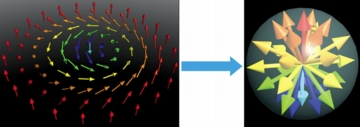 |
| Figure 1: In a skyrmion (left) the electron spins, represented as arrows about which the electrons are rotating, are arranged such they map onto the surface of a sphere (right). Reproduced in part from Ref. 1 © 2011 X. Z. Yu et al. |
Abstract:
A crystal consisting not of atoms but exotic swirling magnetic entities, called skyrmions, has been identified at near room-temperature by Yoshinori Tokura of the RIKEN Advanced Science Institute, Wako, and his colleagues from several other institutes in Japan1. Previous observations of a skyrmion crystal state, in transition-metal-silicide materials, have been at cryogenic temperatures below 40 kelvin. The existence of skyrmions at room temperature improves the practicality of harnessing their potential for use in novel computer memories.
Vortices get organized: Exotic entities that arrange into a crystalline structure at near room-temperature could lead to a new approach to electronic memory
Wako, Japan | Posted on February 26th, 2011Skyrmions are formed on some surfaces when the spins of the electrons—think of an arrow about which each electron rotates—collectively arrange such that they wrap around the surface of a sphere (Fig. 1). This pattern spirals in such a way that the spins on the outside point up whereas those at the core point down. This collection of spins can display many properties associated with a single particle. "A skyrmion crystal is the periodic array of these particle-like entities," explains Tokura.
Earlier neutron-scattering experiments by other researchers identified this unusual effect in both iron-cobalt silicide and manganese silicide. Tokura and his team, however, investigated skyrmions in iron germanium. This alloy has the same cubic atomic crystal structure as iron-cobalt silicide and manganese silicide—the two materials in which skyrmions have been observed at low temperatures; but it remains in the necessary magnetic structure up to a much higher temperature.
Using a transmission electron microscope, the researchers probed the magnetization on the surface of polished layers of the iron-germanium alloy. They found tell-tale signs of skyrmions at temperatures up to 260 kelvin, particularly when they applied a small magnetic field perpendicularly to the surface.
This material also provides an excellent opportunity to investigate the stability of the skyrmion crystal, the team notes. Previous studies focused on very thin layers of material. Tokura and his team investigated the influence of film thickness and found that for thicknesses greater than the distance between skyrmions, about 75 nanometers in this case, the skyrmion crystal state is suppressed and a more conventional ferromagnetic phase starts to dominate.
Skyrmions could play an important role in the development of spintronics—using electron spin to carry information in the same way that electron charge is used in conventional electronics. "Skyrmion crystals could also be applied in memory and logic devices," says Tokura. The advantage over conventional systems is that control is achieved using electric, rather than magnetic fields, which is known to be more efficient.
The corresponding author for this highlight is based at the Emergent Materials Department, RIKEN Advanced Science Institute
####
About Riken Research
RIKEN is one of Japan's largest research organizations with institutes and centers in locations throughout Japan. RIKEN's 3000+ researchers publish several hundred research articles in top scientific and technical journals every year across a broad spectrum of disciplines in physics, chemistry, biology, medicine, engineering and in many areas of technology, and the number of articles is growing year on year.
For more information, please click here
Contacts:
2-1 Hirosawa
Wako, Saitama 351-0198 Japan
+81-(0)48-462-1111
Copyright © Riken Research
If you have a comment, please Contact us.Issuers of news releases, not 7th Wave, Inc. or Nanotechnology Now, are solely responsible for the accuracy of the content.
Bookmark:


| Related Links |
| Related News Press |
News and information
 Simulating magnetization in a Heisenberg quantum spin chain April 5th, 2024
NRL charters Navy’s quantum inertial navigation path to reduce drift April 5th, 2024
Discovery points path to flash-like memory for storing qubits: Rice find could hasten development of nonvolatile quantum memory April 5th, 2024
Laboratories
A battery’s hopping ions remember where they’ve been: Seen in atomic detail, the seemingly smooth flow of ions through a battery’s electrolyte is surprisingly complicated February 16th, 2024
NRL discovers two-dimensional waveguides February 16th, 2024
Three-pronged approach discerns qualities of quantum spin liquids November 17th, 2023
Memory Technology
Utilizing palladium for addressing contact issues of buried oxide thin film transistors April 5th, 2024
Interdisciplinary: Rice team tackles the future of semiconductors Multiferroics could be the key to ultralow-energy computing October 6th, 2023
Researchers discover materials exhibiting huge magnetoresistance June 9th, 2023
Self Assembly
Liquid crystal templated chiral nanomaterials October 14th, 2022
Nanoclusters self-organize into centimeter-scale hierarchical assemblies April 22nd, 2022
Atom by atom: building precise smaller nanoparticles with templates March 4th, 2022
Nanostructures get complex with electron equivalents: Nanoparticles of two different sizes break away from symmetrical designs January 14th, 2022
Discoveries
Chemical reactions can scramble quantum information as well as black holes April 5th, 2024
New micromaterial releases nanoparticles that selectively destroy cancer cells April 5th, 2024
Utilizing palladium for addressing contact issues of buried oxide thin film transistors April 5th, 2024
Announcements
NRL charters Navy’s quantum inertial navigation path to reduce drift April 5th, 2024
Discovery points path to flash-like memory for storing qubits: Rice find could hasten development of nonvolatile quantum memory April 5th, 2024
 |
||
 |
||
| The latest news from around the world, FREE | ||
 |
||
|
|
||
| Premium Products | ||
 |
||
|
Only the news you want to read!
Learn More |
||
 |
||
|
Full-service, expert consulting
Learn More |
||
|
|
||