Home > Press > Grant winner plans new spin on liquid crystals
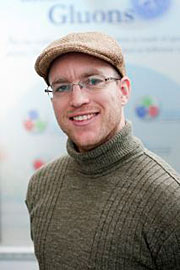 |
| Mark Dalton |
Abstract:
Liquid crystals, used widely in LCD televisions and computer monitors, may play a prominent role in a device being designed by a University of Virginia researcher, who was recently named the recipient of the 2011 JSA Postdoctoral Research Grant at DOE's Jefferson Lab.
Grant winner plans new spin on liquid crystals
Newport News, VA | Posted on February 8th, 2011Mark Dalton, a research associate at UVa, plans to use the $11,000 JSA grant to develop a so-called Kerr cell. The cell, which may include liquid crystals, will be used in a system to produce spinning electrons for a future experiment to be conducted at Jefferson Lab.
"It feels good; it's exciting. I think the work needs to be done, and I'm glad to have the opportunity to do it. And it's nice to be the master of the destiny of the project," Dalton said.
Dalton, who earned his B.S. and Ph.D. at the University of the Witwatersrand in Johannesburg, South Africa, was selected by the Users Group Board of Directors, the governing body of the group that represents scientists who use Jefferson Lab facilities to conduct nuclear physics research. In making the award, the board judged each applicant on his or her record of accomplishment in physics, proposed use of the research grant and the likelihood of further accomplishments in the Jefferson Lab research fields.
Dalton is designing the Kerr cell for what is known as the MOLLER experiment. The experiment will require the delivery of a polarized electron beam - one in which the spins of the electrons are mostly aligned in one direction. The experimenters must also be able to flip that polarization more rapidly and cleanly than the current equipment allows, which is the purpose of the Kerr cell.
"Kerr cells aren't commercially available, so we have to build one," Dalton explained. "It would be a chamber, and inside would be a gas or a liquid, such as liquid crystals, and there would be clear windows on either side, so that the light can get in and out."
Dalton said he'll spend the next year designing and building a prototype of the cell for testing.
####
For more information, please click here
Copyright © Jefferson Lab
If you have a comment, please Contact us.Issuers of news releases, not 7th Wave, Inc. or Nanotechnology Now, are solely responsible for the accuracy of the content.
Bookmark:


| Related News Press |
News and information
 Simulating magnetization in a Heisenberg quantum spin chain April 5th, 2024
NRL charters Navy’s quantum inertial navigation path to reduce drift April 5th, 2024
Discovery points path to flash-like memory for storing qubits: Rice find could hasten development of nonvolatile quantum memory April 5th, 2024
Good as gold - improving infectious disease testing with gold nanoparticles April 5th, 2024
Display technology/LEDs/SS Lighting/OLEDs
Utilizing palladium for addressing contact issues of buried oxide thin film transistors April 5th, 2024
Light guide plate based on perovskite nanocomposites November 3rd, 2023
Simple ballpoint pen can write custom LEDs August 11th, 2023
Academic/Education
Rice University launches Rice Synthetic Biology Institute to improve lives January 12th, 2024
Multi-institution, $4.6 million NSF grant to fund nanotechnology training September 9th, 2022
Spintronics
Quantum materials: Electron spin measured for the first time June 9th, 2023
Linearly assembled Ag-Cu nanoclusters: Spin transfer and distance-dependent spin coupling November 4th, 2022
Announcements
NRL charters Navy’s quantum inertial navigation path to reduce drift April 5th, 2024
Discovery points path to flash-like memory for storing qubits: Rice find could hasten development of nonvolatile quantum memory April 5th, 2024
Grants/Sponsored Research/Awards/Scholarships/Gifts/Contests/Honors/Records
Discovery points path to flash-like memory for storing qubits: Rice find could hasten development of nonvolatile quantum memory April 5th, 2024
Chemical reactions can scramble quantum information as well as black holes April 5th, 2024
 |
||
 |
||
| The latest news from around the world, FREE | ||
 |
||
|
|
||
| Premium Products | ||
 |
||
|
Only the news you want to read!
Learn More |
||
 |
||
|
Full-service, expert consulting
Learn More |
||
|
|
||