Home > Press > Grain orientation boosts thermoelectric performance
 |
| The peak dimensionless thermoelectric figure-of-merit (ZT) of Bi2Te3-based n-type single crystals is about 0.85 in the ab plane at room temperature, which has not been improved over the last 50 years due to the high thermal conductivity of 1.65 W m−1 K−1 even though the power factor is 47 × 10−4 W m−1 K−2. Credit Nano Letters |
Abstract:
Thermoelectric materials promise everything from clean power for cars to clean power from the sun, but making these materials widely useful has been a challenge.
Grain orientation boosts thermoelectric performance
Chestnut Hill, MA | Posted on January 23rd, 2011Now researchers from Boston College, MIT and GMZ Energy have developed an inexpensive, simple mechanical process for achieving a major increase in the efficiency of a common thermoelectric material: bismuth telluride selenide (BiTeSe), which has been used in commercial devices since the 1950s. "Power generation applications for thermoelectrics are not big now because the materials aren't good enough," said MIT professor Gang Chen. He believes their findings could pave the way for a new generation of products - from semiconductors and air conditioners to car exhaust systems and solar power technology - that run cleaner.
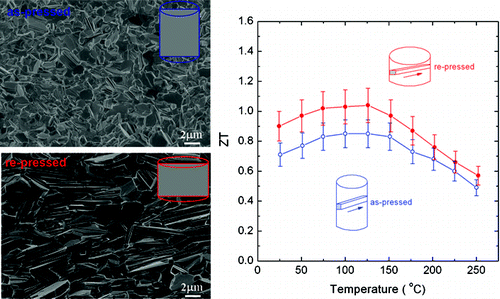
Xiao Yan and his colleagues from BC, MIT and GMZ Energy achieved a 22% improvement in peak thermoelectric figure of merit (ZT - see 1 below) from 0.85 to 1.04 at 125 degrees C in Bi2Te2.7Se0.3 by repressing the as-pressed samples. The main improvement is the large increase of electrical conductivity with only small increase of thermal conductivity and similar Seebeck coefficient. "We want to attain the single-crystal-like high power factor (see 2 below) by preparing preferential grain orientation while maintaining low thermal conductivity by nanocomposite approach," said Boston College professor Zhifeng Ren.
An innovative mechanical process technique was employed by Xiao Yan and his co-workers from BC, MIT and GMZ Energy. As-pressed samples were initially obtained by ball milling the mixture of individual element materials into alloyed BiTeSe nanopowders and then hot pressing the powder into bulk forms with nano constituents. Then as-pressed bulks were pressed again at elevated temperatures in a bigger diameter die to obtain re-pressed bulk samples. "During repressing process, lateral flow takes place, which helps to orient the grains and thus improve the power factor," explained Ren and Chen.
This work was published in Nano Letters, pubs.acs.org/doi/abs/10.1021/nl101156v
(1) ZT is a measure of the thermoelectric performance of a material
(2) Power factor is defined as a product of squared Seebeck coefficient and electrical conductivity.
####
For more information, please click here
Contacts:
Ed Hayward
Boston College Office of Public Affairs
617-552-4826
Copyright © Boston College
If you have a comment, please Contact us.Issuers of news releases, not 7th Wave, Inc. or Nanotechnology Now, are solely responsible for the accuracy of the content.
Bookmark:


| Related News Press |
News and information
 Simulating magnetization in a Heisenberg quantum spin chain April 5th, 2024
NRL charters Navy’s quantum inertial navigation path to reduce drift April 5th, 2024
Discovery points path to flash-like memory for storing qubits: Rice find could hasten development of nonvolatile quantum memory April 5th, 2024
Possible Futures
Discovery points path to flash-like memory for storing qubits: Rice find could hasten development of nonvolatile quantum memory April 5th, 2024
With VECSELs towards the quantum internet Fraunhofer: IAF achieves record output power with VECSEL for quantum frequency converters April 5th, 2024
Materials/Metamaterials/Magnetoresistance
Nanoscale CL thermometry with lanthanide-doped heavy-metal oxide in TEM March 8th, 2024
Focused ion beam technology: A single tool for a wide range of applications January 12th, 2024
Environment
Billions of nanoplastics released when microwaving baby food containers: Exposure to plastic particles kills up to 75% of cultured kidney cells July 21st, 2023
Energy
Development of zinc oxide nanopagoda array photoelectrode: photoelectrochemical water-splitting hydrogen production January 12th, 2024
Shedding light on unique conduction mechanisms in a new type of perovskite oxide November 17th, 2023
Inverted perovskite solar cell breaks 25% efficiency record: Researchers improve cell efficiency using a combination of molecules to address different November 17th, 2023
The efficient perovskite cells with a structured anti-reflective layer – another step towards commercialization on a wider scale October 6th, 2023
Automotive/Transportation
Researchers’ approach may protect quantum computers from attacks March 8th, 2024
Tests find no free-standing nanotubes released from tire tread wear September 8th, 2023
Solar/Photovoltaic
Development of zinc oxide nanopagoda array photoelectrode: photoelectrochemical water-splitting hydrogen production January 12th, 2024
Shedding light on unique conduction mechanisms in a new type of perovskite oxide November 17th, 2023
Inverted perovskite solar cell breaks 25% efficiency record: Researchers improve cell efficiency using a combination of molecules to address different November 17th, 2023
Charged “molecular beasts” the basis for new compounds: Researchers at Leipzig University use “aggressive” fragments of molecular ions for chemical synthesis November 3rd, 2023
 |
||
 |
||
| The latest news from around the world, FREE | ||
 |
||
|
|
||
| Premium Products | ||
 |
||
|
Only the news you want to read!
Learn More |
||
 |
||
|
Full-service, expert consulting
Learn More |
||
|
|
||