Home > Press > Thermoelectrics go nano
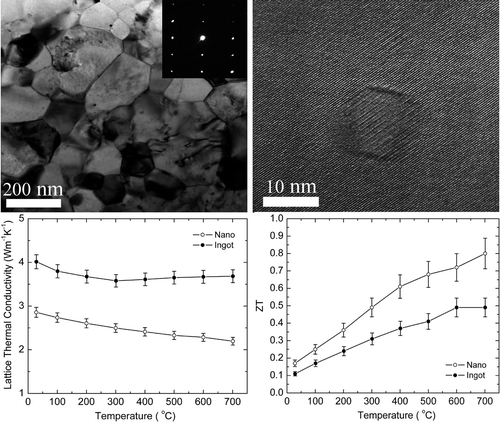 |
| Half-Heuslers would be important thermoelectric materials due to their high temperature stability and abundance if their dimensionless thermoelectric figure of merit (ZT) could be made high enough. Credit 2010 American Chemical Society. |
Abstract:
Recently, researchers from Boston College and MIT used nanotechnology to achieve a dramatic improvement in the thermoelectric performance of p-type half-Heuslers.
Thermoelectrics go nano
Chestnut Hill, MA | Posted on January 19th, 2011Combined with the high temperature stability and abundance of this material, their work could make half-Heuslers good candidates for waste heat recovery in automotive exhaust systems, in which the waste heat of the exhaust is transformed back into electricity by thermoelectric modules, thus improving mileage.
Xiao Yan and his co-workers from BC and MIT achieved a 60-90% higher thermoelectric figure of merit (ZT - see 1 below) in nanostructured bulk samples in comparison with state-of-the-art ingot; specifically, peak ZT enhancements from 0.5 to 0.8 at 700 oC. The improvement mainly comes from the lower thermal conductivity and partially from the higher Seebeck coefficient. "It is the best scenario for a thermoelectric material. Think about it: you are enhancing the electronic transport properties while simultaneously hindering the passage of heat flow," said MIT professor Gang Chen.
A low-cost method was employed by Xiao Yan and his colleagues from BC and MIT, first forming bulk alloyed ingots by arc melting and then milling the material into a fine powder and finally hot-pressing the powder into nanocrystalline ingots. The average grain size of 100-200 nm is the smallest obtained in half-Heusler system to date. "This method is low cost and can be scaled for mass production. This represents an exciting opportunity to improve the thermoelectric performance of materials in a cost-effective manner," said Boston College professor Zhifeng Ren.
This work was published in Nano Letters pubs.acs.org/doi/abs/10.1021/nl104138t
Also contributing to the work were Prof. S. J. Poon from University of Virginia and Prof. T. M. Tritt from Clemson University.
(1) ZT is a measure of the thermoelectric performance of a material.
####
Contacts:
Ed Hayward
Boston College Office of Public Affairs
617-552-4826
Copyright © Boston College
If you have a comment, please Contact us.Issuers of news releases, not 7th Wave, Inc. or Nanotechnology Now, are solely responsible for the accuracy of the content.
Bookmark:


| Related News Press |
News and information
 Simulating magnetization in a Heisenberg quantum spin chain April 5th, 2024
NRL charters Navy’s quantum inertial navigation path to reduce drift April 5th, 2024
Discovery points path to flash-like memory for storing qubits: Rice find could hasten development of nonvolatile quantum memory April 5th, 2024
Possible Futures
Discovery points path to flash-like memory for storing qubits: Rice find could hasten development of nonvolatile quantum memory April 5th, 2024
With VECSELs towards the quantum internet Fraunhofer: IAF achieves record output power with VECSEL for quantum frequency converters April 5th, 2024
Announcements
NRL charters Navy’s quantum inertial navigation path to reduce drift April 5th, 2024
Discovery points path to flash-like memory for storing qubits: Rice find could hasten development of nonvolatile quantum memory April 5th, 2024
Energy
Development of zinc oxide nanopagoda array photoelectrode: photoelectrochemical water-splitting hydrogen production January 12th, 2024
Shedding light on unique conduction mechanisms in a new type of perovskite oxide November 17th, 2023
Inverted perovskite solar cell breaks 25% efficiency record: Researchers improve cell efficiency using a combination of molecules to address different November 17th, 2023
The efficient perovskite cells with a structured anti-reflective layer – another step towards commercialization on a wider scale October 6th, 2023
Automotive/Transportation
Researchers’ approach may protect quantum computers from attacks March 8th, 2024
Tests find no free-standing nanotubes released from tire tread wear September 8th, 2023
 |
||
 |
||
| The latest news from around the world, FREE | ||
 |
||
|
|
||
| Premium Products | ||
 |
||
|
Only the news you want to read!
Learn More |
||
 |
||
|
Full-service, expert consulting
Learn More |
||
|
|
||