Home > Press > NSF Launches an ERC to Develop Smart Lighting
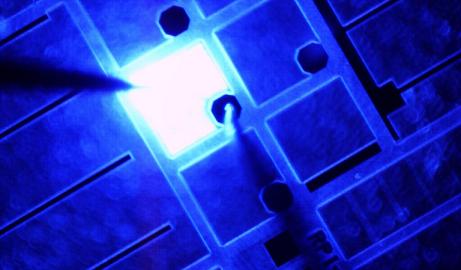 |
| Smart Lighting ERC example |
Abstract:
NSF Launches an Engineering Research Center to Develop Smart Lighting
By Cecile J. Gonzalez, National Science Foundation,
NSF Launches an ERC to Develop Smart Lighting
Arlington, VA | Posted on January 7th, 2011The National Science Foundation (NSF) announces an award to Rensselaer Polytechnic Institute and its partners to establish a new NSF Engineering Research Center (ERC). The ERC will develop interdisciplinary research and education programs that address an important societal need and provide the foundation for new industries through innovation. NSF will invest $18.5 million in the Center over the next five years.
Since 1985 the ERC program has fostered broad-based research and education collaborations in close partnership with industry that focus on making technological breakthroughs and developing new products and services. A new generation of five NSF ERCs will place a greater emphasis on innovation and entrepreneurship and on international collaboration and cultural exchange.
"The Gen-3 ERCs have been designed to build on the well-developed understanding laid down by the two previous generations of ERCs," says Lynn Preston, the leader of the ERC Program. "We have added to Gen-3 ERCs several new dimensions designed to speed the innovation process and prepare engineering graduates who are innovative, creative, and understand how to function in a global economy where engineering talent is broadly distributed throughout the world. We expect these ERCs to make even more significant impacts on the competitiveness of U.S. industry than their predecessors."
The NSF Smart Lighting ERC aims to create new solid-state lighting technologies to enable rapid biological imaging, novel modes of communication, efficient displays, and safer transportation. Solid-state lighting, from sources such as light-emitting diodes, is more efficient and durable than incandescent and fluorescent lighting. ERC researchers will investigate and exploit the distinctive properties of advanced materials to create new lighting devices and systems with fully controllable and tunable characteristics. These innovations will make solid-state lighting significantly more functional and easier to manufacture.
The Smart Lighting ERC will be based at Rensselaer Polytechnic Institute and will partner with Boston University and the University of New Mexico. Chonbuk National University in Korea, National Chiao Tung University in Taiwan, Taiwan National University, and Vilnius University in Lithuania will contribute additional expertise and international perspectives.
Major lighting companies and small start-up firms are among the 18 industry partners enlisted by the ERC to guide strategic planning, spur innovation, and provide university students with first-hand experience in entrepreneurship. To further stimulate technology transfer, the ERC has established partnerships with the Center for Economic Growth in Albany, N.Y., the Optoelectronics Industry Development Association, and small business incubators at each of the partner universities.
*This news release was updated on January 6, 2011, to reflect the current principal investigator.
####
About NSF
The National Science Foundation (NSF) is an independent federal agency that supports fundamental research and education across all fields of science and engineering. In fiscal year (FY) 2010, its budget is about $6.9 billion. NSF funds reach all 50 states through grants to nearly 2,000 universities and institutions. Each year, NSF receives over 45,000 competitive requests for funding, and makes over 11,500 new funding awards. NSF also awards over $400 million in professional and service contracts yearly.
For more information, please click here
Contacts:
Media Contacts
Joshua A. Chamot, NSF (703) 292-7730,
Michael Mullaney, Rensselaer Polytechnic Institute, (518) 276-6161,
Program Contacts
Lynn Preston, NSF, (703) 292-5358,
Deborah Jackson, NSF, (703) 292-7499,
Principal Investigator*
Robert Karlicek, 518-276-3310,
Copyright © NSF
If you have a comment, please Contact us.Issuers of news releases, not 7th Wave, Inc. or Nanotechnology Now, are solely responsible for the accuracy of the content.
Bookmark:


| Related News Press |
News and information
 Simulating magnetization in a Heisenberg quantum spin chain April 5th, 2024
NRL charters Navy’s quantum inertial navigation path to reduce drift April 5th, 2024
Discovery points path to flash-like memory for storing qubits: Rice find could hasten development of nonvolatile quantum memory April 5th, 2024
Good as gold - improving infectious disease testing with gold nanoparticles April 5th, 2024
Display technology/LEDs/SS Lighting/OLEDs
Utilizing palladium for addressing contact issues of buried oxide thin film transistors April 5th, 2024
Light guide plate based on perovskite nanocomposites November 3rd, 2023
Simple ballpoint pen can write custom LEDs August 11th, 2023
Jobs
Could quantum technology be New Mexico’s next economic boon? Quantum New Mexico Coalition aims to establish state as national hub April 1st, 2022
SEMI Partners with GLOBALFOUNDRIES to Offer Apprenticeship Program Aimed at Building the Electronics Talent Pipeline August 11th, 2020
Arrowhead Pharmaceuticals Reports Inducement Grants under NASDAQ Marketplace Rule 5635(c)(4) March 29th, 2019
Govt.-Legislation/Regulation/Funding/Policy
NRL charters Navy’s quantum inertial navigation path to reduce drift April 5th, 2024
Discovery points path to flash-like memory for storing qubits: Rice find could hasten development of nonvolatile quantum memory April 5th, 2024
Chemical reactions can scramble quantum information as well as black holes April 5th, 2024
Academic/Education
Rice University launches Rice Synthetic Biology Institute to improve lives January 12th, 2024
Multi-institution, $4.6 million NSF grant to fund nanotechnology training September 9th, 2022
Announcements
NRL charters Navy’s quantum inertial navigation path to reduce drift April 5th, 2024
Discovery points path to flash-like memory for storing qubits: Rice find could hasten development of nonvolatile quantum memory April 5th, 2024
Energy
Development of zinc oxide nanopagoda array photoelectrode: photoelectrochemical water-splitting hydrogen production January 12th, 2024
Shedding light on unique conduction mechanisms in a new type of perovskite oxide November 17th, 2023
Inverted perovskite solar cell breaks 25% efficiency record: Researchers improve cell efficiency using a combination of molecules to address different November 17th, 2023
The efficient perovskite cells with a structured anti-reflective layer – another step towards commercialization on a wider scale October 6th, 2023
 |
||
 |
||
| The latest news from around the world, FREE | ||
 |
||
|
|
||
| Premium Products | ||
 |
||
|
Only the news you want to read!
Learn More |
||
 |
||
|
Full-service, expert consulting
Learn More |
||
|
|
||