Home > Press > Nanoparticles promise cleaner, cheaper desalination
 |
Abstract:
A research project at Flinders University that promises to reduce dramatically the energy and maintenance costs of desalination has received a grant of $388,000 from the National Centre of Excellence in Desalination (NCED).
Nanoparticles promise cleaner, cheaper desalination
South Australia | Posted on December 22nd, 2010Senator Don Farrell, Parliamentary Secretary for Sustainability and Urban Water, yesterday announced funding of $3 million for 12 projects nationally. Senator Farrell visited Flinders earlier this week to tour the laboratories of the Nanotechnology Desalination Research Project in the School of Chemical and Physical Sciences.
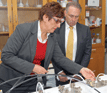
The program's manager, Dr Milena Ginic-Markovic (pictured with Senator Farrell) said the research team was making excellent progress in improving the performance and efficiency of the reverse osmosis process of desalination.
She said that two of the key problems that exist with the current membrane technology are biofouling and mechanical degradation of the membranes.
"The objectives of this three-year project will be to develop a coating for commercially available membranes, which will inhibit biofouling and/or biofoulant growth or reproduction, and to design and synthesise a ‘universal' additive for membrane materials, which will significantly reduce the compaction experienced by current, state-of-the-art polymeric membranes," Dr Ginic-Markovic said.
"By introducing a thin layer of coating and nanoparticles in the membrane system, we can improve the flow of water, reduce the need for cleaning and strengthen the membrane structure."
If the potential reduction of biofouling by 75 per cent is achieved, the energy bill of a desalination plant will be reduced by up 30 per cent, downtime for cleaning could be halved and the life of the membranes extended from two to 10 years.
The NCED, based at Murdoch University, is a Commonwealth Government sponsored consortium of research and industry partners. Its aim is to build national capacity and capability to achieve breakthroughs in fundamental and applied research that will improve desalination at a commercial scale.
####
For more information, please click here
Copyright © Flinders University
If you have a comment, please Contact us.Issuers of news releases, not 7th Wave, Inc. or Nanotechnology Now, are solely responsible for the accuracy of the content.
Bookmark:


| Related News Press |
News and information
 Simulating magnetization in a Heisenberg quantum spin chain April 5th, 2024
NRL charters Navy’s quantum inertial navigation path to reduce drift April 5th, 2024
Discovery points path to flash-like memory for storing qubits: Rice find could hasten development of nonvolatile quantum memory April 5th, 2024
Possible Futures
Discovery points path to flash-like memory for storing qubits: Rice find could hasten development of nonvolatile quantum memory April 5th, 2024
With VECSELs towards the quantum internet Fraunhofer: IAF achieves record output power with VECSEL for quantum frequency converters April 5th, 2024
Academic/Education
Rice University launches Rice Synthetic Biology Institute to improve lives January 12th, 2024
Multi-institution, $4.6 million NSF grant to fund nanotechnology training September 9th, 2022
Announcements
NRL charters Navy’s quantum inertial navigation path to reduce drift April 5th, 2024
Discovery points path to flash-like memory for storing qubits: Rice find could hasten development of nonvolatile quantum memory April 5th, 2024
Environment
Billions of nanoplastics released when microwaving baby food containers: Exposure to plastic particles kills up to 75% of cultured kidney cells July 21st, 2023
Water
Taking salt out of the water equation October 7th, 2022
Grants/Sponsored Research/Awards/Scholarships/Gifts/Contests/Honors/Records
Discovery points path to flash-like memory for storing qubits: Rice find could hasten development of nonvolatile quantum memory April 5th, 2024
Chemical reactions can scramble quantum information as well as black holes April 5th, 2024
 |
||
 |
||
| The latest news from around the world, FREE | ||
 |
||
|
|
||
| Premium Products | ||
 |
||
|
Only the news you want to read!
Learn More |
||
 |
||
|
Full-service, expert consulting
Learn More |
||
|
|
||