Home > Press > Strange New Twist
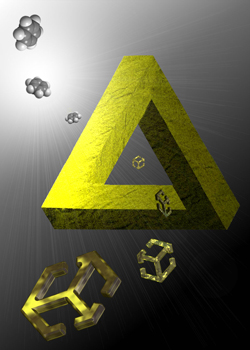 |
| Berkeley Lab researcher have discovered Möbius symmetry in metamolecular trimers made from metals and dielectrics. (Image by Chih-Wei Chang) |
Abstract:
Berkeley Researchers Discover Möbius Symmetry in Metamaterials
Strange New Twist
Berkeley, CA | Posted on December 22nd, 2010Möbius symmetry, the topological phenomenon that yields a half-twisted strip with two surfaces but only one side, has been a source of fascination since its discovery in 1858 by German mathematician August Möbius. As artist M.C. Escher so vividly demonstrated in his "parade of ants," it is possible to traverse the "inside" and "outside" surfaces of a Möbius strip without crossing over an edge. For years, scientists have been searching for an example of Möbius symmetry in natural materials without any success. Now a team of scientists has discovered Möbius symmetry in metamaterials - materials engineered from artificial "atoms" and "molecules" with electromagnetic properties that arise from their structure rather than their chemical composition.
Xiang Zhang, a scientist with the U.S. Department of Energy's Lawrence Berkeley National Laboratory (Berkeley Lab) and a professor at the University of California (UC) Berkeley, led a study in which electromagnetic Möbius symmetry was successfully introduced into composite metamolecular systems made from metals and dielectrics. This discovery opens the door to finding and exploiting novel phenomena in metamaterials.
"We have experimentally observed a new topological symmetry in electromagnetic metamaterial systems that is equivalent to the structural symmetry of a Möbius strip, with the number of twists controlled by sign changes in the electromagnetic coupling between the meta-atoms," Zhang says. "We have further demonstrated that metamaterials with different coupling signs exhibit resonance frequencies that depend on the number but not the locations of the twists. This confirms the topological nature of the symmetry."
Working with metallic resonant meta-atoms configured as coupled split-ring resonators, Zhang and members of his research group assembled three of these identical meta-atoms into trimers. Through careful design of the electromagnetic couplings between the constituent meta-atoms, these trimers displayed Möbius C3 symmetry - meaning Möbius cyclic symmetry through three rotations of 120 degrees. The Möbius twists result from a change in the signs of the electromagnetic coupling constants between the constituent meta-atoms.
"The topological Möbius symmetry we found in our meta-molecule trimers is a new symmetry not found in naturally occurring materials or molecules." Zhang says. "Since the coupling constants of metamolecules can be arbitrarily varied from positive to negative without any constraints, the number of Möbius twists we can introduce are unlimited. This means that topological structures that have thus far been limited to mathematical imagination can now be realized using metamolecules of different designs."
Details on this discovery have been published in the journal Physical Review Letters, in a paper titled "Optical Möbius Symmetry in Metamaterials." Co-authoring the paper with Zhang were Chih-Wei Chang, Ming Liu, Sunghyun Nam, Shuang Zhang, Yongmin Liu and Guy Bartal.
Xiang Zhang is a principal investigator with Berkeley Lab's Materials Sciences Division and the Ernest S. Kuh Endowed Chaired Professor at UC Berkeley, where he directs the Center for Scalable and Integrated NanoManufacturing (SINAM), a National Science Foundation Nano-scale Science and Engineering Center.
In science, symmetry is defined as a system feature or property that is preserved when the system undergoes a change. This is one of the most fundamental and crucial concepts in science, underpinning such physical phenomena as the conservation laws and selection rules that govern the transition of a system from one state to another. Symmetry also dictates chemical reactions and drives a number of important scientific tools, including crystallography and spectroscopy.
While some symmetries, such as spatial geometries, are easily observed, others, such as optical symmetries, may be hidden. A powerful investigative tool for uncovering hidden symmetries is a general phenomenon known as "degeneracy." For example, the energy level degeneracy of an atom in a crystal is correlated with the crystal symmetry. A three-body system, like a trimer, can be especially effective for studying the correlation between degeneracy and symmetry because, although it is a relatively simple system, it reveals a rich spectrum of phenomena.
"The unique properties of a three-body system make experimental investigations of hidden symmetries possible," says Chih-Wei Chang, a former post-doc in Zhang's group and the lead author of the paper in Physical Review Letters, says. "Intrigued by the extraordinary engineering flexibilities of metamaterials, we decided to investigate some non-trivial symmetries hidden beneath these metamolecules by studying their degeneracy properties"
The authors tested their metamaterials for hidden symmetry by shining a light and monitoring the optical resonances. The resulting resonant frequencies revealed that degeneracy is kept even when the coupling constants between meta-atoms flip signs.
"Because degeneracy and symmetry are always correlated, there must be some symmetry hidden beneath the observed degeneracy" says Chang.
The researchers showed that whereas trimer systems with uniform negative (or positive) coupling signs could be symbolized as an equilateral triangle, trimer systems with mixed signs of couplings could only be symbolized as a Möbius strip with topological C3 symmetry. Furthermore, in other metamolecular systems made of six meta-atoms, the authors demonstrated up to three Möbius twists.
Says Chang, now a faculty member at National Taiwan University in Taipei, "When going from natural systems to artificial meta-atoms and metamolecules, we can expect to encounter phenomena far beyond our conventional conceptions. The new symmetries we find in metamaterials could be extended to other kinds of artificial systems, such as Josephson junctions, that will open new avenues for novel phenomena in quantum electronics and quantum optics."
This research was supported by the DOE Office of Science and by the NSF's Nano-scale Science and Engineering Center.
####
About Berkeley Lab
Lawrence Berkeley National Laboratory is a U.S. Department of Energy (DOE) national laboratory managed by the University of California for the DOE Office of Science. Berkeley Lab provides solutions to the world’s most urgent scientific challenges including sustainable energy, climate change, human health, and a better understanding of matter and force in the universe. It is a world leader in improving our lives through team science, advanced computing, and innovative technology. Visit our at www.lbl.gov
For more information, please click here
Contacts:
Lynn Yarris
(510) 486-5375
Copyright © Berkeley Lab
If you have a comment, please Contact us.Issuers of news releases, not 7th Wave, Inc. or Nanotechnology Now, are solely responsible for the accuracy of the content.
Bookmark:


| Related News Press |
News and information
 Simulating magnetization in a Heisenberg quantum spin chain April 5th, 2024
NRL charters Navy’s quantum inertial navigation path to reduce drift April 5th, 2024
Discovery points path to flash-like memory for storing qubits: Rice find could hasten development of nonvolatile quantum memory April 5th, 2024
Govt.-Legislation/Regulation/Funding/Policy
NRL charters Navy’s quantum inertial navigation path to reduce drift April 5th, 2024
Discovery points path to flash-like memory for storing qubits: Rice find could hasten development of nonvolatile quantum memory April 5th, 2024
Chemical reactions can scramble quantum information as well as black holes April 5th, 2024
Possible Futures
Discovery points path to flash-like memory for storing qubits: Rice find could hasten development of nonvolatile quantum memory April 5th, 2024
With VECSELs towards the quantum internet Fraunhofer: IAF achieves record output power with VECSEL for quantum frequency converters April 5th, 2024
Academic/Education
Rice University launches Rice Synthetic Biology Institute to improve lives January 12th, 2024
Multi-institution, $4.6 million NSF grant to fund nanotechnology training September 9th, 2022
Discoveries
Chemical reactions can scramble quantum information as well as black holes April 5th, 2024
New micromaterial releases nanoparticles that selectively destroy cancer cells April 5th, 2024
Utilizing palladium for addressing contact issues of buried oxide thin film transistors April 5th, 2024
Materials/Metamaterials/Magnetoresistance
Nanoscale CL thermometry with lanthanide-doped heavy-metal oxide in TEM March 8th, 2024
Focused ion beam technology: A single tool for a wide range of applications January 12th, 2024
Announcements
NRL charters Navy’s quantum inertial navigation path to reduce drift April 5th, 2024
Discovery points path to flash-like memory for storing qubits: Rice find could hasten development of nonvolatile quantum memory April 5th, 2024
Quantum nanoscience
Simulating magnetization in a Heisenberg quantum spin chain April 5th, 2024
Optically trapped quantum droplets of light can bind together to form macroscopic complexes March 8th, 2024
Bridging light and electrons January 12th, 2024
'Sudden death' of quantum fluctuations defies current theories of superconductivity: Study challenges the conventional wisdom of superconducting quantum transitions January 12th, 2024
 |
||
 |
||
| The latest news from around the world, FREE | ||
 |
||
|
|
||
| Premium Products | ||
 |
||
|
Only the news you want to read!
Learn More |
||
 |
||
|
Full-service, expert consulting
Learn More |
||
|
|
||