Home > Press > Better batteries from the bottom up
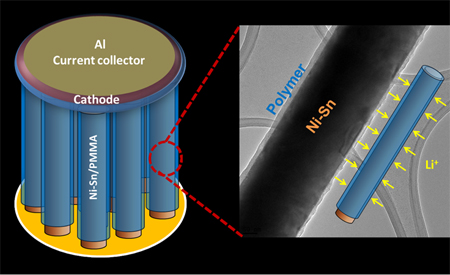 |
| A nanostructured lithium ion battery developed at Rice University may charge faster and last longer than Li ion batteries in current use. Nanowires with a PMMA polymer coating, seen in a transmission electron microscope image at right, solve a long-standing problem of forming ultrathin electrolyte layers around nanostructured electrode materials. (Credit: Ajayan Lab/Rice University) |
Abstract:
Rice University researchers build microbatteries with nanowire hearts
Better batteries from the bottom up
Houston, TX | Posted on December 9th, 2010Rice University researchers have moved a step closer to creating robust, three-dimensional microbatteries that would charge faster and hold other advantages over conventional lithium-ion batteries. They could power new generations of remote sensors, display screens, smart cards, flexible electronics and biomedical devices.
The batteries employ vertical arrays of nickel-tin nanowires perfectly encased in PMMA, a widely used polymer best known as Plexiglas. The Rice laboratory of Pulickel Ajayan found a way to reliably coat single nanowires with a smooth layer of a PMMA-based gel electrolyte that insulates the wires from the counter electrode while allowing ions to pass through.
The work was reported this week in the online edition of the journal Nano Letters.
"In a battery, you have two electrodes separated by a thick barrier," said Ajayan, professor in mechanical engineering and materials science and of chemistry. "The challenge is to bring everything into close proximity so this electrochemistry becomes much more efficient."
Ajayan and his team feel they've done that by growing forests of coated nanowires -- millions of them on a fingernail-sized chip -- for scalable microdevices with greater surface area than conventional thin-film batteries. "You can't simply scale the thickness of a thin-film battery, because the lithium ion kinetics would become sluggish," Ajayan said.
"We wanted to figure out how the proposed 3-D designs of batteries can be built from the nanoscale up," said Sanketh Gowda, a graduate student in Ajayan's lab. "By increasing the height of the nanowires, we can increase the amount of energy stored while keeping the lithium ion diffusion distance constant."
The researchers, led by Gowda and postdoctoral researcher Arava Leela Mohana Reddy, worked for more than a year to refine the process.
"To be fair, the 3-D concept has been around for a while," Reddy said. "The breakthrough here is the ability to put a conformal coat of PMMA on a nanowire over long distances. Even a small break in the coating would destroy it." He said the same approach is being tested on nanowire systems with higher capacities.
The process builds upon the lab's previous research to build coaxial nanowire cables that was reported in Nano Letters last year. In the new work, the researchers grew 10-micron-long nanowires via electrodeposition in the pores of an anodized alumina template. They then widened the pores with a simple chemical etching technique and drop-coated PMMA onto the array to give the nanowires an even casing from top to bottom. A chemical wash removed the template.
They have built one-centimeter square microbatteries that hold more energy and that charge faster than planar batteries of the same electrode length. "By going to 3-D, we're able to deliver more energy in the same footprint," Gowda said.
They feel the PMMA coating will increase the number of times a battery can be charged by stabilizing conditions between the nanowires and liquid electrolyte, which tend to break down over time.
The team is also studying how cycling affects nanowires that, like silicon electrodes, expand and contract as lithium ions come and go. Electron microscope images of nanowires taken after many charge/discharge cycles showed no breaks in the PMMA casing -- not even pinholes. This led the researchers to believe the coating withstands the volume expansion in the electrode, which could increase the batteries' lifespans.
Co-authors are Rice graduate student Xiaobo Zhan; former Rice postdoctoral researcher Manikoth Shaijumon, now an assistant professor at the Indian Institute of Science Education and Research, Thiruvananthapuram, India; and former Rice research scientist Lijie Ci, now a senior research and development manager at Samsung Cheil Industries.
The Hartley Family Foundation and Rice University funded the research.
Read the abstract at pubs.acs.org/doi/abs/10.1021/nl102919m
####
About Rice University
Located in Houston, Rice University is consistently ranked one of America's best teaching and research universities. Known for its "unconventional wisdom," Rice is distinguished by its: size -- 3,279 undergraduates and 2,277 graduate students; selectivity -- 12 applicants for each place in the freshman class; resources -- an undergraduate student-to-faculty ratio of 5-to-1; sixth largest endowment per student among American private research universities; residential college system, which builds communities that are both close-knit and diverse; and collaborative culture, which crosses disciplines, integrates teaching and research, and intermingles undergraduate and graduate work.
For more information, please click here
Contacts:
David Ruth
713-348-6327
Mike Williams
713-348-6728
Copyright © Rice University
If you have a comment, please Contact us.Issuers of news releases, not 7th Wave, Inc. or Nanotechnology Now, are solely responsible for the accuracy of the content.
Bookmark:


| Related News Press |
News and information
 Simulating magnetization in a Heisenberg quantum spin chain April 5th, 2024
NRL charters Navy’s quantum inertial navigation path to reduce drift April 5th, 2024
Discovery points path to flash-like memory for storing qubits: Rice find could hasten development of nonvolatile quantum memory April 5th, 2024
Govt.-Legislation/Regulation/Funding/Policy
NRL charters Navy’s quantum inertial navigation path to reduce drift April 5th, 2024
Discovery points path to flash-like memory for storing qubits: Rice find could hasten development of nonvolatile quantum memory April 5th, 2024
Chemical reactions can scramble quantum information as well as black holes April 5th, 2024
Possible Futures
Discovery points path to flash-like memory for storing qubits: Rice find could hasten development of nonvolatile quantum memory April 5th, 2024
With VECSELs towards the quantum internet Fraunhofer: IAF achieves record output power with VECSEL for quantum frequency converters April 5th, 2024
Academic/Education
Rice University launches Rice Synthetic Biology Institute to improve lives January 12th, 2024
Multi-institution, $4.6 million NSF grant to fund nanotechnology training September 9th, 2022
Discoveries
Chemical reactions can scramble quantum information as well as black holes April 5th, 2024
New micromaterial releases nanoparticles that selectively destroy cancer cells April 5th, 2024
Utilizing palladium for addressing contact issues of buried oxide thin film transistors April 5th, 2024
Announcements
NRL charters Navy’s quantum inertial navigation path to reduce drift April 5th, 2024
Discovery points path to flash-like memory for storing qubits: Rice find could hasten development of nonvolatile quantum memory April 5th, 2024
Energy
Development of zinc oxide nanopagoda array photoelectrode: photoelectrochemical water-splitting hydrogen production January 12th, 2024
Shedding light on unique conduction mechanisms in a new type of perovskite oxide November 17th, 2023
Inverted perovskite solar cell breaks 25% efficiency record: Researchers improve cell efficiency using a combination of molecules to address different November 17th, 2023
The efficient perovskite cells with a structured anti-reflective layer – another step towards commercialization on a wider scale October 6th, 2023
Battery Technology/Capacitors/Generators/Piezoelectrics/Thermoelectrics/Energy storage
What heat can tell us about battery chemistry: using the Peltier effect to study lithium-ion cells March 8th, 2024
A battery’s hopping ions remember where they’ve been: Seen in atomic detail, the seemingly smooth flow of ions through a battery’s electrolyte is surprisingly complicated February 16th, 2024
 |
||
 |
||
| The latest news from around the world, FREE | ||
 |
||
|
|
||
| Premium Products | ||
 |
||
|
Only the news you want to read!
Learn More |
||
 |
||
|
Full-service, expert consulting
Learn More |
||
|
|
||