Home > Press > Platinum-coated nanoparticles could power fuel cell cars
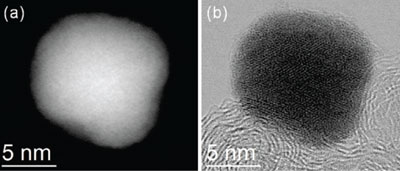 |
| Atomic resolution images of the palladium-cobalt nanoparticle, before platinum deposition. Muller Lab |
Abstract:
Fuel cells may power the cars of the future, but it's not enough to just make them work -- they have to be affordable. Cornell researchers have developed a novel way to synthesize a fuel cell electrocatalytic material without breaking the bank.
By Anne Ju
Platinum-coated nanoparticles could power fuel cell cars
Ithaca, NY | Posted on December 9th, 2010The research, published online Nov. 24 in the Journal of the American Chemical Society, describes a simple method for making nanoparticles that drive the electrocatalytic reactions inside room-temperature fuel cells.
Fuel cells convert chemical energy directly into electrical energy. They consist of an anode, which oxidizes the fuel (such as hydrogen), and a cathode, which reduces oxygen to water. A polymer membrane separates the electrodes. Fuel cell-powered cars in production today use pure platinum to catalyze the oxygen reduction reaction in the cathode side. While platinum is the most efficient catalyst available today for the oxygen reduction reaction, its activity is limited, and it is rare and expensive.
The Cornell researchers' nanoparticles offer an alternative to pure platinum at a fraction of the cost. They are made of a palladium and cobalt core and coated with a one-atom-thick layer of platinum. Palladium, though not as good a catalyst, has similar properties as platinum (it is in the same group on the Periodic Table of Elements; it has the same crystal structure; and it is similar in atomic size), but it costs one-third less and is 50 times more abundant on Earth.
Researchers led by Héctor D. Abruña, the E.M. Chamot Profesor of Chemistry and Chemical Biology, made the nanoparticles on a carbon substrate and made the palladium-cobalt core self-assemble -- cutting down on manufacturing costs. First author Deli Wang, a postdoctoral associate in Abruña's lab, designed the experiments and synthesized the nanoparticles.
David Muller, professor of applied and engineering physics and co-director of the Kavli Institute at Cornell for Nanoscale Science, led the efforts geared at imaging the particles down to atomic resolution to demonstrate their chemical composition and distribution, and to prove the efficacy of the catalytic conversions.
"The crystal structure of the substrate, composition and spatial distribution of the nanoparticles play important roles in determining how well the platinum performs," said Huolin Xin, a graduate student in Muller's lab.
The work was supported by the Energy Materials Center at Cornell, a Department of Energy-supported Energy Frontiers Research Center. Researchers also used equipment at the Cornell Center for Materials Research.
####
For more information, please click here
Contacts:
Media Contact:
Joe Schwartz
(607) 254-6235
Cornell Chronicle:
Anne Ju
(607) 255-9735
Issuers of news releases, not 7th Wave, Inc. or Nanotechnology Now, are solely responsible for the accuracy of the content.
Bookmark:


| Related News Press |
News and information
 Simulating magnetization in a Heisenberg quantum spin chain April 5th, 2024
NRL charters Navy’s quantum inertial navigation path to reduce drift April 5th, 2024
Discovery points path to flash-like memory for storing qubits: Rice find could hasten development of nonvolatile quantum memory April 5th, 2024
Chemistry
What heat can tell us about battery chemistry: using the Peltier effect to study lithium-ion cells March 8th, 2024
Nanoscale CL thermometry with lanthanide-doped heavy-metal oxide in TEM March 8th, 2024
Govt.-Legislation/Regulation/Funding/Policy
NRL charters Navy’s quantum inertial navigation path to reduce drift April 5th, 2024
Discovery points path to flash-like memory for storing qubits: Rice find could hasten development of nonvolatile quantum memory April 5th, 2024
Chemical reactions can scramble quantum information as well as black holes April 5th, 2024
Announcements
NRL charters Navy’s quantum inertial navigation path to reduce drift April 5th, 2024
Discovery points path to flash-like memory for storing qubits: Rice find could hasten development of nonvolatile quantum memory April 5th, 2024
Energy
Development of zinc oxide nanopagoda array photoelectrode: photoelectrochemical water-splitting hydrogen production January 12th, 2024
Shedding light on unique conduction mechanisms in a new type of perovskite oxide November 17th, 2023
Inverted perovskite solar cell breaks 25% efficiency record: Researchers improve cell efficiency using a combination of molecules to address different November 17th, 2023
The efficient perovskite cells with a structured anti-reflective layer – another step towards commercialization on a wider scale October 6th, 2023
Automotive/Transportation
Researchers’ approach may protect quantum computers from attacks March 8th, 2024
Tests find no free-standing nanotubes released from tire tread wear September 8th, 2023
Fuel Cells
Current and Future Developments in Nanomaterials and Carbon Nanotubes: Applications of Nanomaterials in Energy Storage and Electronics October 28th, 2022
 |
||
 |
||
| The latest news from around the world, FREE | ||
 |
||
|
|
||
| Premium Products | ||
 |
||
|
Only the news you want to read!
Learn More |
||
 |
||
|
Full-service, expert consulting
Learn More |
||
|
|
||