Home > Press > Technology uses auto exhaust heat to create electricity, boost mileage
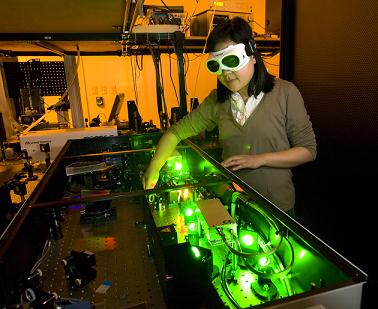 |
| Purdue mechanical engineering doctoral student Yaguo Wang works with a high-speed laser at the Birck Nanotechnology Center to study thermoelectric generators. The devices harvest heat from an engine's exhaust to generate electricity, which could reduce a car's fuel consumption. (Purdue University photo/Mark Simons) |
Abstract:
Researchers are creating a system that harvests heat from an engine's exhaust to generate electricity, reducing a car's fuel consumption.
Technology uses auto exhaust heat to create electricity, boost mileage
West Lafayette, IN | Posted on November 24th, 2010The effort is funded with a $1.4 million, three-year grant from the National Science Foundation and the U.S. Department of Energy. A Purdue University team is collaborating with General Motors, which is developing a prototype using thermoelectric generators, or TEGs, said Xianfan Xu, a Purdue professor of mechanical engineering and electrical and computer engineering.
TEGs generate an electric current to charge batteries and power a car's electrical systems, reducing the engine's workload and improving fuel economy.
The prototype, to be installed in the exhaust system behind the catalytic converter, will harvest heat from gases that are about 700 degrees Celsius, or nearly 1,300 degrees Fahrenheit, Xu said.
Current thermoelectric technology cannot withstand the temperatures inside catalytic converters, where gases are about 1,000 degrees Celsius, he said. However, researchers also are working on new thermoelectrics capable of withstanding such high temperatures, a step that would enable greater fuel savings.
The project begins January 1. The first prototype aims to reduce fuel consumption by 5 percent, and future systems capable of working at higher temperatures could make possible a 10 percent reduction, said Xu, whose work is based at the Birck Nanotechnology Center in Purdue's Discovery Park.
The research team, led by Xu, involves Purdue faculty members Timothy Fisher, a professor of mechanical engineering; Stephen Heister, a professor of aeronautics and astronautics; Timothy Sands, the Basil S. Turner Professor of Engineering, a professor of materials engineering and electrical and computer engineering, and executive vice president for academic affairs and provost; and Yue Wu, an assistant professor of chemical engineering.
The thermoelectric material is contained in chips a few inches square that will be tailored for their specific location within the system.
"They are optimized to work best at different temperatures, which decrease as gas flows along the system," Xu said.
The researchers are tackling problems associated with the need to improve efficiency and reliability, to integrate a complex mix of materials that might expand differently when heated, and to extract as much heat as possible from the exhaust gases.
Thermoelectric materials generate electricity when there is a temperature difference.
"The material is hot on the side facing the exhaust gases and cool on the other side, and this difference must be maintained to continually generate a current," said Xu, who has been collaborating with GM in thermoelectric research for about a decade.
A critical research goal is to develop materials that are poor heat conductors.
"You don't want heat to transfer rapidly from the hot side to the cool side of the chip," Xu said. "You want to maintain the temperature difference to continuously generate current."
Researchers at GM are using a thermoelectric material called skutterudite, a mineral made of cobalt, arsenide, nickel or iron.
"The biggest challenge is system-level design - how to optimize everything to get as much heat as possible from the exhaust gas," Xu said. "The engine exhaust has to lose as much heat as possible to the material."
Rare-earth elements, such as lanthanum, cesium, neodymium and erbium, reduce the thermal conductivity of skutterudite. The elements are mixed with skutterudite inside a furnace. Because using pure rare-earth elements is costly, researchers also are working to replace them with alloys called "mischmetals."
The work builds on previous research at Purdue involving the National Science Foundation, the Defense Advanced Research Projects Agency, the Air Force Office of Scientific Research and the Rolls-Royce University Technology Center.
Findings, as well as teaching- and research-oriented materials from the project will be provided via websites including Purdue's nanoHUB and thermalHUB Web portals. The research will provide graduate and undergraduate students with training in interdisciplinary areas and industrial experience through internships.
Thermoelectric technologies also might be used in other applications such as harnessing waste heat to generate electricity in homes and power plants and for a new type of solar cell and solid-state refrigerator, Xu said.
####
For more information, please click here
Contacts:
Writer:
Emil Venere
765-494-4709
Source:
Xianfan Xu
765-494-5639
Copyright © Purdue University
If you have a comment, please Contact us.Issuers of news releases, not 7th Wave, Inc. or Nanotechnology Now, are solely responsible for the accuracy of the content.
Bookmark:


| Related News Press |
News and information
 Simulating magnetization in a Heisenberg quantum spin chain April 5th, 2024
NRL charters Navy’s quantum inertial navigation path to reduce drift April 5th, 2024
Discovery points path to flash-like memory for storing qubits: Rice find could hasten development of nonvolatile quantum memory April 5th, 2024
Chemistry
What heat can tell us about battery chemistry: using the Peltier effect to study lithium-ion cells March 8th, 2024
Nanoscale CL thermometry with lanthanide-doped heavy-metal oxide in TEM March 8th, 2024
Possible Futures
Discovery points path to flash-like memory for storing qubits: Rice find could hasten development of nonvolatile quantum memory April 5th, 2024
With VECSELs towards the quantum internet Fraunhofer: IAF achieves record output power with VECSEL for quantum frequency converters April 5th, 2024
Academic/Education
Rice University launches Rice Synthetic Biology Institute to improve lives January 12th, 2024
Multi-institution, $4.6 million NSF grant to fund nanotechnology training September 9th, 2022
Announcements
NRL charters Navy’s quantum inertial navigation path to reduce drift April 5th, 2024
Discovery points path to flash-like memory for storing qubits: Rice find could hasten development of nonvolatile quantum memory April 5th, 2024
Environment
Billions of nanoplastics released when microwaving baby food containers: Exposure to plastic particles kills up to 75% of cultured kidney cells July 21st, 2023
Energy
Development of zinc oxide nanopagoda array photoelectrode: photoelectrochemical water-splitting hydrogen production January 12th, 2024
Shedding light on unique conduction mechanisms in a new type of perovskite oxide November 17th, 2023
Inverted perovskite solar cell breaks 25% efficiency record: Researchers improve cell efficiency using a combination of molecules to address different November 17th, 2023
The efficient perovskite cells with a structured anti-reflective layer – another step towards commercialization on a wider scale October 6th, 2023
Automotive/Transportation
Researchers’ approach may protect quantum computers from attacks March 8th, 2024
Tests find no free-standing nanotubes released from tire tread wear September 8th, 2023
Grants/Sponsored Research/Awards/Scholarships/Gifts/Contests/Honors/Records
Discovery points path to flash-like memory for storing qubits: Rice find could hasten development of nonvolatile quantum memory April 5th, 2024
Chemical reactions can scramble quantum information as well as black holes April 5th, 2024
Solar/Photovoltaic
Development of zinc oxide nanopagoda array photoelectrode: photoelectrochemical water-splitting hydrogen production January 12th, 2024
Shedding light on unique conduction mechanisms in a new type of perovskite oxide November 17th, 2023
Inverted perovskite solar cell breaks 25% efficiency record: Researchers improve cell efficiency using a combination of molecules to address different November 17th, 2023
Charged “molecular beasts” the basis for new compounds: Researchers at Leipzig University use “aggressive” fragments of molecular ions for chemical synthesis November 3rd, 2023
 |
||
 |
||
| The latest news from around the world, FREE | ||
 |
||
|
|
||
| Premium Products | ||
 |
||
|
Only the news you want to read!
Learn More |
||
 |
||
|
Full-service, expert consulting
Learn More |
||
|
|
||