Home > Press > Purdue gets $1.5 million for quantum information center
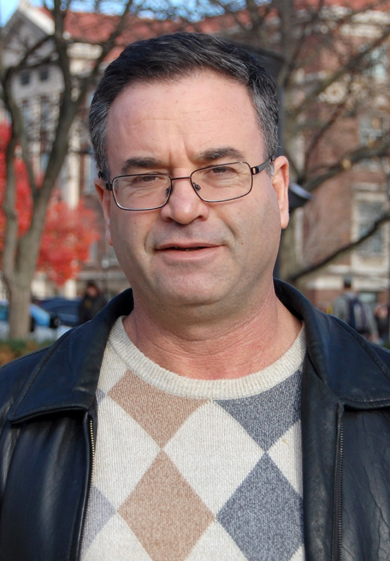 |
| Sabre Kais |
Abstract:
Purdue University has been awarded $1.5 million to study quantum information science, a new field paving the way for quantum computing - a novel method to process information that is faster, more powerful and more efficient than classical computing.
By Elizabeth K. Gardner
Purdue gets $1.5 million for quantum information center
West Lafayette, IN | Posted on November 22nd, 2010Purdue University has been awarded $1.5 million to study quantum information science, a new field paving the way for quantum computing - a novel method to process information that is faster, more powerful and more efficient than classical computing.
The National Science Foundation-funded Center for Quantum Information and Computation for Chemistry will focus on the role of quantum information in chemical systems and on developing algorithms for chemical problems that can be solved efficiently using quantum computers.
Sabre Kais, the project's principal investigator, said quantum information science draws on physical science, mathematics, computer science and engineering to understand how certain fundamental laws of physics can be harnessed to improve the acquisition, transmission and processing of information.
"The center will bring together experts in theoretical chemistry and quantum information processing to investigate information techniques used to gain new insights into a variety of chemical processes from bond breaking to photosynthesis," said Kais, who is a professor of chemistry and a researcher in the Birck Nanotechnology Center. "This work will advance our understanding of chemical phenomena and could lead to the realization of quantum computers, which would be capable of performing complex calculations and simulations impossible on today's computers."
Quantum computing aims to use the behavior of atomic and subatomic particles like electrons, protons and photons to create a new way to store and process information. These particles would be turned into quantum bits, or qubits for computing.
While classical computers use transistors that are either "on" or "off" to represent a 1 or 0, qubits offer a third option of being both 1 and 0 at the same time to exponentially increase the number of calculations a computer can run simultaneously.
These particles also have the ability to be put into a state of entanglement, where a change applied to one is instantly reflected by the others, which offers the potential for massive parallel processing.
In the field of chemistry there are calculations that cannot be done through classical computing because it would take years for the computer to run through and evaluate all of the possibilities, Kais said.
"For example, obtaining the exact electronic structure of complex molecules can require running through more than 100 quadrillion configurations," he said. "This is an impossible task on any current computer. We hope to design a quantum algorithm that can be used on a quantum computer to solve this problem in a matter of minutes."
The center also will develop new software tools for the scientific community and will serve as an educational resource through public lectures, new course development, distance education initiatives and K-12 classroom activities.
Partners in the Purdue-based center include Alan Aspuru-Guzik of Harvard University, Kenneth R. Brown of the Georgia Institute of Technology, Daniel A. Lidar of the University of Southern California and Peter J. Love of Haverford College.
The center is funded by the National Science Foundation Centers for Chemical Innovation Program, which supports research centers that can address major, long-term fundamental chemical research challenges that have a high probability of both producing transformative research and leading to innovations.
####
For more information, please click here
Contacts:
Writer
Elizabeth K. Gardner
765-494-2081
Source
Sabre Kais
765-494-5965
Copyright © Purdue University
If you have a comment, please Contact us.Issuers of news releases, not 7th Wave, Inc. or Nanotechnology Now, are solely responsible for the accuracy of the content.
Bookmark:


| Related News Press |
News and information
 Simulating magnetization in a Heisenberg quantum spin chain April 5th, 2024
NRL charters Navy’s quantum inertial navigation path to reduce drift April 5th, 2024
Discovery points path to flash-like memory for storing qubits: Rice find could hasten development of nonvolatile quantum memory April 5th, 2024
Chemistry
What heat can tell us about battery chemistry: using the Peltier effect to study lithium-ion cells March 8th, 2024
Nanoscale CL thermometry with lanthanide-doped heavy-metal oxide in TEM March 8th, 2024
Govt.-Legislation/Regulation/Funding/Policy
NRL charters Navy’s quantum inertial navigation path to reduce drift April 5th, 2024
Discovery points path to flash-like memory for storing qubits: Rice find could hasten development of nonvolatile quantum memory April 5th, 2024
Chemical reactions can scramble quantum information as well as black holes April 5th, 2024
Academic/Education
Rice University launches Rice Synthetic Biology Institute to improve lives January 12th, 2024
Multi-institution, $4.6 million NSF grant to fund nanotechnology training September 9th, 2022
Quantum Computing
Simulating magnetization in a Heisenberg quantum spin chain April 5th, 2024
Discovery points path to flash-like memory for storing qubits: Rice find could hasten development of nonvolatile quantum memory April 5th, 2024
With VECSELs towards the quantum internet Fraunhofer: IAF achieves record output power with VECSEL for quantum frequency converters April 5th, 2024
Chemical reactions can scramble quantum information as well as black holes April 5th, 2024
Announcements
NRL charters Navy’s quantum inertial navigation path to reduce drift April 5th, 2024
Discovery points path to flash-like memory for storing qubits: Rice find could hasten development of nonvolatile quantum memory April 5th, 2024
Quantum nanoscience
Simulating magnetization in a Heisenberg quantum spin chain April 5th, 2024
Optically trapped quantum droplets of light can bind together to form macroscopic complexes March 8th, 2024
Bridging light and electrons January 12th, 2024
'Sudden death' of quantum fluctuations defies current theories of superconductivity: Study challenges the conventional wisdom of superconducting quantum transitions January 12th, 2024
 |
||
 |
||
| The latest news from around the world, FREE | ||
 |
||
|
|
||
| Premium Products | ||
 |
||
|
Only the news you want to read!
Learn More |
||
 |
||
|
Full-service, expert consulting
Learn More |
||
|
|
||