Home > Press > Detecting cancer with the prick of a finger
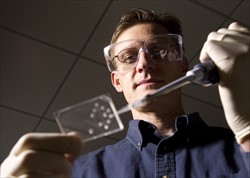 |
| Chemistry professor Adam Woolley created a microchip that could speed up cancer detection. Photograph by Mark A. Philbrick |
Abstract:
BYU researchers create microdevice to speed up cancer detection
By Todd Hollingshead
Detecting cancer with the prick of a finger
Provo, UT | Posted on November 20th, 2010Researchers at BYU have created a micro device that could both decrease the amount of blood and time needed to test for cancer-markers in a patient's blood.
Chemistry professor Adam Woolley's research, published in a recent issue of the journal, Lab on a Chip, details the device and technique that would allow for effective detection of biomarkers in a blood sample in a matter of minutes rather than days or weeks.
"You could walk into the doctor's office, the nurse could prick your finger instead of sticking a needle in your vein, and 30 or 40 minutes later, you'd get the results back in the same doctor's office," Woolley said.
Woolley said the current approach for detecting biomarkers, ELISA (enzyme-linked immunosorbent assay), works well as long as you're doing it in high volumes. This is why blood samples are usually sent to a clinical lab where they can run dozens of samples at the same time.
And while ELISA is efficient and cost effective if, say, there are 90 blood samples to process, the BYU micro device would allow a technician to look at just one sample quickly and cost-effectively to determine if there are markers for, say, breast cancer or prostate cancer.
The microchip researched and created by Woolley and doctoral student Weichun Yang could lead to effective testing for cancer-marking proteins with the use of only microliters of blood instead of milliliters - a smaller sample by a factor of a thousand.
"Detecting cancer biomarkers in a point-of-care setting can significantly improve the throughput of cancer screening and diagnose a cancer tumor at its early stage," said Yang, lead author on the paper. "These devices provide a robust, quick, and portable system for early stage disease diagnosis."
Whereas ELISA uses a series of antibodies as hooks to grab targeted proteins and identify them, Woolley's method uses only one antibody step, which is then followed by a step where voltage is applied and the proteins are identified by the speed at which they move.
The new micro device can also detect multiple cancer biomarkers in blood simultaneously. In this particular round of research, Woolley and his team used the chip to detect four biomarkers simultaneously, but the device has the potential to detect upwards of 10 or 20.
Woolley said he and his team are now looking at ways to speed up the biomarker detection process even more. Ideally, he'd like to get the 30- to 40-minute process down to 20, 15 or even 10 minutes.
"If you learn from your doctor that you might have a life-threatening disease and that some initial testing must be performed, you don't want to wait weeks to find out what's going on," Woolley said. "You'd like to know that very day."
Woolley's research was funded by a National Institutes of Health grant awarded in 2006. Other co-authors on the study were post-doctorates Ming Yu and Xiuhua Sun.
####
For more information, please click here
Contacts:
Media Contact
Todd Hollingshead
801-422-8373
Copyright © Brigham Young University
If you have a comment, please Contact us.Issuers of news releases, not 7th Wave, Inc. or Nanotechnology Now, are solely responsible for the accuracy of the content.
Bookmark:


| Related News Press |
News and information
 Simulating magnetization in a Heisenberg quantum spin chain April 5th, 2024
NRL charters Navy’s quantum inertial navigation path to reduce drift April 5th, 2024
Discovery points path to flash-like memory for storing qubits: Rice find could hasten development of nonvolatile quantum memory April 5th, 2024
Microfluidics/Nanofluidics
Implantable device shrinks pancreatic tumors: Taming pancreatic cancer with intratumoral immunotherapy April 14th, 2023
Researchers design new inks for 3D-printable wearable bioelectronics: Potential uses include printing electronic tattoos for medical tracking applications August 19th, 2022
Oregon State University research pushes closer to new therapy for pancreatic cancer May 6th, 2022
Govt.-Legislation/Regulation/Funding/Policy
NRL charters Navy’s quantum inertial navigation path to reduce drift April 5th, 2024
Discovery points path to flash-like memory for storing qubits: Rice find could hasten development of nonvolatile quantum memory April 5th, 2024
Chemical reactions can scramble quantum information as well as black holes April 5th, 2024
Possible Futures
Discovery points path to flash-like memory for storing qubits: Rice find could hasten development of nonvolatile quantum memory April 5th, 2024
With VECSELs towards the quantum internet Fraunhofer: IAF achieves record output power with VECSEL for quantum frequency converters April 5th, 2024
Academic/Education
Rice University launches Rice Synthetic Biology Institute to improve lives January 12th, 2024
Multi-institution, $4.6 million NSF grant to fund nanotechnology training September 9th, 2022
Nanomedicine
New micromaterial releases nanoparticles that selectively destroy cancer cells April 5th, 2024
Good as gold - improving infectious disease testing with gold nanoparticles April 5th, 2024
Researchers develop artificial building blocks of life March 8th, 2024
Announcements
NRL charters Navy’s quantum inertial navigation path to reduce drift April 5th, 2024
Discovery points path to flash-like memory for storing qubits: Rice find could hasten development of nonvolatile quantum memory April 5th, 2024
Nanobiotechnology
New micromaterial releases nanoparticles that selectively destroy cancer cells April 5th, 2024
Good as gold - improving infectious disease testing with gold nanoparticles April 5th, 2024
Researchers develop artificial building blocks of life March 8th, 2024
 |
||
 |
||
| The latest news from around the world, FREE | ||
 |
||
|
|
||
| Premium Products | ||
 |
||
|
Only the news you want to read!
Learn More |
||
 |
||
|
Full-service, expert consulting
Learn More |
||
|
|
||