Home > Press > A new read on DNA sequencing
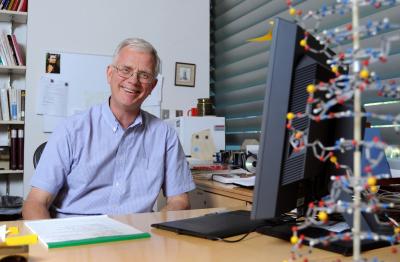 |
| Stuart Lindsay is a biohysicist at the Biodesign Institute at Arizona State University. Credit: The Biodesign Institute at Arizona State University |
Abstract:
Stuart Lindsay, of the Biodesign Institute at Arizona State University, has demonstrated a technique that may lead to rapid, low cost reading of whole genomes
A new read on DNA sequencing
Phoenix, AZ | Posted on November 15th, 2010The twisting, ladder-like form of the DNA molecule—the architectural floor plan of life—contains a universe of information critical to human health. Enormous effort has been invested in deciphering the genetic code, including, most famously, the Human Genome Project. Nevertheless, the process of reading some three-billion nucleotide "letters" to reveal an individual's full genome remains a costly and complex undertaking.
Now biophysicist Stuart Lindsay, of the Biodesign Institute at Arizona State University, has demonstrated a technique that may lead to rapid, low cost reading of whole genomes, through recognition of the basic chemical units—the nucleotide bases that make up the DNA double helix. An affordable technique for DNA sequencing would be a tremendous advance for medicine, allowing routine clinical genomic screening for diagnostic purposes; the design of a new generation of custom-fit pharmaceuticals; and even genomic tinkering to enhance cellular resistance to viral or bacterial infection.
Lindsay is an ASU Regents' Professor and Carson Presidential Chair of Physics and Chemistry as well as director of the Biodesign Institute's Center for Single Molecule Biophysics. His group's research appears in the current issue of the journal Nature Nanotechnology.
Lindsay's technique for reading the DNA code relies on a fundamental property of matter known as quantum tunneling, which operates at the subatomic scale. According to quantum theory, elementary particles like electrons can do some very strange and counter-intuitive things, in defiance of classical laws of physics. Such sub-atomic, quantum entities possess both a particle and a wave-like nature. Part of the consequence of this is that an electron has some probability of moving from one side of a barrier to the other, regardless of the height or width of such a barrier.
Remarkably, an electron can accomplish this feat, even when the potential energy of the barrier exceeds the kinetic energy of the particle. Such behavior is known as quantum tunneling, and the flow of electrons is a tunneling current. Tunneling is confined to small distances—so small that a tunnel junction should be able to read one DNA base (there are four of them in the gentic code, A,T,C and G) at a time without interference from flanking bases. But the same sensitivity to distance means that vibrations of the DNA, or intervening water molecules, ruin the tunneling signal. So the Lindsay group has developed "recognition molecules" that "grab hold" of each base in turn, clutching the base against the electrodes that read out the signal. They call this new method "recognition tunneling."
The current paper in Nature Nanotechnology shows that single bases inside a DNA chain can indeed be read with tunneling, without interference from neighboring bases. Each base generates a distinct electronic signal, current spikes of a particular size and frequency that serve to identify each base. Surprisingly, the technique even recognizes a small chemical change that nature sometimes uses to fine-tune the expression of genes, the so called "epigenetic" code. While an individual's genetic code is the same in every cell, the epigenetic code is tissue and cell specific and unlike the genome itself, the epigenome can respond to environmental changes during an individual's life.
To read longer lengths of DNA, Lindsay's group is working to couple the tunneling readout to a nanopore—a tiny hole through which DNA is dragged, one base at a time, by an electric field. The paper in Nature Nanotechnology has something to say about this problem too. "It has always been believed that the problem with passing DNA through a nanopore is that it flies through so quickly that there is no time to read the sequence" Lindsay says. Surprisingly, the tunneling signals reported in the Nanture Nanotechnology paper last for a long time—nearly a second per base read.
To test this result, Lindsay teamed with a colleague, Robert Ros, to measure how hard one has to pull to break the complex of a DNA base plus the recognition molecules. They did this with an atomic force microscope. "These measurements confirmed the long lifetime of the complex, and also showed that the reading time could be speeded up at will by the application of a small additional pulling force" says Ros. "Thus the stage is set for combining tunneling reads with a device that passes DNA through a nanopore" says Lindsay.
Sequencing through recognition tunneling, if proven successful for whole genome reading, could represent a substantial savings in cost and hopefully, in time as well. Existing methods of DNA sequencing typically rely on cutting the full molecule into thousands of component bits, snipping apart the ladder of complementary bases and reading these fragments. Later, the pieces must be meticulously re-assembled, with the aid of massive computing power. "Direct readout of the epigenetic code holds the key to understanding why cells in different tissues are different, despite having the same genome" Lindsay adds, a reference to the new ability to read epigenetic modifications with tunneling.
Lindsay stresses much work remains to be done before the application of sequencing by recognition can become a clinical reality. "Right now, we can only read two or three bases as the tunneling probe drifts over them, and some bases are more accurately identified than others," he says. However, the group expects this to improve as future generations of recognition molecules are synthesized.
"The basic physics is now demonstrated" Lindsay says, adding "perhaps it will soon be possible to incorporate these principles into mass produced computer chips." The day of the "genome on a lap-top" might be coming sooner than previously thought possible.
####
For more information, please click here
Contacts:
Joseph Caspermeyer
480-727-0369
Copyright © Arizona State University
If you have a comment, please Contact us.Issuers of news releases, not 7th Wave, Inc. or Nanotechnology Now, are solely responsible for the accuracy of the content.
Bookmark:


| Related News Press |
Physics
 Simulating magnetization in a Heisenberg quantum spin chain April 5th, 2024
News and information
Simulating magnetization in a Heisenberg quantum spin chain April 5th, 2024
NRL charters Navy’s quantum inertial navigation path to reduce drift April 5th, 2024
Discovery points path to flash-like memory for storing qubits: Rice find could hasten development of nonvolatile quantum memory April 5th, 2024
Possible Futures
Discovery points path to flash-like memory for storing qubits: Rice find could hasten development of nonvolatile quantum memory April 5th, 2024
With VECSELs towards the quantum internet Fraunhofer: IAF achieves record output power with VECSEL for quantum frequency converters April 5th, 2024
Academic/Education
Rice University launches Rice Synthetic Biology Institute to improve lives January 12th, 2024
Multi-institution, $4.6 million NSF grant to fund nanotechnology training September 9th, 2022
Nanomedicine
New micromaterial releases nanoparticles that selectively destroy cancer cells April 5th, 2024
Good as gold - improving infectious disease testing with gold nanoparticles April 5th, 2024
Researchers develop artificial building blocks of life March 8th, 2024
Announcements
NRL charters Navy’s quantum inertial navigation path to reduce drift April 5th, 2024
Discovery points path to flash-like memory for storing qubits: Rice find could hasten development of nonvolatile quantum memory April 5th, 2024
Nanobiotechnology
New micromaterial releases nanoparticles that selectively destroy cancer cells April 5th, 2024
Good as gold - improving infectious disease testing with gold nanoparticles April 5th, 2024
Researchers develop artificial building blocks of life March 8th, 2024
Quantum nanoscience
Simulating magnetization in a Heisenberg quantum spin chain April 5th, 2024
Optically trapped quantum droplets of light can bind together to form macroscopic complexes March 8th, 2024
Bridging light and electrons January 12th, 2024
'Sudden death' of quantum fluctuations defies current theories of superconductivity: Study challenges the conventional wisdom of superconducting quantum transitions January 12th, 2024
 |
||
 |
||
| The latest news from around the world, FREE | ||
 |
||
|
|
||
| Premium Products | ||
 |
||
|
Only the news you want to read!
Learn More |
||
 |
||
|
Full-service, expert consulting
Learn More |
||
|
|
||