Home > Press > UPenn Scientists Develop Method for Detecting MicroRNA From Living Cells
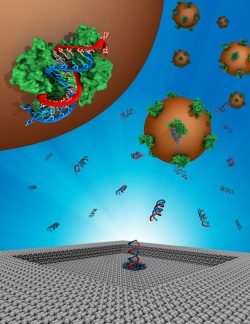 |
| Probe-microRNA duplexes translocate through thin nanopores. (Artwork: Robert Johnson) |
Abstract:
Researchers at the University of Pennsylvania have developed a new electronic method for detecting microRNA isolated from living cells. MicroRNAs are a class of small biomolecules that control gene expression into proteins, the "workers" of the cell. MicroRNAs act by binding to specific messenger RNAs that code for proteins, and, by doing so, inhibit protein synthesis.
UPenn Scientists Develop Method for Detecting MicroRNA From Living Cells
Philadelphia, PA | Posted on October 26th, 2010MicroRNAs, or miRNAs, were initially identified in roundworms in 1993. Since then, biologists have discovered that microRNAs control gene expression, and therefore there is immense interest in these molecules as potential therapeutics for silencing cancer and disease-related genes.
The problem with microRNA detection is that the number of copies of microRNA in cells is so small that detection is quite challenging. The team developed a method to fabricate nanopores in the thinnest silicon nitride membranes reported to date, about 6 nm thick.
First, the team showed that these nanopores increase the signal resolution from reading DNA molecules as they pass through the pores. After demonstrating the enhanced sensitivity, the Penn team needed a method to isolate a specific microRNA from cells.
They teamed with a group headed by Larry McReynolds of New England Biolabs.
"Larry and co-workers had a neat trick: they use a viral protein called p19 to tightly bind duplex RNA molecules of the exact dimensions of microRNAs," Meni Wanunu, a research associate at Penn, said. "So we devised a plan that uses this protein to isolate very small amounts of specific microRNAs that we can then quantify using our pores."
The team focused on detecting miR122a, a liver-specific microRNA in mammals.
They first demonstrated that their nanopores are reliable enough to quantify the concentrations of these tiny molecules that are only 22 bases long, or 6 nm in length. After having made ultrathin membranes by locally etching silicon nitride, the group used electron beams to drill the nanopores in the thinned portion of the silicon nitride membranes.
"Using 3 nm diameter pores, these duplex RNA molecules just squeeze through the pores and in doing so, each molecule produces a nice electronic signal," Wanunu said. "We were delighted, things worked out really nice. These are the smallest synthetic pores in all dimensions, and it is surprising how stable and robust they are. We now use them routinely for various investigations; they are our new state-of-the-art."
The article, featured on the cover of the November 2010 issue of Nature Nanotechnology, shows a duplex microRNA molecule passing through a very thin nanopore made at Penn.
"It is wonderful to see the expected improvements in signal to noise ratios using these thin nanopores," Marija Drndiæ, an associate professor of physics and the group leader on the project, said. "In spite of their being thin, they are quite robust, and they seem to function every time because they do not tend to trap hydrophobic contaminants and they allow unimpeded flow through them. All this makes them ideal candidates for various biophysical applications."
The Penn team is now working on specific methods for detecting other small molecules, as well as integrating these nanopores with fluidic systems to improve sensitivity.
The research was conducted by Wanunu, Drndiæ Tali Dadosh and Vishva Ray of Penn, and Jingmin Jin and McReynolds of New England Biolabs.
The research was supported by a National Institutes of Health grant and the Penn Genome Frontiers Institute of the Commonwealth of Pennsylvania and Pennsylvania Department of Health.
The Department of Health specifically disclaims responsibility for any analyses, interpretations or conclusions.
####
For more information, please click here
Contacts:
Jacquie Posey
215-898-8658
Copyright © University of Pennsylvania
If you have a comment, please Contact us.Issuers of news releases, not 7th Wave, Inc. or Nanotechnology Now, are solely responsible for the accuracy of the content.
Bookmark:


| Related News Press |
News and information
 Simulating magnetization in a Heisenberg quantum spin chain April 5th, 2024
NRL charters Navy’s quantum inertial navigation path to reduce drift April 5th, 2024
Discovery points path to flash-like memory for storing qubits: Rice find could hasten development of nonvolatile quantum memory April 5th, 2024
Govt.-Legislation/Regulation/Funding/Policy
NRL charters Navy’s quantum inertial navigation path to reduce drift April 5th, 2024
Discovery points path to flash-like memory for storing qubits: Rice find could hasten development of nonvolatile quantum memory April 5th, 2024
Chemical reactions can scramble quantum information as well as black holes April 5th, 2024
Possible Futures
Discovery points path to flash-like memory for storing qubits: Rice find could hasten development of nonvolatile quantum memory April 5th, 2024
With VECSELs towards the quantum internet Fraunhofer: IAF achieves record output power with VECSEL for quantum frequency converters April 5th, 2024
Academic/Education
Rice University launches Rice Synthetic Biology Institute to improve lives January 12th, 2024
Multi-institution, $4.6 million NSF grant to fund nanotechnology training September 9th, 2022
Nanomedicine
New micromaterial releases nanoparticles that selectively destroy cancer cells April 5th, 2024
Good as gold - improving infectious disease testing with gold nanoparticles April 5th, 2024
Researchers develop artificial building blocks of life March 8th, 2024
Announcements
NRL charters Navy’s quantum inertial navigation path to reduce drift April 5th, 2024
Discovery points path to flash-like memory for storing qubits: Rice find could hasten development of nonvolatile quantum memory April 5th, 2024
Nanobiotechnology
New micromaterial releases nanoparticles that selectively destroy cancer cells April 5th, 2024
Good as gold - improving infectious disease testing with gold nanoparticles April 5th, 2024
Researchers develop artificial building blocks of life March 8th, 2024
 |
||
 |
||
| The latest news from around the world, FREE | ||
 |
||
|
|
||
| Premium Products | ||
 |
||
|
Only the news you want to read!
Learn More |
||
 |
||
|
Full-service, expert consulting
Learn More |
||
|
|
||