Home > Press > All the Same Size
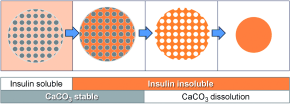 |
| Swapping spheres: Monodisperse protein microspheres can be fabricated by templating on porous CaCO3 microcores (see picture; CaCO3 gray, insulin orange). The CaCO3 cores decompose upon variation of pH from 9.0 to 5.0, whereas the insulin model protein precipitates. The method requires mild conditions, no additives, and minimal processing. |
Abstract:
Assembly of uniformly pure protein microparticles using calcium carbonate templates
All the Same Size
Weinheim, Germany | Posted on October 25th, 2010Proteins are an interesting class of drugs because they demonstrate high biological activity and are highly specific in their effects. It has become possible to produce more and more proteins with tailored pharmacological properties; however transport and controlled release of the protein drugs in the body have remained a challenge. In the journal Angewandte Chemie, Helmuth Möhwald of the Max Planck Institute of Colloids and Interfaces in Golm/Potsdam (Germany) and Dmitry V. Volodkin and Regine von Klitzing of the TU Berlin (Germany) have now introduced an alternative to the usual transport agents, such as liposomes: by using a simple, inexpensive, gentle process, they were able to produce pure protein microspheres of uniform size.
Loading nano- and microscale transport systems with proteins is the most common strategy used to bring drugs to their target area and achieve a longer period of activity. The challenge is to produce particles with a precisely defined quantity of protein, size, morphology, composition, and density. These characteristics are critical for the attainment of high bioavailability and a defined rate of release at the desired location. Unfortunately, they are difficult to control when using conventional methods for the production of protein particles, such as crystallization, spray drying, or incorporation in liposomes or polymer matrices. Another disadvantage is that these processes generally require organic solvents, high temperatures, or other conditions that can compromise the stability of the proteins.
The researchers were looking for a method that would deliver uniform protein particles without destructive additives and under mild conditions. The team has now developed such a method, which is also very simple and inexpensive, and successfully tested it on insulin, a classic therapeutic protein. The secret to their success lies in porous calcium carbonate microspheres of defined size, and a change of pH value. In a slightly alkaline aqueous environment (high pH value), the protein insulin is soluble. When the calcium carbonate spheres are added to such a protein solution, their pores are filled with the insulin solution. When the solution is then neutralized with acid, the insulin becomes insoluble and precipitates out in the pores. If the solution is acidified further, until the calcium carbonate spheres slowly begin to dissolve in the slightly acidic solution. The insulin remains behind as a loose matrix, which shrinks down into compact micrometer-scale spheres. This results in protein particles of uniform size and high protein density.
Author: Dmitry V. Volodkin, Technische Universität Berlin (Germany),
www.chemie.tu-berlin.de/klitzing/menue/ueber_uns/arbeitsgruppe/volodkin/
Title: Pure Protein Microspheres by Calcium Carbonate Templating
Angewandte Chemie International Edition, Permalink to the article:dx.doi.org/10.1002/anie.201005089
####
For more information, please click here
Copyright © Angewandte Chemie International Edition
If you have a comment, please Contact us.Issuers of news releases, not 7th Wave, Inc. or Nanotechnology Now, are solely responsible for the accuracy of the content.
Bookmark:


| Related News Press |
News and information
 Simulating magnetization in a Heisenberg quantum spin chain April 5th, 2024
NRL charters Navy’s quantum inertial navigation path to reduce drift April 5th, 2024
Discovery points path to flash-like memory for storing qubits: Rice find could hasten development of nonvolatile quantum memory April 5th, 2024
Nanomedicine
New micromaterial releases nanoparticles that selectively destroy cancer cells April 5th, 2024
Good as gold - improving infectious disease testing with gold nanoparticles April 5th, 2024
Researchers develop artificial building blocks of life March 8th, 2024
Announcements
NRL charters Navy’s quantum inertial navigation path to reduce drift April 5th, 2024
Discovery points path to flash-like memory for storing qubits: Rice find could hasten development of nonvolatile quantum memory April 5th, 2024
Nanobiotechnology
New micromaterial releases nanoparticles that selectively destroy cancer cells April 5th, 2024
Good as gold - improving infectious disease testing with gold nanoparticles April 5th, 2024
Researchers develop artificial building blocks of life March 8th, 2024
 |
||
 |
||
| The latest news from around the world, FREE | ||
 |
||
|
|
||
| Premium Products | ||
 |
||
|
Only the news you want to read!
Learn More |
||
 |
||
|
Full-service, expert consulting
Learn More |
||
|
|
||