Home > Press > Lastest Graphene Research Could Lead to Improvements in Bluetooth Headsets and Other Wireless Devices
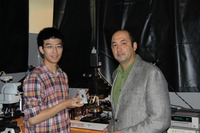 |
| Alexander Balandin, right, and Guanxiong Liu, one of Balandin’s graduate students |
Abstract:
Researchers at UC Riverside continue advancements with graphene, the single-atom thick carbon crytal that was the subject of this year's Nobel Prize in physics
Lastest Graphene Research Could Lead to Improvements in Bluetooth Headsets and Other Wireless Devices
Riverside, CA | Posted on October 18th, 2010Researchers at the UC Riverside Bourns College of Engineering have built and successfully tested an amplifier made from graphene that could lead to more efficient circuits in electronic chips, such as those used in Bluetooth headsets and toll collection devices in cars.
Graphene, a single-atom thick carbon crystal, was first isolated in 2004 by Andre Geim and Konstantin Novoselov, who won the Nobel Prize in physics this month for that work. Graphene has many extraordinary properties, including superior electrical and heat conductivity, mechanical strength and unique optical absorption.
The demonstration at UCR of the graphene amplifier with signal processing functions is a major step forward in graphene technology because it is a transition from individual graphene devices to graphene circuits and chips, said Alexander Balandin, a professor of electrical engineering, who performed the work along with a graduate student and researchers at Rice University.
The triple-mode amplifier based on graphene has advantages over amplifiers built from conventional semiconductors, such as silicon, said Balandin, who is also chair of the UC Riverside Materials Science and Engineering program. The graphene amplifier reveals greater functionality and a faster speed because of graphene's electrical ambipolarity (current conduction by negative and positive charges).
It can be switched between different modes of operation by a simple change of applied voltage. These characteristics are expected to result in simpler and smaller chips, a faster system response and less power consumption.
The experimental demonstration of the graphene amplifier functionality was reported last week in the journal ACS Nano.
The fabrication and experimental testing were performed in Balandin's Nano-Device Laboratory. The co-authors of the paper are Guanxiong Liu, one of Balandin's graduate students, Kartik Mohanram, an assistant professor at Rice University, and Xuebei Yan, one of Mohanram's graduate students.
The researchers from Rice University designed the amplifier and testing protocol. Liu built the device in the UCR clean room. Liu and Yan then tested the amplifier in Balandin's lab.
The triple-mode amplifier can be charged at anytime during operation in the three modes: positive, negative or both. By combining these three modes, the researchers demonstrated the amplifier can achieve the modulation necessary for phase shift keying and frequency shift keying, which are widely used in wireless and audio applications.
These applications include: Bluetooth headsets for cell phones; radio frequency identification (RFID), which is used in wireless products, including toll collection devices in cars, cards used to pay for public transportation and identification tags on animals; and ZigBee, a communication protocol used in devices such as such as wireless light switches with lamps and electrical meters with in-home-display.
####
About UC Riverside
The University of California, Riverside (www.ucr.edu) is a doctoral research university, a living laboratory for groundbreaking exploration of issues critical to Inland Southern California, the state and communities around the world. Reflecting California's diverse culture, UCR's enrollment of over 19,000 is expected to grow to 21,000 students by 2020. The campus is planning a medical school and has reached the heart of the Coachella Valley by way of the UCR Palm Desert Graduate Center. The campus has an annual statewide economic impact of more than $1 billion.
For more information, please click here
Copyright © UC Riverside
If you have a comment, please Contact us.Issuers of news releases, not 7th Wave, Inc. or Nanotechnology Now, are solely responsible for the accuracy of the content.
Bookmark:


| Related News Press |
News and information
 Simulating magnetization in a Heisenberg quantum spin chain April 5th, 2024
NRL charters Navy’s quantum inertial navigation path to reduce drift April 5th, 2024
Discovery points path to flash-like memory for storing qubits: Rice find could hasten development of nonvolatile quantum memory April 5th, 2024
Possible Futures
Discovery points path to flash-like memory for storing qubits: Rice find could hasten development of nonvolatile quantum memory April 5th, 2024
With VECSELs towards the quantum internet Fraunhofer: IAF achieves record output power with VECSEL for quantum frequency converters April 5th, 2024
Academic/Education
Rice University launches Rice Synthetic Biology Institute to improve lives January 12th, 2024
Multi-institution, $4.6 million NSF grant to fund nanotechnology training September 9th, 2022
Chip Technology
Discovery points path to flash-like memory for storing qubits: Rice find could hasten development of nonvolatile quantum memory April 5th, 2024
Utilizing palladium for addressing contact issues of buried oxide thin film transistors April 5th, 2024
HKUST researchers develop new integration technique for efficient coupling of III-V and silicon February 16th, 2024
Nanotubes/Buckyballs/Fullerenes/Nanorods/Nanostrings
Tests find no free-standing nanotubes released from tire tread wear September 8th, 2023
Detection of bacteria and viruses with fluorescent nanotubes July 21st, 2023
Nanoelectronics
Interdisciplinary: Rice team tackles the future of semiconductors Multiferroics could be the key to ultralow-energy computing October 6th, 2023
Key element for a scalable quantum computer: Physicists from Forschungszentrum Jülich and RWTH Aachen University demonstrate electron transport on a quantum chip September 23rd, 2022
Reduced power consumption in semiconductor devices September 23rd, 2022
Atomic level deposition to extend Moore’s law and beyond July 15th, 2022
Announcements
NRL charters Navy’s quantum inertial navigation path to reduce drift April 5th, 2024
Discovery points path to flash-like memory for storing qubits: Rice find could hasten development of nonvolatile quantum memory April 5th, 2024
 |
||
 |
||
| The latest news from around the world, FREE | ||
 |
||
|
|
||
| Premium Products | ||
 |
||
|
Only the news you want to read!
Learn More |
||
 |
||
|
Full-service, expert consulting
Learn More |
||
|
|
||