Home > Press > Researchers show how cells open 'doors' to release neurotransmitters
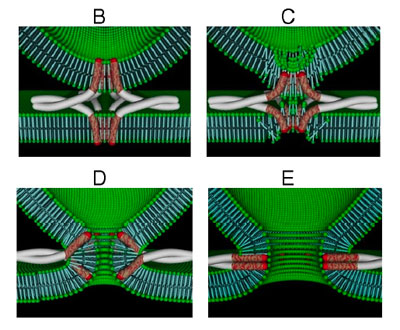 |
| A schematic model of a fusion pore opening. |
Abstract:
Like opening a door to exit a room, cells in the body open up their outer membranes to release such chemicals as neurotransmitters and other hormones.
Cornell researchers have shed new light on this lightning-quick, impossibly small-scale process, called exocytosis, by casting sharp focus on what happens right at the moment the "doors" on the cell wall open.
By Anne Ju
Researchers show how cells open 'doors' to release neurotransmitters
Ithaca, NY | Posted on October 13th, 2010Publishing online Oct. 11 in Proceedings of the National Academy of Sciences, researchers led by Cornell's Manfred Lindau used a combination of molecular biology, electrophysiology, microfabricated electrochemical sensors and advanced microscopy to elucidate exocytosis of noradrenaline. This is a neurotransmitter released from the adrenal gland by a type of neuroendocrine cell called a chromaffin cell.
Lindau, professor of applied and engineering physics, studies the properties of exocytosis by looking at how packets of chemicals called vesicles adhere to the cell wall and open the door between the vesicle interior and cell's exterior. This "door" is called the fusion pore.
"Biochemists have been working on experiments to identify what proteins and molecules are the main players in this mechanism of release," Lindau said.
It turns out that neurotransmitter release is largely regulated by a set of proteins called SNARE proteins, and one called synaptobrevin is located on the cell's vesicle membrane. The synaptobrevins bind with other proteins called syntaxin and SNAP-25, which are located in the plasma membrane that encloses the cell. When the cell is excited and the neurotransmitter release is triggered, these proteins together are believed to open the fusion pore.
Lindau's team of researchers used genetically altered mouse embryos that lacked synaptobrevin and introduced viruses with modified versions of the protein into their experiments. They then imaged and studied the release function of the cells for the different versions of the synaptobrevins.
They discovered that one end of the synaptobrevin -- the part that anchors it in the vesicle membrane -- is pulled deeper into the vesicle membrane when the cell is stimulated. This movement is what temporarily changes the structure of the membrane and allows the opening of the fusion pore and neurotransmitter release. It had previously been thought that the fusion pore originates by an indirect effect of the SNARE protein in the membrane lipids. Lindau's experiments have shown that the vesicle membrane component of synaptobrevin is the active part of the molecular nanomachine that forms the fusion pore.
To continue visualizing the molecular details of this complex process, Lindau is working on sabbatical at the University of Oxford with professor Mark Sansom on molecular dynamics and computer simulations of the SNARE proteins and neurotransmitter exocytosis.
The research published in PNAS was funded primarily by the National Institutes of Health and the Cornell Nanobiotechnology Center, which is supported by the National Science Foundation. The paper's authors include former Cornell graduate students Annita Ngatchou and Kassandra Kisler, postdoctoral associates Qinghua Fang and Yong Zhao, and collaborators from the Max Planck Institute for Biophysical Chemistry, the University of Saarland in Germany and the University of Copenhagen.
####
For more information, please click here
Contacts:
Media Contact:
Joe Schwartz
(607) 254-6235
Cornell Chronicle:
Anne Ju
(607) 255-9735
Copyright © Cornell University
If you have a comment, please Contact us.Issuers of news releases, not 7th Wave, Inc. or Nanotechnology Now, are solely responsible for the accuracy of the content.
Bookmark:


| Related News Press |
News and information
 Simulating magnetization in a Heisenberg quantum spin chain April 5th, 2024
NRL charters Navy’s quantum inertial navigation path to reduce drift April 5th, 2024
Discovery points path to flash-like memory for storing qubits: Rice find could hasten development of nonvolatile quantum memory April 5th, 2024
Govt.-Legislation/Regulation/Funding/Policy
NRL charters Navy’s quantum inertial navigation path to reduce drift April 5th, 2024
Discovery points path to flash-like memory for storing qubits: Rice find could hasten development of nonvolatile quantum memory April 5th, 2024
Chemical reactions can scramble quantum information as well as black holes April 5th, 2024
Academic/Education
Rice University launches Rice Synthetic Biology Institute to improve lives January 12th, 2024
Multi-institution, $4.6 million NSF grant to fund nanotechnology training September 9th, 2022
Molecular Machines
First electric nanomotor made from DNA material: Synthetic rotary motors at the nanoscale perform mechanical work July 22nd, 2022
Nanotech scientists create world's smallest origami bird March 17th, 2021
Giant nanomachine aids the immune system: Theoretical chemistry August 28th, 2020
Nanomedicine
New micromaterial releases nanoparticles that selectively destroy cancer cells April 5th, 2024
Good as gold - improving infectious disease testing with gold nanoparticles April 5th, 2024
Researchers develop artificial building blocks of life March 8th, 2024
Announcements
NRL charters Navy’s quantum inertial navigation path to reduce drift April 5th, 2024
Discovery points path to flash-like memory for storing qubits: Rice find could hasten development of nonvolatile quantum memory April 5th, 2024
Nanobiotechnology
New micromaterial releases nanoparticles that selectively destroy cancer cells April 5th, 2024
Good as gold - improving infectious disease testing with gold nanoparticles April 5th, 2024
Researchers develop artificial building blocks of life March 8th, 2024
 |
||
 |
||
| The latest news from around the world, FREE | ||
 |
||
|
|
||
| Premium Products | ||
 |
||
|
Only the news you want to read!
Learn More |
||
 |
||
|
Full-service, expert consulting
Learn More |
||
|
|
||