Home > Press > Brilliant protection for LEDs
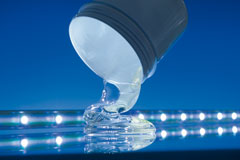 |
| Bayer MaterialScience has developed raw materials for highly transparent two-component polyurethane casting compounds that can be used to manufacture lighting strips and other lighting elements with light-emitting diodes (LEDs). The LEDs are given effective and long-term protection against moisture, weathering and cleaning agents by being integrated into the elements. |
Abstract:
Highly transparent casting compound formulated from Desmodur® and Desmophen®
Moisture-repellent, solvent-free and lightfast
Brilliant protection for LEDs
Leverkusen | Posted on October 13th, 2010Experts from Bayer MaterialScience have developed raw materials for highly transparent two-component polyurethane casting compounds that can be used to manufacture lighting strips and other lighting elements with light-emitting diodes (LEDs). The LEDs are given effective and long-term protection against moisture, weathering and cleaning agents by being integrated into the elements.
The new casting compounds from Bayer MaterialScience meet a demand created by the current transformation in lighting technology. LEDs are becoming increasingly popular as they convert around 90 percent of the electrical energy fed in into light and have a service life averaging 50,000 hours. By way of comparison, a conventional light bulb uses only around ten percent and blows after an average of 2,000 hours. LEDs also open up a whole new range of creative options for furniture designers, interior designers and architects. They are compact and can be combined into programmable lighting elements that constantly change color.
The casting compounds are formulated from solvent-free, aliphatic Desmodur® grades in combination with solvent-free Desmophen® grades. The two liquid components, which are combined without any air bubbles shortly before processing, are used to cast the LED strips required. The compound hardens to create a highly transparent casting that completely embeds the LEDs. The specific selection of the two components enables the consistency of the casting compound to be adjusted from highly flexible to very hard. This allows production of high-quality lighting elements for an extremely wide range of applications using a broad array of design options.
"Aliphatic polyisocyanates and polyols from the Desmodur® and Desmophen® ranges are established raw materials for brilliant and extremely resistant coatings. They are now also lending their excellent properties to molded parts," said Ulrich Meier-Westhues from the team of developers at Bayer MaterialScience. The molded parts are crystal clear, lightfast and highly resistant to chemicals and mechanical stress. Their properties can also be tailored to suit specific requirements thanks to the wide range of Desmodur® and Desmophen® grades available.
Dr. Meier-Westhues is convinced that "thanks to their water-repellent effect, casting compounds will also help LED strips make inroads in bathrooms, saunas, swimming pools, external facades and gardens in the future".
The company also plans to exhibit this innovation at K 2010 in Düsseldorf from October 27 to November 3, 2010.
Further information on Bayer MaterialScience's participation at the trade show (Hall 6, Stand A 75) can be found at www.k2010.bayermaterialscience.com.
####
About Bayer MaterialScience
With 2009 sales of EUR 7.5 billion, Bayer MaterialScience is among the world’s largest polymer companies. Business activities are focused on the manufacture of high-tech polymer materials and the development of innovative solutions for products used in many areas of daily life. The main segments served are the automotive, electrical and electronics, construction and the sports and leisure industries. At the end of 2009, Bayer MaterialScience had 30 production sites and employed approximately 14,300 people around the globe. Bayer MaterialScience is a Bayer Group company.
For more information, please click here
Contacts:
Dr. Frank Rothbarth
External Communications / Trade press
Bayer MaterialScience AG
Building: K 12
51368 Leverkusen
Germany
Tel.: +49 214 30-25363
Fax: +49 214 30-66426
Copyright © Bayer MaterialScience
If you have a comment, please Contact us.Issuers of news releases, not 7th Wave, Inc. or Nanotechnology Now, are solely responsible for the accuracy of the content.
Bookmark:


| Related News Press |
News and information
 Simulating magnetization in a Heisenberg quantum spin chain April 5th, 2024
NRL charters Navy’s quantum inertial navigation path to reduce drift April 5th, 2024
Discovery points path to flash-like memory for storing qubits: Rice find could hasten development of nonvolatile quantum memory April 5th, 2024
Good as gold - improving infectious disease testing with gold nanoparticles April 5th, 2024
Display technology/LEDs/SS Lighting/OLEDs
Utilizing palladium for addressing contact issues of buried oxide thin film transistors April 5th, 2024
Light guide plate based on perovskite nanocomposites November 3rd, 2023
Simple ballpoint pen can write custom LEDs August 11th, 2023
Announcements
NRL charters Navy’s quantum inertial navigation path to reduce drift April 5th, 2024
Discovery points path to flash-like memory for storing qubits: Rice find could hasten development of nonvolatile quantum memory April 5th, 2024
 |
||
 |
||
| The latest news from around the world, FREE | ||
 |
||
|
|
||
| Premium Products | ||
 |
||
|
Only the news you want to read!
Learn More |
||
 |
||
|
Full-service, expert consulting
Learn More |
||
|
|
||