Home > Press > Cheek Swab May Detect Lung Cancer
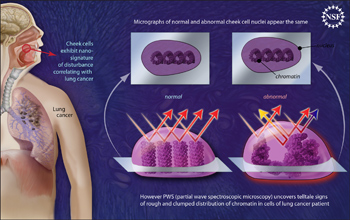 |
| Nano-scale disturbances in cheek cells indicate the presence of lung cancer. |
Abstract:
In clinical trial, technique appears to detect lung cancer far afield from a tumor
Cheek Swab May Detect Lung Cancer
Arlington, VA | Posted on October 7th, 2010Early detection is critical for improving cancer survival rates. Yet, one of the deadliest cancers in the United States, lung cancer, is notoriously difficult to detect in its early stages.
Now, researchers have developed a method to detect lung cancer by merely shining diffuse light on cells swabbed from patients' cheeks.
In a new clinical study, the analysis technique--called partial wave spectroscopic (PWS) microscopy--was able to differentiate individuals with lung cancer from those without, even if the non-cancerous patients had been lifetime smokers or suffered from chronic obstructive pulmonary disease (COPD).
The findings-released by a team of engineers and physicians from NorthShore University Health System, Northwestern University and New York University-appear in print in the Oct. 15, 2010, issue of the journal Cancer Research.
"This study is important because it provides the proof of concept that a minimally intrusive, risk-stratification technique may allow us to tailor screening for lung cancer, the leading cause of cancer deaths in Americans," said physician and researcher Hemant Roy of NorthShore University HealthSystems and the University of Chicago, the lead author on the paper. "This represents a major step forward in translating biomedical optics breakthroughs for personalized screening for lung cancer."
The recent results are an extension of several successful trials involving the light-scattering analysis technique, including early detection successes with pancreatic cancer and colon cancer. NSF has supported the team's work since 2002, with an early grant to Roy's collaborator and co-author, bioengineer Vadim Backman of Northwestern University.
"Their work has now transitioned to a larger $2 million Emerging Frontiers in Research and Innovation award," said Leon Esterowitz, a biophotonics expert and program director at NSF who has long supported the research. "The results have even larger implications in that the techniques and the ‘field effect' may be a general phenomena that could be applied to a multitude of epithelial cancers, the most common cancer type."
The continuing clinical and laboratory experiments involving the PWS light-scattering technique-and its predecessor technologies, four-dimensional elastic light scattering fingerprinting (4D-ELF) and low-coherence enhanced backscattering spectroscopy (LEBS)-are revealing new information about the changes cells undergo when cancer emerges somewhere in the body.
Within affected cells, including otherwise healthy cells far from an actual tumor, the molecules in the nucleus and cellular skeleton appear to change. On the scale of roughly 200 nanometers or less, even to the scale of molecules, an affected cell's structure becomes so distorted that light scatters through the cell in a telling way.
The ability of cancer to cause changes in distant, healthy tissue is called the "field effect" or "field of injury" effect, and is the physical mechanism that allows cells in the cheek to reveal changes triggered by a tumor far off in a patient's lung.
"Microscopic histology and cytology have been a staple of clinical diagnostics detecting micro-scale alterations in cell structure," added Backman. "However, the resolution of conventional microscopy is limited. PWS-based nanocytology, on the other hand, detects cellular alterations at the nanoscale in otherwise microscopically normal-appearing cells."
"What is intriguing is that the very same nanoscale alterations seem to develop early in very different types of cancer including lung, colon and pancreatic cancers," Backman continued. "Not only does this suggest that nanocytology has the potential to become a general platform for cancer screening, but also that these nanoscale alterations are a ubiquitous event in early carcinogenesis with critical consequences for cell function. Elucidating the mechanisms of these alterations will help us understand the initial stages of carcinogenesis and improve screening."
This research was supported by the National Science Foundation through ten individual grants over the last decade, including CBET-0939778 and CBET-0937987.
####
About NSF
The National Science Foundation (NSF) is an independent federal agency that supports fundamental research and education across all fields of science and engineering. In fiscal year (FY) 2010, its budget is about $6.9 billion. NSF funds reach all 50 states through grants to nearly 2,000 universities and institutions. Each year, NSF receives over 45,000 competitive requests for funding, and makes over 11,500 new funding awards. NSF also awards over $400 million in professional and service contracts yearly.
For more information, please click here
Contacts:
Media Contacts
Joshua A. Chamot, NSF (703) 292-7730
Megan Fellman, Northwestern University (847) 491-3115
Jim Anthony, NorthShore University HealthSystem (847) 570-6132
Program Contacts
Sohi Rastegar, NSF (703) 292-8305
Leon Esterowitz, NSF (703) 292-7942
Principal Investigators
Vadim Backman, Northwestern University (847) 467-4010
Co-Investigators
Hemant Roy, NorthShore University HealthSystems and the University of Chicago
Copyright © NSF
If you have a comment, please Contact us.Issuers of news releases, not 7th Wave, Inc. or Nanotechnology Now, are solely responsible for the accuracy of the content.
Bookmark:


| Related News Press |
News and information
 Simulating magnetization in a Heisenberg quantum spin chain April 5th, 2024
NRL charters Navy’s quantum inertial navigation path to reduce drift April 5th, 2024
Discovery points path to flash-like memory for storing qubits: Rice find could hasten development of nonvolatile quantum memory April 5th, 2024
Possible Futures
Discovery points path to flash-like memory for storing qubits: Rice find could hasten development of nonvolatile quantum memory April 5th, 2024
With VECSELs towards the quantum internet Fraunhofer: IAF achieves record output power with VECSEL for quantum frequency converters April 5th, 2024
Academic/Education
Rice University launches Rice Synthetic Biology Institute to improve lives January 12th, 2024
Multi-institution, $4.6 million NSF grant to fund nanotechnology training September 9th, 2022
Nanomedicine
New micromaterial releases nanoparticles that selectively destroy cancer cells April 5th, 2024
Good as gold - improving infectious disease testing with gold nanoparticles April 5th, 2024
Researchers develop artificial building blocks of life March 8th, 2024
Announcements
NRL charters Navy’s quantum inertial navigation path to reduce drift April 5th, 2024
Discovery points path to flash-like memory for storing qubits: Rice find could hasten development of nonvolatile quantum memory April 5th, 2024
Nanobiotechnology
New micromaterial releases nanoparticles that selectively destroy cancer cells April 5th, 2024
Good as gold - improving infectious disease testing with gold nanoparticles April 5th, 2024
Researchers develop artificial building blocks of life March 8th, 2024
 |
||
 |
||
| The latest news from around the world, FREE | ||
 |
||
|
|
||
| Premium Products | ||
 |
||
|
Only the news you want to read!
Learn More |
||
 |
||
|
Full-service, expert consulting
Learn More |
||
|
|
||