Home > Press > Researchers find way for superconductivity and magnetism to coexist
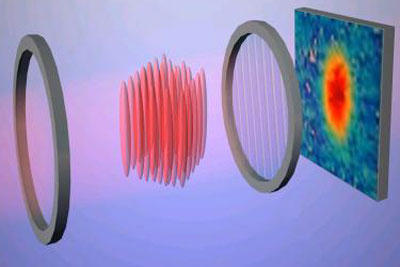 |
| Schematic showing an array of tubes containing lithium atoms. The system is probed by imaging the shadow cast by this ensemble. Nature Supplementary Information |
Abstract:
Dogs and cats, Harry Potter and Voldemort, superconductivity and magnetism -- they tend not to coexist. Superconductivity, the flow of electrons without resistance, is typically suppressed by magnetic fields, which disrupt the intricately choreographed electron motion.
By Anne Ju
Researchers find way for superconductivity and magnetism to coexist
Ithaca, NY | Posted on October 7th, 2010Theoretical physicists at Cornell, working with experimental physicists at Rice University, have carefully engineered a system in which these conflicting properties are believed to put aside their differences.
Publishing online Sept. 30 in the journal Nature, the researchers made and tested an ultra-thin, ultra-cold analogue of a magnetic superconductor -- a sort of one-dimensional wire filled with lithium atoms.
The researchers placed the lithium atoms into bundles of narrow tubes, each of which was only one atom thick. In order to see superconducting properties, they cooled the tubes to about 10 nanokelvin (less than one-hundred-millionth of a degree above absolute zero).
Inside the tubes, the atoms could only bounce off each other in a straight line along the tube. This kinetic restriction stabilizes a "spin density wave" wherein the magnetism is periodically modulated along the tube, on an atomic scale. Superconductivity predominantly builds up in the regions where the magnetism is weakest.
The Cornell theory team, which included assistant professor Erich Mueller and graduate student Stefan Baur, analyzed the experimental data and produced microscopic models of the system. Their principal mathematical technique, the Bethe-Ansatz, was invented by Cornell physicist and Nobel laureate Hans Bethe in the 1930s. Mueller describes the technique as "one of Bethe's greatest legacies."
The work was supported by the Defense Advanced Research Projects Agency's Optical Lattice Emulator program, which seeks to understand and explore the quantum mechanical properties of materials through experiments on atomic clouds.
####
For more information, please click here
Contacts:
Media Contact:
Joe Schwartz
(607) 254-6235
Cornell Chronicle:
Anne Ju
(607) 255-9735
Copyright © Cornell University
If you have a comment, please Contact us.Issuers of news releases, not 7th Wave, Inc. or Nanotechnology Now, are solely responsible for the accuracy of the content.
Bookmark:


| Related News Press |
News and information
 Simulating magnetization in a Heisenberg quantum spin chain April 5th, 2024
NRL charters Navy’s quantum inertial navigation path to reduce drift April 5th, 2024
Discovery points path to flash-like memory for storing qubits: Rice find could hasten development of nonvolatile quantum memory April 5th, 2024
Possible Futures
Discovery points path to flash-like memory for storing qubits: Rice find could hasten development of nonvolatile quantum memory April 5th, 2024
With VECSELs towards the quantum internet Fraunhofer: IAF achieves record output power with VECSEL for quantum frequency converters April 5th, 2024
Academic/Education
Rice University launches Rice Synthetic Biology Institute to improve lives January 12th, 2024
Multi-institution, $4.6 million NSF grant to fund nanotechnology training September 9th, 2022
Announcements
NRL charters Navy’s quantum inertial navigation path to reduce drift April 5th, 2024
Discovery points path to flash-like memory for storing qubits: Rice find could hasten development of nonvolatile quantum memory April 5th, 2024
Quantum nanoscience
Simulating magnetization in a Heisenberg quantum spin chain April 5th, 2024
Optically trapped quantum droplets of light can bind together to form macroscopic complexes March 8th, 2024
Bridging light and electrons January 12th, 2024
'Sudden death' of quantum fluctuations defies current theories of superconductivity: Study challenges the conventional wisdom of superconducting quantum transitions January 12th, 2024
 |
||
 |
||
| The latest news from around the world, FREE | ||
 |
||
|
|
||
| Premium Products | ||
 |
||
|
Only the news you want to read!
Learn More |
||
 |
||
|
Full-service, expert consulting
Learn More |
||
|
|
||