Home > Press > Cilia Revolution
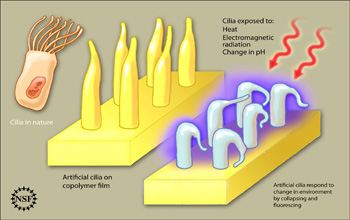 |
| Cilia occur on a variety of cells and unicellular organisms in nature. They primarily help collect sensory information, or produce mechanical responses that help single-celled and simple multicellular organisms spontaneously move about. For the first time, researchers have created artificial cilia. These cilia respond to changes in temperature, electromagnetic radiation and acidity by collapsing and fluorescing blue. As the environment changes back to its original state, the cilia go back to their previous state as well. Credit: Zina Deretsky, National Science Foundation |
Abstract:
Man-made, hair-like structures poised to change industry paradigms
Cilia Revolution
Arlington, VA | Posted on October 1st, 2010University of Southern Mississippi scientists recently imitated Mother Nature by developing, for the first time, a new, skinny-molecule-based material that resembles cilia, the tiny, hair-like structures through which organisms derive smell, vision, hearing and fluid flow.
While the new material isn't exactly like cilia, it responds to thermal, chemical, and electromagnetic stimulation, allowing researchers to control it and opening unlimited possibilities for future use.
This finding is published in today's edition of the journal Advanced Functional Materials. The National Science Foundation's Division of Materials Research supports Southern Miss's Materials Research Science and Engineering Center for Response-Driven Polymeric Materials, where the research took place.
Cilia are wavy, hair-like structures that extend outward from the surfaces of various organisms such as human skin. People, animals and single-celled organisms use them to sense the environment, gather information about it and adapt to it.
Scientists long imagined what could be done if they could engineer cilia for other organic and nonorganic uses. But creating them solely belonged to the life nurturing processes of nature, until now. Marek Urban, Southern Miss professor of polymer science and engineering, along with a team of researchers, developed a new thin copolymer film with whisker-like formations that mimics Mother Nature.
"Our interest is in developing materials with multi-level responses at various length and time scales," said Urban. "I believe this is the future of science and engineering that will drive future technologies."
Employing a process used for years to produce latex paints, the researchers formed thin copolymer-based films whose chemical composition makes possible filaments that have built-in molecular sensors that respond to temperature, acidity and ultraviolet radiation. Moreover, the filaments are capable of locomotion, waving, shrinking and expanding in response to stimuli. They also are capable of fluorescence, that is, absorbing and emitting light and changing colors as a reaction to ultraviolet rays.
The ability to engineer this cilia-like biosensor may give scientists an ability to, for example, test for the presence of toxins, oxygen or even lack of oxygen in an environment. Future opportunities for sensor use might include developing new sensors for testing glucose levels, using the sensors for drug testing, or testing for air or water safety.
There is no limit to dreaming up applications for such a material, said Urban. "Many new ideas are being generated as we speak, but it is too early to reveal them."
Immediate next steps will be to team up engineers to make use of the materials.
Former Southern Miss graduate students Fang Liu, who now works with Proctor and Gamble, and research associate Dhanya Ramachandran contributed to this research.
####
About National Science Foundation
The National Science Foundation (NSF) is an independent federal agency that supports fundamental research and education across all fields of science and engineering. In fiscal year (FY) 2010, its budget is about $6.9 billion. NSF funds reach all 50 states through grants to nearly 2,000 universities and institutions. Each year, NSF receives over 45,000 competitive requests for funding, and makes over 11,500 new funding awards. NSF also awards over $400 million in professional and service contracts yearly.
For more information, please click here
Contacts:
Media Contacts
Bobbie Mixon, NSF (703) 292-8485
Program Contacts
Thomas P. Rieker, NSF (703) 292-4914
Principal Investigators
Marek W. Urban, The University of Southern Mississippi (601) 266-6868
Copyright © National Science Foundation
If you have a comment, please Contact us.Issuers of news releases, not 7th Wave, Inc. or Nanotechnology Now, are solely responsible for the accuracy of the content.
Bookmark:


| Related News Press |
News and information
 Simulating magnetization in a Heisenberg quantum spin chain April 5th, 2024
NRL charters Navy’s quantum inertial navigation path to reduce drift April 5th, 2024
Discovery points path to flash-like memory for storing qubits: Rice find could hasten development of nonvolatile quantum memory April 5th, 2024
Possible Futures
Discovery points path to flash-like memory for storing qubits: Rice find could hasten development of nonvolatile quantum memory April 5th, 2024
With VECSELs towards the quantum internet Fraunhofer: IAF achieves record output power with VECSEL for quantum frequency converters April 5th, 2024
Academic/Education
Rice University launches Rice Synthetic Biology Institute to improve lives January 12th, 2024
Multi-institution, $4.6 million NSF grant to fund nanotechnology training September 9th, 2022
Sensors
Announcements
NRL charters Navy’s quantum inertial navigation path to reduce drift April 5th, 2024
Discovery points path to flash-like memory for storing qubits: Rice find could hasten development of nonvolatile quantum memory April 5th, 2024
Water
Taking salt out of the water equation October 7th, 2022
 |
||
 |
||
| The latest news from around the world, FREE | ||
 |
||
|
|
||
| Premium Products | ||
 |
||
|
Only the news you want to read!
Learn More |
||
 |
||
|
Full-service, expert consulting
Learn More |
||
|
|
||