Home > Press > Coriolis PharmaService chooses NanoSight to study the aggregation of protein drugs and vaccines
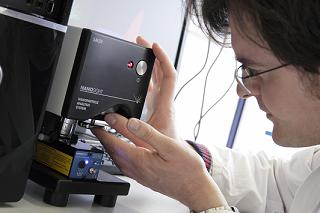 |
| The NanoSight LM 20 system in use at Coriolis PharmaServices |
Abstract:
Munich-based company Coriolis PharmaServices GmbH is using NanoSight's LM-20 nanoparticle characterization system to investigate the aggregation behaviour of protein drugs and vaccines.
Coriolis PharmaService chooses NanoSight to study the aggregation of protein drugs and vaccines
Salisbury, UK | Posted on September 8th, 2010Coriolis is a contract research organization for the formulation and analytics of pharmaceutical proteins and vaccines for their customers from national and international pharmaceutical companies. A special focus during formulation development is set on the characterization of subvisible particles and aggregation. The main application requirement for the NanoSight system is to measure the number and the size distribution of aggregates in pharmaceutical protein formulations and of vaccines, e.g. virus-like particles. Protein aggregation is a major stability issue and can result in reduced biological activity and enhanced immunogenicity of the product. Therefore, it is important to analyze the aggregation behaviour of pharmaceutical proteins and develop methods and formulations that avoid aggregation already at the beginning of formulation development.
Coriolis uses a variety of instrumental techniques to quantify and size aggregates, depending on the size range of interest. Dynamic light scattering is ideal to analyze monodisperse systems, e.g. 5-20 nm range, but once the aggregates start to form and grow (in the hundreds of nm range), nanoparticle tracking analysis (NTA) from NanoSight gives a real distribution picture. For samples in the µm range, microflow imaging (MFI) and light obscuration are used.
In contrast to DLS, NTA works well with polydisperse samples giving an estimation of the total concentration of particles and the possibility to distinguish different size populations, e.g. 60 and 100 nm particles. This is not possible by DLS due to the poor resolution.
Speaking at the recent National Biotech Conference 2010 in San Francisco, the Coriolis team under Dr Michael Wiggenhorn reported that to achieve a comprehensive characterization of nanoscale particulates in protein formulations, it is important to combine techniques that operate in that range. However, the ability of NTA to provide a real-time image of samples permits the analysis of potentially occurring difficulties during the measurement which is not possible using DLS.
To learn more about nanoparticle characterization using Nanoparticle Tracking Analysis, NTA, please visit the company website (www.nanosight.com) and register for the latest issue of NanoTrail, the company's electronic newsletter. For more about Coriolis, please see their website
(www.coriolis-pharma.com).
####
About NanoSight
NanoSight Limited, of Salisbury, UK, provides unique nanoparticle characterization technology. “Nanoparticle Tracking Analysis” (NTA) detects and visualizes populations of nanoparticles in liquids down to 10nm (material dependent) and measures the size of each particle from direct observations of diffusion. This particle-by-particle methodology goes beyond traditional light scattering techniques such as Dynamic Light Scattering (DLS), or Photon Correlation Spectroscopy (PCS), in providing high-resolution particle size distributions. Additionally NanoSight measures concentration and validates all data with video of particles moving under Brownian motion.
This characterization information is highly informative in understanding the more complex suspensions in biological systems, hence its wide application in development of drug delivery systems, viral vaccines, the study of toxicology of nanoparticles and their environmental fate and in biomarker detection. This real-time data also provides insight into the kinetics of protein aggregation and other time-dependent phenomena in a quantitative manner, at deeply sub-micron sizes.
NanoSight has more than 250 systems installed worldwide with users including BASF, BP, GlaxoSmithKline, Novartis, 3M Corp., Roche, Solvay and Unilever together with many universities and research institutes. There are currently 100+ third party papers citing NanoSight results, with this reference base growing very rapidly as NanoSight consolidates its key contribution to nanoparticle characterization. For more information, visit the NanoSight website (www.nanosight.com).
For more information, please click here
Contacts:
NanoSight Limited
Minton Park
London Road
Amesbury SP4 7RT
T +44 (0) 1980 676060
F +44 (0) 1980 624703
NetDyaLog Limited
39 de Bohun Court
Saffron Walden
Essex CB10 2BA
T +44 (0) 1799 521881
M +44 (0) 7843 012997
Copyright © NanoSight
If you have a comment, please Contact us.Issuers of news releases, not 7th Wave, Inc. or Nanotechnology Now, are solely responsible for the accuracy of the content.
Bookmark:


| Related News Press |
News and information
 Simulating magnetization in a Heisenberg quantum spin chain April 5th, 2024
NRL charters Navy’s quantum inertial navigation path to reduce drift April 5th, 2024
Discovery points path to flash-like memory for storing qubits: Rice find could hasten development of nonvolatile quantum memory April 5th, 2024
Nanomedicine
New micromaterial releases nanoparticles that selectively destroy cancer cells April 5th, 2024
Good as gold - improving infectious disease testing with gold nanoparticles April 5th, 2024
Researchers develop artificial building blocks of life March 8th, 2024
Announcements
NRL charters Navy’s quantum inertial navigation path to reduce drift April 5th, 2024
Discovery points path to flash-like memory for storing qubits: Rice find could hasten development of nonvolatile quantum memory April 5th, 2024
Tools
Ferroelectrically modulate the Fermi level of graphene oxide to enhance SERS response November 3rd, 2023
The USTC realizes In situ electron paramagnetic resonance spectroscopy using single nanodiamond sensors November 3rd, 2023
Nanobiotechnology
New micromaterial releases nanoparticles that selectively destroy cancer cells April 5th, 2024
Good as gold - improving infectious disease testing with gold nanoparticles April 5th, 2024
Researchers develop artificial building blocks of life March 8th, 2024
 |
||
 |
||
| The latest news from around the world, FREE | ||
 |
||
|
|
||
| Premium Products | ||
 |
||
|
Only the news you want to read!
Learn More |
||
 |
||
|
Full-service, expert consulting
Learn More |
||
|
|
||