Home > Press > Cobalt-Controlled Communication
 |
Abstract:
Fine Performance Tuning of an Organometallic Molecular Wire by Added Dicobalt Fragments
Cobalt-Controlled Communication
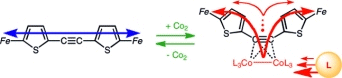
Germany | Posted on September 6th, 2010Smaller and smarter: this is the aim of research in the quest for ever faster electronic devices smaller in size but capable of performing more complicated tasks. Devices consisting of the smallest possible components, molecular parts, have emerged as the answer. Molecular wires, the most basic components of molecular electronic circuits, need to be accurately adjusted for optimal performance. Y. Tanaka, T. Koike, and M. Akita of the Chemical Resources Laboratory, Tokyo Institute of Technology, reveal the key factor for tuning wire-like performance in the Short Communication published in the European Journal of Inorganic Chemistry.
The factors affecting the communication performance of molecular devices are important for the development of molecular electronics. Parts of molecular electronic circuits (wires, switches, resistors, diodes, etc.) must have adjustable electronic properties to optimize this communication. Akita et al. prepared a molecular wire containing a C?C moiety between two iron centers. The communication between the iron centers was modified by coordination of a dicobalt cluster to the C?C part of the wire. Fine tuning was achieved by attaching, removing, or replacing the ligands on the added cobalt system as needed, which changed the electronic properties of the Co atoms with respect to those of the Fe atoms, thus controlling the transfer of electrons between the iron centers over a path through the cobalt atoms. In contrast to the direct Fe-Fe transition mechanism for the diiron wire, the communication mechanism of the dicobalt adducts involved indirect Fe-Co-Fe electron transfer. The mixed-valence characteristics of the compounds were studied by electrochemical and spectroscopic methods. The diiron compound belongs to Robin-Day Class III, and the dicobalt adducts have properties that place them between Class IIA and IIB. All molecular wires reported in this paper can be interconverted easily in a reversible manner.
The most important contribution of this study to the understanding of fine tuning of molecular devices is the key role played by the donor properties of the ligands attached to the cobalt fragments on the path between the two communicating iron centers. It was demonstrated that the properties of electron transfer through the molecular wire could be adjusted by tailoring the electronic properties of these ligands.
Author: Munetaka Akita, Tokyo Institute of Technology, Yokohama (Japan), www.res.titech.ac.jp/~smart/A_akita_e.html
Title: Reversible, Fine Performance Tuning of an Organometallic Molecular Wire by Additi on, Ligand Replacement and Removal of Dicobalt Fragments
European Journal of Inorganic Chemistry, 2010, No. 23, 3571-3575, Permalink to the article: dx.doi.org/10.1002/ejic.201000661
####
For more information, please click here
Copyright © Wiley-VCH
If you have a comment, please Contact us.Issuers of news releases, not 7th Wave, Inc. or Nanotechnology Now, are solely responsible for the accuracy of the content.
Bookmark:


| Related News Press |
News and information
 Simulating magnetization in a Heisenberg quantum spin chain April 5th, 2024
NRL charters Navy’s quantum inertial navigation path to reduce drift April 5th, 2024
Discovery points path to flash-like memory for storing qubits: Rice find could hasten development of nonvolatile quantum memory April 5th, 2024
Molecular Machines
First electric nanomotor made from DNA material: Synthetic rotary motors at the nanoscale perform mechanical work July 22nd, 2022
Nanotech scientists create world's smallest origami bird March 17th, 2021
Giant nanomachine aids the immune system: Theoretical chemistry August 28th, 2020
Nanoelectronics
Interdisciplinary: Rice team tackles the future of semiconductors Multiferroics could be the key to ultralow-energy computing October 6th, 2023
Key element for a scalable quantum computer: Physicists from Forschungszentrum Jülich and RWTH Aachen University demonstrate electron transport on a quantum chip September 23rd, 2022
Reduced power consumption in semiconductor devices September 23rd, 2022
Atomic level deposition to extend Moore’s law and beyond July 15th, 2022
Announcements
NRL charters Navy’s quantum inertial navigation path to reduce drift April 5th, 2024
Discovery points path to flash-like memory for storing qubits: Rice find could hasten development of nonvolatile quantum memory April 5th, 2024
 |
||
 |
||
| The latest news from around the world, FREE | ||
 |
||
|
|
||
| Premium Products | ||
 |
||
|
Only the news you want to read!
Learn More |
||
 |
||
|
Full-service, expert consulting
Learn More |
||
|
|
||